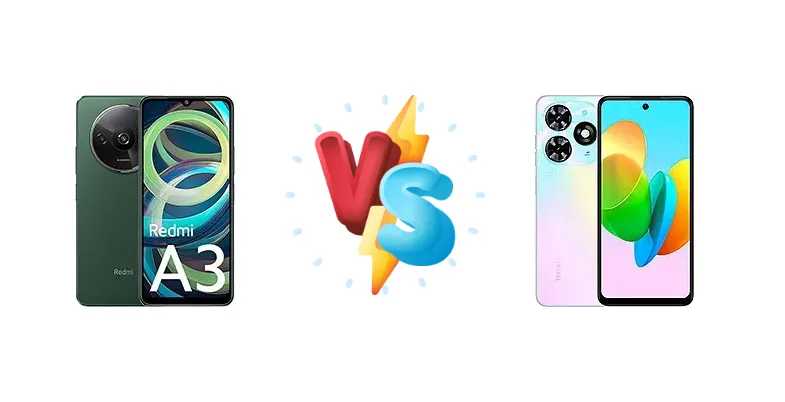
The Xiaomi Redmi A3 and Tecno Spark 20C represent the fiercely competitive sub-$150 smartphone market. Both aim to deliver essential smartphone functionality at an incredibly accessible price point. This comparison dissects their core specifications to determine which device offers the best balance of performance and features for the budget-conscious consumer.
🏆 Quick Verdict
For most users, the Tecno Spark 20C emerges as the slightly better choice. While both phones utilize a Mediatek chipset with similar CPU cores, the 18W charging capability of the Spark 20C provides a significant advantage in daily usability, offsetting the minor chipset differences.
| Network |
|---|
| 2G bands | GSM 850 / 900 / 1800 / 1900 | GSM 850 / 900 / 1800 / 1900 |
| 3G bands | HSDPA 850 / 900 / 2100 | HSDPA 900 / 2100 |
| 4G bands | 1, 3, 5, 7, 8, 20, 28, 38, 40, 41 | LTE |
| Speed | HSPA, LTE | HSPA, LTE |
| Technology | GSM / HSPA / LTE | GSM / HSPA / LTE |
| Launch |
|---|
| Announced | 2024, February 14 | 2023, November 27 |
| Status | Available. Released 2024, February 23 | Available. Released 2023, December |
| Body |
|---|
| Build | Glass front (Gorilla Glass 3), glass back or silicone polymer back (eco leather), plastic frame | Glass front, plastic back, plastic frame |
| Dimensions | 168.3 x 76.3 x 8.3 mm (6.63 x 3.00 x 0.33 in) | 163.7 x 75.6 x 8.6 mm (6.44 x 2.98 x 0.34 in) |
| SIM | Nano-SIM + Nano-SIM | Nano-SIM + Nano-SIM |
| Weight | 193 g or 199 g (6.81 oz) | - |
| Display |
|---|
| Protection | Corning Gorilla Glass 3 | - |
| Resolution | 720 x 1650 pixels (~268 ppi density) | 720 x 1612 pixels, 20:9 ratio (~267 ppi density) |
| Size | 6.71 inches, 106.5 cm2 (~82.9% screen-to-body ratio) | 6.6 inches, 104.6 cm2 (~84.6% screen-to-body ratio) |
| Type | IPS LCD, 90Hz, 500 nits (HBM) | IPS LCD, 90Hz |
| Platform |
|---|
| CPU | Octa-core (4x2.2 GHz Cortex-A53 & 4x1.6 GHz Cortex-A53) | Octa-core 2.2 GHz Cortex-A53 |
| Chipset | Mediatek Helio G36 (12 nm) | Mediatek |
| GPU | PowerVR GE8320 | - |
| OS | Android 14 or Android 14 (Go edition), upgradable to Android 15 | Android 13 |
| Memory |
|---|
| Card slot | microSDXC (dedicated slot) | microSDXC |
| Internal | 64GB 2GB RAM, 64GB 3GB RAM, 64GB 4GB RAM, 128GB 3GB RAM, 128GB 4GB RAM, 128GB 6GB RAM, 128GB 8GB RAM | 128GB 4GB RAM, 128GB 8GB RAM, 256GB 4GB RAM |
| Main Camera |
|---|
| Features | LED flash, HDR | Dual-LED flash, HDR |
| Single | 8 MP, f/2.0, (wide)
Auxiliary lens | 50 MP, (wide), 1/2.8", PDAF
Auxiliary lens |
| Video | 1080p@30fps | 1080p@30fps |
| Selfie camera |
|---|
| Features | - | Dual-LED flash |
| Single | 5 MP, f/2.2, (wide) | 8 MP |
| Video | 1080p@30fps | Yes |
| Sound |
|---|
| 35mm jack | Yes | Yes |
| Loudspeaker | Yes | Yes, with stereo speakers |
| Comms |
|---|
| Bluetooth | 5.4, A2DP, LE | Yes |
| NFC | Yes (market/region dependent) | No |
| Positioning | GPS, GLONASS, GALILEO, BDS | GPS |
| Radio | FM radio | FM radio |
| USB | USB Type-C 2.0 | USB Type-C, OTG |
| WLAN | Wi-Fi 802.11 a/b/g/n/ac, dual-band | Yes |
| Features |
|---|
| Sensors | Fingerprint (side-mounted), accelerometer, compass | Fingerprint (side-mounted), accelerometer, compass |
| Battery |
|---|
| Charging | 10W wired | 18W wired |
| Type | 5000 mAh | 5000 mAh |
| Misc |
|---|
| Colors | Midnight Black, Forest Green (Olive Green), Star Blue (Lake Blue) | Mystery White, Alpenglow Gold, Magic Skin, Gravity Black |
| Models | 23129RN51X, 23129RN51H | BG7n, BG7 |
| Price | € 74.14 / $ 70.57 / £ 53.99 / ₹ 6,995 | About 140 EUR |
| SAR EU | 0.92 W/kg (head) 0.99 W/kg (body) | - |
Xiaomi Redmi A3
- Established brand reputation (Xiaomi)
- Potentially slightly more power-efficient chipset (Helio G36 12nm)
- Reliable software experience (MIUI)
- Slow 10W charging
- Limited detailed specifications
- Likely basic camera performance
Tecno Spark 20C
- Faster 18W charging
- More modern charging standard
- Competitive pricing
- Less well-known brand (Tecno)
- Chipset details are vague
- Potential for more pre-installed bloatware
Display Comparison
Neither Xiaomi nor Tecno provide display specifications beyond size. Given the price point, both likely utilize LCD panels with 720p+ resolution. The absence of details like peak brightness or color gamut suggests a focus on cost reduction. Expect similar viewing experiences, adequate for indoor use but potentially washed out in direct sunlight. Bezels are likely to be substantial on both devices.
Camera Comparison
Camera details are sparse for both devices. It's safe to assume both will feature a primary camera and potentially a secondary depth or macro sensor. Without knowing sensor sizes or apertures, it's difficult to assess image quality. However, given the price bracket, image processing will likely prioritize computational photography to enhance detail and dynamic range. Expect acceptable results in good lighting conditions, but struggles in low light.
Performance
Both the Redmi A3 and Spark 20C are powered by Mediatek processors featuring an octa-core CPU clocked at 2.2 GHz Cortex-A53 cores. The Redmi A3 specifies the Mediatek Helio G36 (12nm), while the Spark 20C only lists 'Mediatek'. The G36's 12nm process node suggests slightly better power efficiency compared to a potentially older Mediatek chipset in the Spark 20C, but the real-world performance difference will be minimal for typical tasks like browsing and social media. Neither phone is designed for demanding gaming or intensive multitasking.
Battery Life
Battery capacity is not specified for either device. However, the key differentiator is charging speed. The Redmi A3 supports only 10W wired charging, a relatively slow standard in 2024. The Tecno Spark 20C, conversely, boasts 18W wired charging. This faster charging capability translates to significantly reduced charging times, allowing users to quickly top up their battery when needed. This is a crucial advantage for users who rely heavily on their smartphones throughout the day.
Buying Guide
Buy the Xiaomi Redmi A3 if you prioritize a brand with a well-established ecosystem and are comfortable with slower charging speeds. It's a solid, reliable option for basic smartphone tasks. Buy the Tecno Spark 20C if you value faster charging and a more modern charging standard, making it ideal for users who frequently find themselves needing a quick power boost throughout the day.
Frequently Asked Questions
❓ Is the Mediatek chipset in the Tecno Spark 20C significantly different from the Helio G36 in the Redmi A3?
While the exact Mediatek chipset in the Spark 20C isn't specified, both phones utilize an octa-core CPU with Cortex-A53 cores clocked at 2.2 GHz. The Redmi A3's Helio G36 benefits from a 12nm process, potentially offering slightly better efficiency, but the performance difference in everyday tasks will be negligible.
❓ How long will it take to fully charge the Tecno Spark 20C with the 18W charger?
Without knowing the battery capacity, a precise estimate is impossible. However, 18W charging is considerably faster than the Redmi A3's 10W. Expect a full charge in approximately 2-3 hours, depending on usage during charging, a substantial improvement over the Redmi A3.
❓ Will either of these phones struggle with popular apps like WhatsApp, Facebook, and YouTube?
Neither phone should struggle with basic app usage like WhatsApp, Facebook, or YouTube. The processors are sufficient for these tasks. However, expect some lag when multitasking or running multiple apps simultaneously.