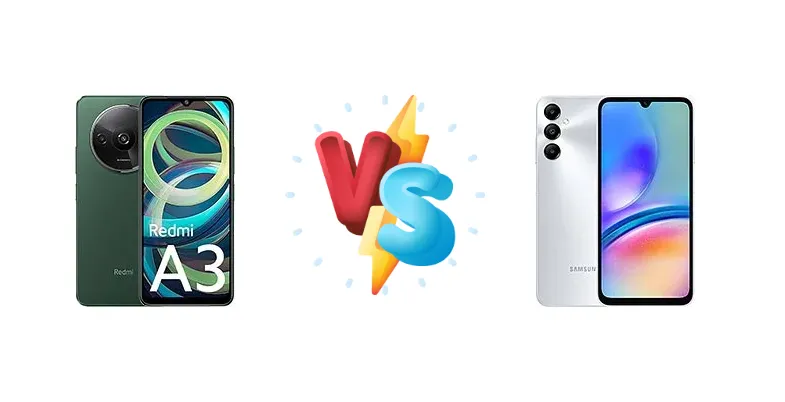
The sub-$150 smartphone market is fiercely competitive. The Xiaomi Redmi A3 and Samsung Galaxy A05s represent two compelling options, each prioritizing different aspects of the user experience. This comparison dissects their core specifications to determine which device delivers the best value for your money, focusing on performance, battery life, and display quality.
🏆 Quick Verdict
For the average user prioritizing sustained performance and a brighter display, the Samsung Galaxy A05s is the better choice. Its Snapdragon 680 chipset, fabricated on a more efficient 6nm process, offers a noticeable advantage over the Redmi A3’s Helio G36, while the measured 468 nits brightness provides a more usable outdoor experience.
| Network |
|---|
| 2G bands | GSM 850 / 900 / 1800 / 1900 | GSM 850 / 900 / 1800 / 1900 |
| 3G bands | HSDPA 850 / 900 / 2100 | HSDPA 850 / 900 / 2100 |
| 4G bands | 1, 3, 5, 7, 8, 20, 28, 38, 40, 41 | 1, 3, 5, 7, 8, 20, 28, 38, 40, 41 |
| Speed | HSPA, LTE | HSPA, LTE |
| Technology | GSM / HSPA / LTE | GSM / HSPA / LTE |
| Launch |
|---|
| Announced | 2024, February 14 | 2023, September 25 |
| Status | Available. Released 2024, February 23 | Available. Released 2023, October 18 |
| Body |
|---|
| Build | Glass front (Gorilla Glass 3), glass back or silicone polymer back (eco leather), plastic frame | Glass front, plastic back, plastic frame |
| Dimensions | 168.3 x 76.3 x 8.3 mm (6.63 x 3.00 x 0.33 in) | 168 x 77.8 x 8.8 mm (6.61 x 3.06 x 0.35 in) |
| SIM | Nano-SIM + Nano-SIM | · Nano-SIM· Nano-SIM + Nano-SIM |
| Weight | 193 g or 199 g (6.81 oz) | 194 g (6.84 oz) |
| Display |
|---|
| Protection | Corning Gorilla Glass 3 | - |
| Resolution | 720 x 1650 pixels (~268 ppi density) | 1080 x 2400 pixels, 20:9 ratio (~393 ppi density) |
| Size | 6.71 inches, 106.5 cm2 (~82.9% screen-to-body ratio) | 6.7 inches, 108.4 cm2 (~82.9% screen-to-body ratio) |
| Type | IPS LCD, 90Hz, 500 nits (HBM) | PLS LCD, 90Hz |
| Platform |
|---|
| CPU | Octa-core (4x2.2 GHz Cortex-A53 & 4x1.6 GHz Cortex-A53) | Octa-core (4x2.4 GHz Kryo 265 Gold & 4x1.9 GHz Kryo 265 Silver) |
| Chipset | Mediatek Helio G36 (12 nm) | Qualcomm SM6225 Snapdragon 680 4G (6 nm) |
| GPU | PowerVR GE8320 | Adreno 610 |
| OS | Android 14 or Android 14 (Go edition), upgradable to Android 15 | Android 13, up to 2 major Android upgrades, One UI 7 |
| Memory |
|---|
| Card slot | microSDXC (dedicated slot) | microSDXC (dedicated slot) |
| Internal | 64GB 2GB RAM, 64GB 3GB RAM, 64GB 4GB RAM, 128GB 3GB RAM, 128GB 4GB RAM, 128GB 6GB RAM, 128GB 8GB RAM | 64GB 4GB RAM, 128GB 4GB RAM, 128GB 6GB RAM |
| Main Camera |
|---|
| Features | LED flash, HDR | LED flash |
| Single | 8 MP, f/2.0, (wide)
Auxiliary lens | - |
| Triple | - | 50 MP, f/1.8, (wide), 1/2.8", 0.64µm, AF
2 MP (macro)
Auxiliary lens |
| Video | 1080p@30fps | 1080p@30/60fps |
| Selfie camera |
|---|
| Single | 5 MP, f/2.2, (wide) | 13 MP, f/2.0, (wide), 1/3.X", 1.12µm |
| Video | 1080p@30fps | 1080p@30fps |
| Sound |
|---|
| 35mm jack | Yes | Yes |
| Loudspeaker | Yes | Yes |
| Comms |
|---|
| Bluetooth | 5.4, A2DP, LE | 5.1, A2DP, LE |
| NFC | Yes (market/region dependent) | Yes (market/region dependent) |
| Positioning | GPS, GLONASS, GALILEO, BDS | GPS, GLONASS, GALILEO, BDS, QZSS |
| Radio | FM radio | Unspecified |
| USB | USB Type-C 2.0 | USB Type-C 2.0 |
| WLAN | Wi-Fi 802.11 a/b/g/n/ac, dual-band | Wi-Fi 802.11 a/b/g/n/ac, dual-band, Wi-Fi Direct |
| Features |
|---|
| Sensors | Fingerprint (side-mounted), accelerometer, compass | Fingerprint (side-mounted), accelerometer, proximity |
| Battery |
|---|
| Charging | 10W wired | 25W wired |
| Type | 5000 mAh | Li-Po 5000 mAh |
| Misc |
|---|
| Colors | Midnight Black, Forest Green (Olive Green), Star Blue (Lake Blue) | Black, Silver, Light Green, Violet |
| Models | 23129RN51X, 23129RN51H | SM-A057F, SM-A057F/DS, SM-A057M, SM-A057M/DS, SM-A057G/DSN, SM-A057G |
| Price | € 74.14 / $ 70.57 / £ 53.99 / ₹ 6,995 | $ 134.00 / C$ 146.99 / £ 83.94 / € 100.99 |
| SAR EU | 0.92 W/kg (head) 0.99 W/kg (body) | 0.58 W/kg (head) 1.31 W/kg (body) |
Xiaomi Redmi A3
- Potentially lower price point
- Simple and straightforward user experience
- Reliable for basic tasks
- Slower processor and less efficient architecture
- Slow 10W charging
- Display brightness likely inferior
Samsung Galaxy A05s
- Faster and more efficient Snapdragon 680 chipset
- 25W fast charging
- Brighter and higher contrast display
- Slightly higher price
- Camera performance likely similar to Redmi A3
- May not be significantly better for extremely light use cases
Display Comparison
The Samsung Galaxy A05s boasts a significantly brighter display, measured at 468 nits, compared to the Redmi A3’s unspecified brightness. This difference is crucial for outdoor visibility. While the Redmi A3’s panel technology isn’t specified, the A05s’ 1418:1 contrast ratio suggests a more vibrant image. The lack of high refresh rate support on either device is typical for this price segment, but the A05s’ superior brightness gives it a clear edge for everyday use.
Camera Comparison
Both devices likely feature similar camera setups geared towards casual photography. The context data only mentions 'Photo / Video' for the A05s, suggesting a standard configuration. Given the price point, image quality will heavily rely on software processing. The Redmi A3’s camera specifications are entirely absent, making a direct comparison impossible. However, it’s reasonable to assume both phones will struggle in low-light conditions and offer limited detail. The presence of a 2MP macro camera on either device is largely a marketing tactic, offering minimal practical benefit.
Performance
The core difference lies in the chipsets. The Samsung Galaxy A05s utilizes the Qualcomm Snapdragon 680 (6nm), featuring a more modern architecture with 4x2.4 GHz Kryo 265 Gold and 4x1.9 GHz Kryo 265 Silver cores. This contrasts with the Xiaomi Redmi A3’s MediaTek Helio G36 (12nm) and its older Cortex-A53 cores clocked at 2.2 GHz and 1.6 GHz. The 6nm fabrication process of the Snapdragon 680 translates to better power efficiency and potentially less thermal throttling under sustained load, making it more suitable for gaming and multitasking. While both are octa-core CPUs, the Snapdragon 680’s core design provides a performance advantage.
Battery Life
The Samsung Galaxy A05s shines with its 25W wired charging capability, allowing for significantly faster top-ups compared to the Redmi A3’s slow 10W charging. While the A05s’ battery capacity isn’t specified, its active use score of 11:32h demonstrates excellent battery life. The Redmi A3’s battery capacity is also unknown, but the slower charging speed suggests it may need more frequent charging cycles. The A05s’ faster charging is a significant convenience factor for users who rely heavily on their smartphones throughout the day.
Buying Guide
Buy the Xiaomi Redmi A3 if you need a phone primarily for basic communication, light social media use, and aren't concerned with demanding applications. Its lower price point makes it ideal for first-time smartphone users or as a reliable backup device. Buy the Samsung Galaxy A05s if you prefer a smoother multitasking experience, enjoy occasional gaming, and value a brighter, more visible display, even if it means spending slightly more.
Frequently Asked Questions
❓ Will the Snapdragon 680 in the Galaxy A05s handle popular games like PUBG Mobile?
The Snapdragon 680 is capable of running PUBG Mobile at medium settings with reasonable frame rates. However, don't expect a flagship gaming experience. The Helio G36 in the Redmi A3 will struggle with more demanding titles and may exhibit significant frame drops.
❓ How long will it take to fully charge the Samsung Galaxy A05s with the 25W charger?
While the exact 0-100% charge time isn't specified, the 25W charging capability of the Galaxy A05s should allow for a full charge in approximately 1.5 to 2 hours, significantly faster than the Redmi A3's 10W charging.
❓ Is the lack of information about the Redmi A3's battery capacity a cause for concern?
The absence of battery capacity information is a red flag. Combined with the slow 10W charging, it suggests the Redmi A3 may require more frequent charging compared to the Galaxy A05s, even if the capacity is similar.
❓ Does either phone support expandable storage via microSD card?
While not explicitly stated in the provided data, both Samsung and Xiaomi typically include microSD card slots in their budget A-series and Redmi devices, respectively. It's highly probable that both the A05s and A3 support expandable storage.