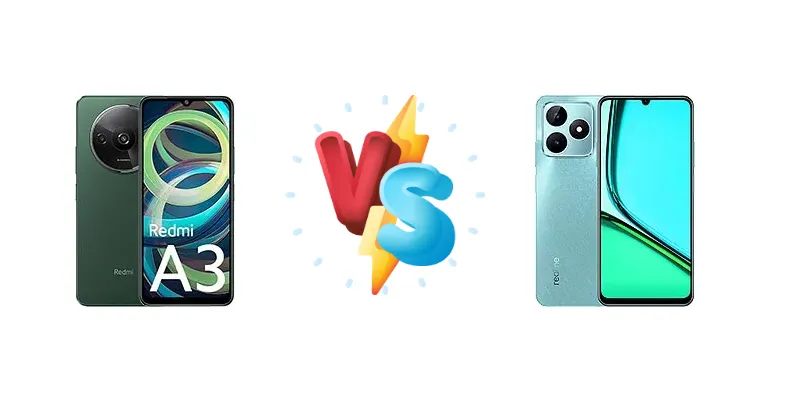
The sub-$150 smartphone market is fiercely competitive, and the Xiaomi Redmi A3 and Realme C51s are two contenders vying for your attention. Both aim to deliver essential smartphone functionality at an accessible price, but they take different approaches to achieving this. The Redmi A3 focuses on a familiar MediaTek chipset, while the C51s opts for a Unisoc processor and significantly faster charging. This comparison will dissect their key differences to determine which device offers the best value.
🏆 Quick Verdict
For the average user prioritizing quick top-ups and potentially slightly smoother multitasking, the Realme C51s is the better choice. Its 33W charging capability, reducing a 0-50% charge to just 28 minutes, is a significant advantage over the Redmi A3’s slower 10W charging. While the Redmi A3 is still a capable device, the C51s offers a more modern convenience.
| Network |
|---|
| 2G bands | GSM 850 / 900 / 1800 / 1900 | GSM 850 / 900 / 1800 / 1900 |
| 3G bands | HSDPA 850 / 900 / 2100 | HSDPA 900 / 2100 |
| 4G bands | 1, 3, 5, 7, 8, 20, 28, 38, 40, 41 | 1, 3, 5, 8, 38, 40 |
| Speed | HSPA, LTE | HSPA, LTE |
| Technology | GSM / HSPA / LTE | GSM / HSPA / LTE |
| Launch |
|---|
| Announced | 2024, February 14 | 2024, March 15 |
| Status | Available. Released 2024, February 23 | Available. Released 2024, March 15 |
| Body |
|---|
| Build | Glass front (Gorilla Glass 3), glass back or silicone polymer back (eco leather), plastic frame | Glass front, plastic frame, plastic back |
| Dimensions | 168.3 x 76.3 x 8.3 mm (6.63 x 3.00 x 0.33 in) | 167.2 x 76.7 x 7.5 mm (6.58 x 3.02 x 0.30 in) |
| SIM | Nano-SIM + Nano-SIM | Nano-SIM + Nano-SIM |
| Weight | 193 g or 199 g (6.81 oz) | 182 g (6.42 oz) |
| Display |
|---|
| Protection | Corning Gorilla Glass 3 | - |
| Resolution | 720 x 1650 pixels (~268 ppi density) | 720 x 1600 pixels, 20:9 ratio (~260 ppi density) |
| Size | 6.71 inches, 106.5 cm2 (~82.9% screen-to-body ratio) | 6.74 inches, 109.7 cm2 (~85.5% screen-to-body ratio) |
| Type | IPS LCD, 90Hz, 500 nits (HBM) | IPS LCD, 90Hz, 560 nits (peak) |
| Platform |
|---|
| CPU | Octa-core (4x2.2 GHz Cortex-A53 & 4x1.6 GHz Cortex-A53) | Octa-core (2x1.8 GHz Cortex-A75 & 6x1.8 GHz Cortex-A55) |
| Chipset | Mediatek Helio G36 (12 nm) | Unisoc Tiger T612 (12 nm) |
| GPU | PowerVR GE8320 | Mali-G57 |
| OS | Android 14 or Android 14 (Go edition), upgradable to Android 15 | Android 13, Realme UI |
| Memory |
|---|
| Card slot | microSDXC (dedicated slot) | microSDXC (dedicated slot) |
| Internal | 64GB 2GB RAM, 64GB 3GB RAM, 64GB 4GB RAM, 128GB 3GB RAM, 128GB 4GB RAM, 128GB 6GB RAM, 128GB 8GB RAM | 128GB 6GB RAM |
| Main Camera |
|---|
| Features | LED flash, HDR | LED flash, HDR, panorama |
| Single | 8 MP, f/2.0, (wide)
Auxiliary lens | 50 MP, f/1.8, 27mm (wide), 1/2.76", 0.64µm, PDAF
Auxiliary lens |
| Video | 1080p@30fps | 1080p@30fps |
| Selfie camera |
|---|
| Features | - | HDR |
| Single | 5 MP, f/2.2, (wide) | 5 MP, f/2.2, 28mm (wide), 1/5.0", 1.12µm |
| Video | 1080p@30fps | 720p@30fps |
| Sound |
|---|
| 35mm jack | Yes | Yes |
| Loudspeaker | Yes | Yes |
| Comms |
|---|
| Bluetooth | 5.4, A2DP, LE | 5.0, A2DP, LE |
| NFC | Yes (market/region dependent) | Yes, 360˚ (market/region dependent) |
| Positioning | GPS, GLONASS, GALILEO, BDS | GPS, GLONASS, GALILEO |
| Radio | FM radio | Unspecified |
| USB | USB Type-C 2.0 | USB Type-C |
| WLAN | Wi-Fi 802.11 a/b/g/n/ac, dual-band | Wi-Fi 802.11 a/b/g/n/ac, dual-band |
| Features |
|---|
| Sensors | Fingerprint (side-mounted), accelerometer, compass | Fingerprint (side-mounted), accelerometer, gyro, proximity, compass |
| Battery |
|---|
| Charging | 10W wired | 33W wired, 0-50% in 28 min |
| Type | 5000 mAh | 5000 mAh |
| Misc |
|---|
| Colors | Midnight Black, Forest Green (Olive Green), Star Blue (Lake Blue) | Shiny Green, Mighty Black |
| Models | 23129RN51X, 23129RN51H | RMX3765 |
| Price | € 74.14 / $ 70.57 / £ 53.99 / ₹ 6,995 | About 100 EUR |
| SAR EU | 0.92 W/kg (head) 0.99 W/kg (body) | - |
Xiaomi Redmi A3
- Established Brand Reputation
- Potentially Lower Price (depending on region)
- Familiar MediaTek Chipset
- Slow 10W Charging
- Less Efficient CPU Architecture
Realme C51s
- 33W Fast Charging (0-50% in 28 min)
- More Modern Unisoc Tiger T612 Chipset
- Potentially Smoother Multitasking
- Less Brand Recognition
- Unisoc Chipset Software Optimization (potential variability)
Display Comparison
Neither device boasts a standout display. Both utilize 12nm chipsets, suggesting a focus on cost optimization over premium display features. While specific display specs (resolution, panel type) are missing, the focus here is on performance and battery life. Expect basic LCD panels suitable for everyday use, but not ideal for media consumption in bright sunlight.
Camera Comparison
Without detailed camera specifications, a direct comparison is difficult. However, given the price point, both devices likely feature basic camera setups. It’s reasonable to assume both will include a primary camera and potentially a depth sensor. The image processing capabilities will likely be the differentiating factor, and Realme’s software optimizations often lean towards vibrant, social media-ready images. The Redmi A3 may offer a more natural color profile. The absence of OIS on either device suggests image stabilization will rely heavily on software.
Performance
The core difference lies in the chipsets. The Realme C51s’ Unisoc Tiger T612 features 2x Cortex-A75 cores clocked at 1.8 GHz alongside 6x Cortex-A55 cores, also at 1.8 GHz. This architecture is generally more efficient for multitasking and handling demanding apps compared to the Xiaomi Redmi A3’s MediaTek Helio G36. The Helio G36 utilizes 4x Cortex-A53 cores at 2.2 GHz and 4x Cortex-A53 cores at 1.6 GHz. While the G36’s higher clock speed on some cores might show a slight edge in single-core tasks, the T612’s A75 cores provide a more substantial boost in overall responsiveness and app loading times. This translates to a smoother user experience for the C51s, particularly when switching between applications.
Battery Life
The Realme C51s’ 33W wired charging is a game-changer in this price segment. Achieving a 0-50% charge in just 28 minutes is a significant advantage over the Redmi A3’s 10W charging, which will take considerably longer. While battery capacity isn’t specified for either device, the faster charging of the C51s mitigates the impact of a potentially smaller battery. Users who frequently find themselves needing a quick power boost will greatly appreciate the C51s’ charging speed.
Buying Guide
Buy the Xiaomi Redmi A3 if you prioritize a well-established brand ecosystem and are comfortable with slower charging speeds. It’s a solid choice for basic smartphone tasks like calling, texting, and light social media use. Buy the Realme C51s if you value faster charging, potentially smoother app switching, and a more modern processor architecture, making it ideal for users who are frequently on the go and need to quickly replenish their battery.
Frequently Asked Questions
❓ Will the Unisoc Tiger T612 in the Realme C51s struggle with demanding games like PUBG Mobile?
While the T612 isn't a gaming powerhouse, it's capable of running PUBG Mobile at medium settings with reasonable frame rates. Expect some frame drops during intense action. The Helio G36 in the Redmi A3 will likely offer similar performance, but the T612’s architecture may provide slightly more consistent frame rates.
❓ Is the 10W charging on the Xiaomi Redmi A3 realistically usable for someone who needs their phone throughout the day?
10W charging is slow by today’s standards. It’s best suited for overnight charging. If you frequently need to top up your phone during the day, the Redmi A3’s charging speed will be a significant inconvenience. The Realme C51s’ 33W charging is far more practical for busy users.
❓ Does the Realme C51s support reverse charging to charge other devices?
Based on available information, the Realme C51s does not appear to support reverse charging. This feature is uncommon in this price segment.
❓ Which phone is likely to receive more software updates and security patches?
Xiaomi generally has a better track record for providing software updates, even for its budget devices. However, Realme has been improving in this area. It's difficult to predict long-term support, but Xiaomi is currently the safer bet.