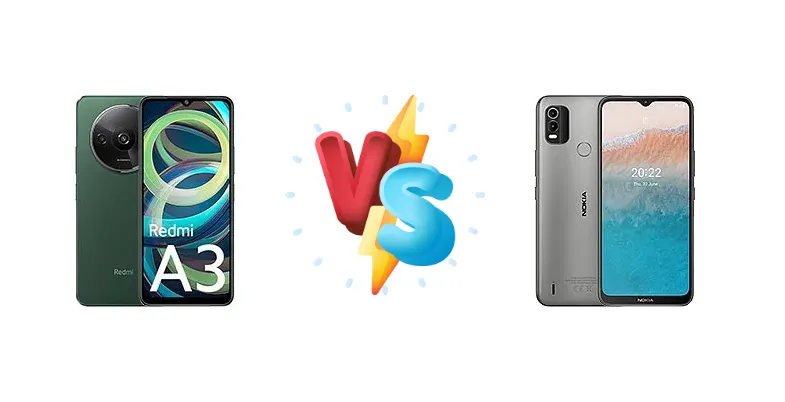
The Xiaomi Redmi A3 and Nokia C21 Plus represent the extreme end of the smartphone price spectrum. Both aim to deliver essential smartphone functionality at an incredibly low cost, but they take different approaches to achieving this. This comparison dissects their core components to determine which offers the best value for users prioritizing performance versus longevity and brand reputation.
🏆 Quick Verdict
For the average user seeking a responsive experience, the Xiaomi Redmi A3 is the clear winner. Its Mediatek Helio G36 chipset, built on a more modern 12nm process, provides a noticeable performance advantage over the Nokia C21 Plus’s older 28nm Unisoc SC9863A, despite both being octa-core CPUs. While both offer similar 10W charging, the A3’s superior processing power makes it the better choice for everyday tasks.
| Network |
|---|
| 2G bands | GSM 850 / 900 / 1800 / 1900 | GSM 850 / 900 / 1800 / 1900 |
| 3G bands | HSDPA 850 / 900 / 2100 | HSDPA 850 / 900 / 2100 |
| 4G bands | 1, 3, 5, 7, 8, 20, 28, 38, 40, 41 | LTE |
| Speed | HSPA, LTE | HSPA 42.2/5.76 Mbps, LTE Cat4 150/50 Mbps |
| Technology | GSM / HSPA / LTE | GSM / HSPA / LTE |
| | - | HSDPA 850 / 900 / 1700(AWS) / 1900 / 2100 |
| Launch |
|---|
| Announced | 2024, February 14 | 2022, February 28 |
| Status | Available. Released 2024, February 23 | Available. Released 2022, April 29 |
| Body |
|---|
| Build | Glass front (Gorilla Glass 3), glass back or silicone polymer back (eco leather), plastic frame | Glass front, aluminum frame, plastic back |
| Dimensions | 168.3 x 76.3 x 8.3 mm (6.63 x 3.00 x 0.33 in) | 164.8 x 75.9 x 8.6 mm (6.49 x 2.99 x 0.34 in) |
| SIM | Nano-SIM + Nano-SIM | · Nano-SIM· Nano-SIM + Nano-SIM |
| Weight | 193 g or 199 g (6.81 oz) | 178 g or 191 g (6.28 oz) |
| | - | Splash protection |
| Display |
|---|
| Protection | Corning Gorilla Glass 3 | Scratch-resistant glass |
| Resolution | 720 x 1650 pixels (~268 ppi density) | 720 x 1600 pixels, 20:9 ratio (~269 ppi density) |
| Size | 6.71 inches, 106.5 cm2 (~82.9% screen-to-body ratio) | 6.52 inches, 102.6 cm2 (~82.1% screen-to-body ratio) |
| Type | IPS LCD, 90Hz, 500 nits (HBM) | IPS LCD |
| Platform |
|---|
| CPU | Octa-core (4x2.2 GHz Cortex-A53 & 4x1.6 GHz Cortex-A53) | Octa-core (4x1.6 GHz Cortex-A55 & 4x1.2 GHz Cortex-A55) |
| Chipset | Mediatek Helio G36 (12 nm) | Unisoc SC9863A (28 nm) |
| GPU | PowerVR GE8320 | IMG8322 |
| OS | Android 14 or Android 14 (Go edition), upgradable to Android 15 | Android 11 (Go edition) |
| Memory |
|---|
| Card slot | microSDXC (dedicated slot) | microSDXC (dedicated slot) |
| Internal | 64GB 2GB RAM, 64GB 3GB RAM, 64GB 4GB RAM, 128GB 3GB RAM, 128GB 4GB RAM, 128GB 6GB RAM, 128GB 8GB RAM | 32GB 2GB RAM, 32GB 3GB RAM, 64GB 2GB RAM, 64GB 3GB RAM, 64GB 4GB RAM |
| | - | eMMC 5.1 |
| Main Camera |
|---|
| Dual | - | 13 MP, (wide), AF
Auxiliary lens |
| Features | LED flash, HDR | LED flash, HDR, panorama |
| Single | 8 MP, f/2.0, (wide)
Auxiliary lens | 5 MP |
| Video | 1080p@30fps | 1080p@30fps |
| Selfie camera |
|---|
| Features | - | LED flash |
| Single | 5 MP, f/2.2, (wide) | 5 MP |
| Video | 1080p@30fps | 720p |
| Sound |
|---|
| 3.5mm jack | - | Yes |
| 35mm jack | Yes | Yes |
| Loudspeaker | Yes | Yes |
| Comms |
|---|
| Bluetooth | 5.4, A2DP, LE | 4.2, A2DP |
| NFC | Yes (market/region dependent) | No |
| Positioning | GPS, GLONASS, GALILEO, BDS | GPS |
| Radio | FM radio | FM radio |
| USB | USB Type-C 2.0 | microUSB 2.0 |
| WLAN | Wi-Fi 802.11 a/b/g/n/ac, dual-band | Wi-Fi 802.11 b/g/n |
| Features |
|---|
| Sensors | Fingerprint (side-mounted), accelerometer, compass | Fingerprint (rear-mounted), accelerometer, proximity |
| Battery |
|---|
| Charging | 10W wired | 10W wired |
| Type | 5000 mAh | Li-Ion 4000/5050 mAh |
| Misc |
|---|
| Colors | Midnight Black, Forest Green (Olive Green), Star Blue (Lake Blue) | Dark Cyan, Warm Gray |
| Models | 23129RN51X, 23129RN51H | TA-1433, TA-1431, TA-1426, TA-1424 |
| Price | € 74.14 / $ 70.57 / £ 53.99 / ₹ 6,995 | About 120 EUR |
| SAR | - | 0.57 W/kg (head) 0.65 W/kg (body) |
| SAR EU | 0.92 W/kg (head) 0.99 W/kg (body) | 0.40 W/kg (head) 0.99 W/kg (body) |
Xiaomi Redmi A3
- Superior chipset performance with the Mediatek Helio G36.
- More efficient 12nm process for better battery life.
- Potentially smoother user experience for multitasking and app loading.
- Xiaomi’s software can include bloatware.
- Build quality may be less robust than Nokia’s.
Nokia C21 Plus
- Nokia’s reputation for software updates and reliability.
- Potentially more durable build quality.
- Clean Android Go edition experience (likely).
- Significantly slower performance due to the older Unisoc chipset.
- Less efficient 28nm process leading to shorter battery life.
- Limited multitasking capabilities.
Display Comparison
Neither Xiaomi nor Nokia provide display specifications beyond resolution. However, given the price point, both likely utilize LCD panels. The key difference lies in the underlying hardware powering the display. The Redmi A3’s more powerful chipset can potentially drive a higher refresh rate display (though not confirmed), and handle more complex image processing. The C21 Plus, constrained by its chipset, will likely offer a more basic visual experience. Bezels are expected to be substantial on both devices, typical of this price bracket.
Camera Comparison
Detailed camera specifications are unavailable. However, given the target market, both phones likely feature basic camera setups. It’s reasonable to assume the Redmi A3’s image signal processor (ISP), integrated within the Helio G36, will offer superior image processing capabilities compared to the C21 Plus’s ISP. This could result in better dynamic range, noise reduction, and overall image quality, even with similar sensor resolutions. The presence of a more powerful chipset allows for more complex computational photography techniques.
Performance
The core of the difference between these two phones is the chipset. The Redmi A3’s Mediatek Helio G36 (12nm) is significantly more efficient and powerful than the Nokia C21 Plus’s Unisoc SC9863A (28nm). The 12nm process allows for higher transistor density and lower power consumption, translating to better performance and potentially improved battery life. While both are octa-core, the Redmi A3’s CPU configuration (4x2.2 GHz Cortex-A53 & 4x1.6 GHz Cortex-A53) features faster cores compared to the C21 Plus’s (4x1.6 GHz Cortex-A55 & 4x1.2 GHz Cortex-A55). The Cortex-A55 architecture in the C21 Plus is more efficient *per clock*, but the lower clock speeds and older process node ultimately limit its overall performance. This difference will be most noticeable when opening apps, browsing the web, and multitasking.
Battery Life
Both devices feature 10W wired charging, indicating similar charging speeds. While battery capacity isn’t specified, the Redmi A3’s more efficient chipset (12nm vs 28nm) will likely result in better battery life despite potentially having a similar capacity. The lower power consumption of the Helio G36 means less energy is wasted during everyday tasks, extending the time between charges. Expect a 0-100% charge to take approximately 2.5-3.5 hours on both devices.
Buying Guide
Buy the Xiaomi Redmi A3 if you need a smartphone capable of handling basic multitasking, social media, and light gaming without significant lag. Its newer chipset provides a smoother user experience. Buy the Nokia C21 Plus if you prioritize a well-established brand known for software support and a potentially more durable build quality, and are willing to accept a slower, less responsive performance profile. The C21 Plus is best suited for users with very basic smartphone needs.
Frequently Asked Questions
❓ Will the Unisoc SC9863A in the Nokia C21 Plus struggle with popular apps like WhatsApp and Facebook?
Yes, the Unisoc SC9863A is a very basic chipset. While it can run these apps, you may experience noticeable lag when switching between them or loading media. The Redmi A3’s Helio G36 will provide a much smoother experience with these commonly used applications.
❓ Is the 10W charging on either phone fast enough for daily use?
10W charging is quite slow by modern standards. Expect a full charge to take several hours. However, given the limited battery capacity and low power consumption of these devices, it’s generally sufficient for overnight charging. The Redmi A3’s more efficient chipset may mean you don’t need to charge it as frequently.
❓ Which phone is better for playing casual games like Candy Crush or Subway Surfers?
The Xiaomi Redmi A3 is the better choice for casual gaming. The Helio G36 chipset offers a noticeable performance boost, resulting in smoother gameplay and fewer frame drops compared to the Nokia C21 Plus’s Unisoc SC9863A. While neither phone is designed for demanding games, the A3 will provide a more enjoyable experience.