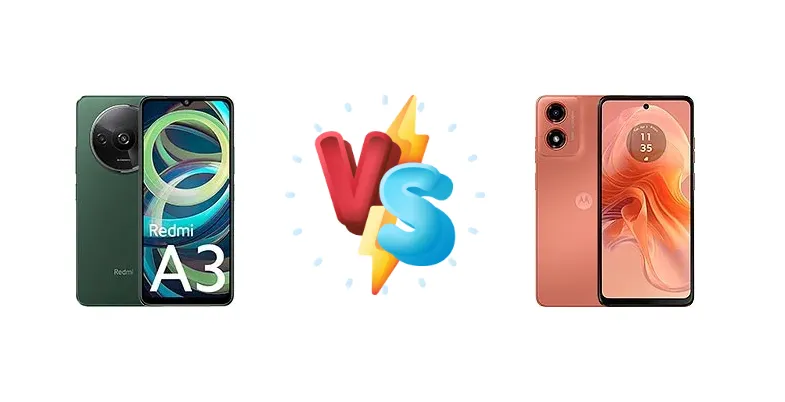
The sub-$150 smartphone market is fiercely competitive, and the Xiaomi Redmi A3 and Motorola Moto G04s are two contenders vying for dominance. Both aim to deliver essential smartphone functionality at an incredibly accessible price point, but they take different approaches to achieving this. This comparison dissects their key specifications to determine which device offers the best overall value for budget-conscious consumers.
🏆 Quick Verdict
For the average user prioritizing a slightly more responsive experience, the Motorola Moto G04s emerges as the better choice. Its Unisoc T606 chipset, featuring Cortex-A75 cores, provides a noticeable performance edge over the Redmi A3’s Helio G36, especially in multitasking. However, the Redmi A3’s lower price may appeal to those on the tightest of budgets.
| Network |
|---|
| 2G bands | GSM 850 / 900 / 1800 / 1900 | GSM 850 / 900 / 1800 / 1900 |
| 3G bands | HSDPA 850 / 900 / 2100 | HSDPA 850 / 900 / 2100 |
| 4G bands | 1, 3, 5, 7, 8, 20, 28, 38, 40, 41 | 1, 3, 5, 7, 8, 20, 28, 38, 40, 41 |
| Speed | HSPA, LTE | HSPA, LTE |
| Technology | GSM / HSPA / LTE | GSM / HSPA / LTE |
| Launch |
|---|
| Announced | 2024, February 14 | 2024, April 09 |
| Status | Available. Released 2024, February 23 | Available. Released 2024, April 29 |
| Body |
|---|
| Build | Glass front (Gorilla Glass 3), glass back or silicone polymer back (eco leather), plastic frame | Glass front (Gorilla Glass 3), plastic frame, plastic back |
| Dimensions | 168.3 x 76.3 x 8.3 mm (6.63 x 3.00 x 0.33 in) | 163.5 x 74.5 x 8 mm (6.44 x 2.93 x 0.31 in) |
| SIM | Nano-SIM + Nano-SIM | Nano-SIM + Nano-SIM |
| Weight | 193 g or 199 g (6.81 oz) | 178.8 g (6.31 oz) |
| Display |
|---|
| Protection | Corning Gorilla Glass 3 | Corning Gorilla Glass 3 |
| Resolution | 720 x 1650 pixels (~268 ppi density) | 720 x 1612 pixels, 20:9 ratio (~269 ppi density) |
| Size | 6.71 inches, 106.5 cm2 (~82.9% screen-to-body ratio) | 6.56 inches, 103.4 cm2 (~84.9% screen-to-body ratio) |
| Type | IPS LCD, 90Hz, 500 nits (HBM) | IPS LCD, 90Hz |
| Platform |
|---|
| CPU | Octa-core (4x2.2 GHz Cortex-A53 & 4x1.6 GHz Cortex-A53) | Octa-core (2x1.6 GHz Cortex-A75 & 6x1.6 GHz Cortex-A55) |
| Chipset | Mediatek Helio G36 (12 nm) | Unisoc T606 (12 nm) |
| GPU | PowerVR GE8320 | Mali-G57 MP1 |
| OS | Android 14 or Android 14 (Go edition), upgradable to Android 15 | Android 14, no major Android upgrades planned |
| Memory |
|---|
| Card slot | microSDXC (dedicated slot) | microSDXC (dedicated slot) |
| Internal | 64GB 2GB RAM, 64GB 3GB RAM, 64GB 4GB RAM, 128GB 3GB RAM, 128GB 4GB RAM, 128GB 6GB RAM, 128GB 8GB RAM | 64GB 4GB RAM, 128GB 4GB RAM, 128GB 8GB RAM, 256GB 4GB RAM |
| Main Camera |
|---|
| Features | LED flash, HDR | LED flash, HDR |
| Single | 8 MP, f/2.0, (wide)
Auxiliary lens | 50 MP, f/1.8, (wide), 0.64µm, PDAF |
| Video | 1080p@30fps | 1080p@30fps |
| Selfie camera |
|---|
| Features | - | HDR |
| Single | 5 MP, f/2.2, (wide) | 5 MP, f/2.2, (wide) |
| Video | 1080p@30fps | 1080p@30fps |
| Sound |
|---|
| 35mm jack | Yes | Yes |
| Loudspeaker | Yes | Yes |
| Comms |
|---|
| Bluetooth | 5.4, A2DP, LE | 5.0, A2DP, LE |
| NFC | Yes (market/region dependent) | Yes (market/region dependent) |
| Positioning | GPS, GLONASS, GALILEO, BDS | GPS, GALILEO, GLONASS |
| Radio | FM radio | No |
| USB | USB Type-C 2.0 | USB Type-C 2.0 |
| WLAN | Wi-Fi 802.11 a/b/g/n/ac, dual-band | Wi-Fi 802.11 a/b/g/n/ac, dual-band |
| Features |
|---|
| Sensors | Fingerprint (side-mounted), accelerometer, compass | Fingerprint (side-mounted), accelerometer, proximity |
| Battery |
|---|
| Charging | 10W wired | 15W wired |
| Type | 5000 mAh | 5000 mAh |
| Misc |
|---|
| Colors | Midnight Black, Forest Green (Olive Green), Star Blue (Lake Blue) | Concord Black, Sea Green, Satin Blue, Sunrise Orange |
| Models | 23129RN51X, 23129RN51H | XT2421-8 |
| Price | € 74.14 / $ 70.57 / £ 53.99 / ₹ 6,995 | £ 90.86 / € 78.23 |
| SAR EU | 0.92 W/kg (head) 0.99 W/kg (body) | - |
Xiaomi Redmi A3
- Potentially lower price point
- Likely good battery efficiency due to less powerful chipset
- Simple and straightforward user experience
- Slower processor compared to the Moto G04s
- Slower charging speed (10W)
- Less responsive multitasking
Motorola Moto G04s
- More powerful Unisoc T606 chipset with Cortex-A75 cores
- Faster 15W wired charging
- Smoother multitasking and app launches
- May be slightly more expensive than the Redmi A3
- Potentially slightly shorter battery life due to more powerful processor
- Software updates may be less frequent
Display Comparison
Neither device boasts a standout display. Both utilize 12nm chipsets, suggesting similar power constraints impacting display capabilities. While specific display specs (resolution, brightness) are missing, the focus here is on performance. The absence of high refresh rates on either device indicates a prioritization of battery life over visual fluidity. Bezels are likely to be substantial on both, typical for this price bracket. Color accuracy is expected to be standard, leaning towards warmer tones to maximize perceived vibrancy.
Camera Comparison
Camera performance is likely to be comparable, with both devices likely featuring a primary sensor and potentially a secondary depth or macro lens. Given the price point, image quality will be heavily reliant on software processing. The absence of OIS on either device means low-light photography will be challenging. While sensor sizes are unknown, the image signal processor (ISP) within the Unisoc T606 *may* offer slightly better noise reduction capabilities, but this is speculative. The 2MP macro cameras often found in this segment are unlikely to deliver significant detail.
Performance
The core difference lies in the chipsets. The Redmi A3’s Mediatek Helio G36 utilizes four Cortex-A53 cores clocked at 2.2 GHz and another four at 1.6 GHz. This is a homogenous core configuration, optimized for efficiency but lacking the performance punch of the Moto G04s. The Motorola employs the Unisoc T606, featuring a more modern architecture with two Cortex-A75 cores at 1.6 GHz and six Cortex-A55 cores, also at 1.6 GHz. The A75 cores provide a significant uplift in single-core performance, translating to snappier app launches and smoother multitasking. While both are 12nm chips, the architectural advantage of the Unisoc T606 is clear. RAM configurations are likely similar, but the chipset difference will be the dominant factor.
Battery Life
Battery capacity is not specified, but both phones will likely feature batteries in the 4000-5000 mAh range. The Moto G04s has a clear advantage in charging speed with 15W wired charging compared to the Redmi A3’s 10W. This translates to a significantly faster 0-100% charge time, reducing downtime. While the Redmi A3 might offer slightly longer battery life due to the less powerful chipset, the convenience of faster charging on the Moto G04s is a compelling benefit.
Buying Guide
Buy the Xiaomi Redmi A3 if you need the absolute lowest possible price and are primarily focused on basic tasks like calling, texting, and light social media use. Buy the Motorola Moto G04s if you prefer a smoother, more responsive user experience, particularly when switching between apps or engaging in casual gaming, and are willing to spend a little extra for that performance boost.
Frequently Asked Questions
❓ Will the Unisoc T606 in the Moto G04s handle popular apps like WhatsApp and Facebook smoothly?
Yes, the Unisoc T606’s Cortex-A75 cores provide sufficient processing power for smooth operation of common social media apps like WhatsApp and Facebook. The performance uplift over the Helio G36 will be noticeable when switching between these apps and others.
❓ Is the 10W charging on the Redmi A3 painfully slow in real-world use?
While 10W charging isn't fast by modern standards, it's adequate for overnight charging. Expect a full charge to take around 3-4 hours. The slower charging speed is a trade-off for the lower price point.
❓ Can either of these phones handle basic mobile games like Candy Crush or Subway Surfers?
Both the Redmi A3 and Moto G04s can handle casual games like Candy Crush and Subway Surfers without significant issues. However, more demanding games may require lower graphics settings to maintain a playable frame rate, with the Moto G04s offering a slightly better experience.
❓ How does the software experience differ between Xiaomi's MIUI and Motorola's near-stock Android on these devices?
Motorola generally offers a cleaner, near-stock Android experience with minimal bloatware. Xiaomi’s MIUI is more heavily customized, offering a wider range of features but potentially at the cost of performance and a more cluttered interface. Software update frequency is typically faster on Motorola devices.