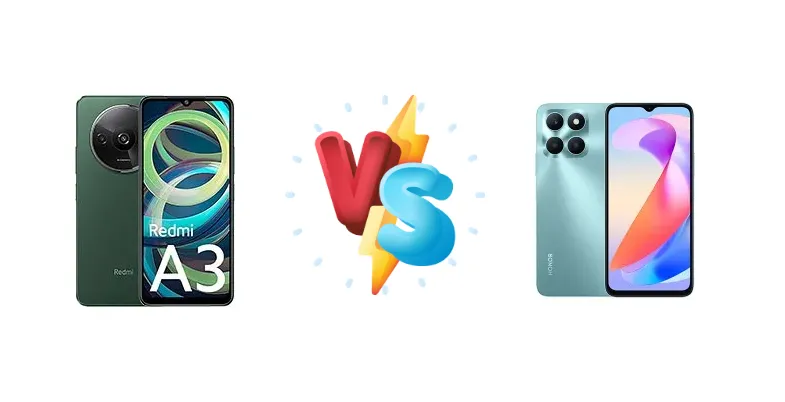
The Xiaomi Redmi A3 and Honor X6a represent the fiercely competitive sub-$150 smartphone market. Both devices leverage the Mediatek Helio G36 chipset, but diverge in charging capabilities and subtle CPU clock speed differences. This comparison dissects these nuances to determine which phone delivers the best value for budget-conscious consumers.
🏆 Quick Verdict
For most users, the Honor X6a emerges as the better choice. While both phones share the same Helio G36 chipset, the X6a’s significantly faster 22.5W charging – capable of a 31% charge in just 20 minutes – provides a tangible usability advantage over the Redmi A3’s slower 10W charging.
| Network |
|---|
| 2G bands | GSM 850 / 900 / 1800 / 1900 | GSM 850 / 900 / 1800 / 1900 |
| 3G bands | HSDPA 850 / 900 / 2100 | HSDPA 850 / 900 / 1900 / 2100 |
| 4G bands | 1, 3, 5, 7, 8, 20, 28, 38, 40, 41 | LTE |
| Speed | HSPA, LTE | HSPA, LTE |
| Technology | GSM / HSPA / LTE | GSM / HSPA / LTE |
| Launch |
|---|
| Announced | 2024, February 14 | 2023, July 28 |
| Status | Available. Released 2024, February 23 | Available. Released 2023, July 28 |
| Body |
|---|
| Build | Glass front (Gorilla Glass 3), glass back or silicone polymer back (eco leather), plastic frame | - |
| Dimensions | 168.3 x 76.3 x 8.3 mm (6.63 x 3.00 x 0.33 in) | 163.3 x 75.1 x 8.4 mm (6.43 x 2.96 x 0.33 in) |
| SIM | Nano-SIM + Nano-SIM | Nano-SIM + Nano-SIM |
| Weight | 193 g or 199 g (6.81 oz) | 188 g (6.63 oz) |
| Display |
|---|
| Protection | Corning Gorilla Glass 3 | - |
| Resolution | 720 x 1650 pixels (~268 ppi density) | 720 x 1612 pixels, 20:9 ratio (~269 ppi density) |
| Size | 6.71 inches, 106.5 cm2 (~82.9% screen-to-body ratio) | 6.56 inches, 103.4 cm2 (~84.3% screen-to-body ratio) |
| Type | IPS LCD, 90Hz, 500 nits (HBM) | TFT LCD, 90Hz |
| Platform |
|---|
| CPU | Octa-core (4x2.2 GHz Cortex-A53 & 4x1.6 GHz Cortex-A53) | Octa-core (4x2.2 GHz Cortex-A53 & 4x1.7 GHz Cortex-A53) |
| Chipset | Mediatek Helio G36 (12 nm) | Mediatek Helio G36 (12 nm) |
| GPU | PowerVR GE8320 | PowerVR GE8320 |
| OS | Android 14 or Android 14 (Go edition), upgradable to Android 15 | Android 13, upgradable to Android 14, MagicOS 8 |
| Memory |
|---|
| Card slot | microSDXC (dedicated slot) | microSDXC |
| Internal | 64GB 2GB RAM, 64GB 3GB RAM, 64GB 4GB RAM, 128GB 3GB RAM, 128GB 4GB RAM, 128GB 6GB RAM, 128GB 8GB RAM | 128GB 4GB RAM, 128GB 6GB RAM, 256GB 6GB RAM |
| Main Camera |
|---|
| Features | LED flash, HDR | LED flash, HDR, panorama |
| Single | 8 MP, f/2.0, (wide)
Auxiliary lens | - |
| Triple | - | 50 MP, f/1.8, (wide), PDAF
2 MP (macro)
Auxiliary lens |
| Video | 1080p@30fps | 1080p@30fps |
| Selfie camera |
|---|
| Single | 5 MP, f/2.2, (wide) | 5 MP, f/2.2, (wide) |
| Video | 1080p@30fps | 1080p@30fps |
| Sound |
|---|
| 35mm jack | Yes | Yes |
| Loudspeaker | Yes | Yes |
| Comms |
|---|
| Bluetooth | 5.4, A2DP, LE | 5.1, A2DP, LE |
| NFC | Yes (market/region dependent) | Yes |
| Positioning | GPS, GLONASS, GALILEO, BDS | GPS, GLONASS, GALILEO, BDS |
| Radio | FM radio | No |
| USB | USB Type-C 2.0 | USB Type-C 2.0, OTG |
| WLAN | Wi-Fi 802.11 a/b/g/n/ac, dual-band | Wi-Fi 802.11 a/b/g/n/ac, dual-band, Wi-Fi Direct |
| Features |
|---|
| Sensors | Fingerprint (side-mounted), accelerometer, compass | Fingerprint (side-mounted), accelerometer, proximity, gyro |
| Battery |
|---|
| Charging | 10W wired | 22.5W wired, 31% in 20 min |
| Type | 5000 mAh | Li-Po 5200 mAh |
| Misc |
|---|
| Colors | Midnight Black, Forest Green (Olive Green), Star Blue (Lake Blue) | Cyan Lake, Midnight Black |
| Models | 23129RN51X, 23129RN51H | WDY-LX1, WDY-LX2 |
| Price | € 74.14 / $ 70.57 / £ 53.99 / ₹ 6,995 | About 150 EUR |
| SAR EU | 0.92 W/kg (head) 0.99 W/kg (body) | - |
Xiaomi Redmi A3
- Potentially lower price point
- Likely similar performance to Honor X6a for basic tasks
- May have slightly larger battery capacity (unconfirmed)
- Significantly slower 10W charging
- Slightly lower CPU clock speed on efficiency cores
- Likely less refined software experience
Honor X6a
- Faster 22.5W charging with 31% in 20 minutes
- Slightly higher CPU clock speed on efficiency cores
- Potentially better software optimization
- May be slightly more expensive than Redmi A3
- Potentially smaller battery capacity (unconfirmed)
- Similar performance to Redmi A3 for demanding tasks
Display Comparison
Both the Redmi A3 and Honor X6a are expected to feature LCD panels, typical for this price bracket. Specific details like resolution and peak brightness are not provided, but we can anticipate 720p+ resolutions. The absence of high refresh rates (90Hz or 120Hz) is also expected. The display experience will likely be similar, focusing on basic readability rather than visual fidelity. Bezels are likely to be substantial on both devices, maximizing screen real estate within a budget.
Camera Comparison
Camera specifications are not detailed, but both phones likely feature a primary camera alongside depth and/or macro sensors. Given the price point, image quality will be adequate for social media sharing in good lighting conditions. The absence of Optical Image Stabilization (OIS) is expected. The usefulness of any included 2MP macro camera is questionable, offering limited detail and requiring ideal lighting. Image processing will likely prioritize contrast and saturation to enhance visual appeal, but will struggle in low-light scenarios.
Performance
Both devices are powered by the Mediatek Helio G36 (12 nm). The CPU configuration is nearly identical: an octa-core setup with 4x2.2 GHz Cortex-A53 cores and 4x1.6 GHz Cortex-A53 cores on the Redmi A3, versus 4x2.2 GHz Cortex-A53 and 4x1.7 GHz Cortex-A53 cores on the Honor X6a. The slightly higher clock speed on the X6a’s efficiency cores (1.7 GHz vs 1.6 GHz) will yield a marginal performance boost in multi-threaded tasks, but this difference will be largely imperceptible in everyday use. Both phones will likely be paired with 3-4GB of RAM, impacting multitasking capabilities. Thermal throttling is unlikely to be a major concern given the chipset's low power draw.
Battery Life
Battery capacity is not specified for either device. However, the Honor X6a’s 22.5W wired charging is a significant advantage. The claim of a 31% charge in 20 minutes translates to a considerably faster top-up time compared to the Redmi A3’s 10W charging. While the Redmi A3 might have a slightly larger battery capacity, the X6a’s faster charging mitigates the impact of a potentially smaller battery, offering more convenient and frequent top-ups. A full 0-100% charge on the Redmi A3 will likely take well over 2 hours, while the X6a should achieve a full charge in under 1.5 hours.
Buying Guide
Buy the Xiaomi Redmi A3 if your primary concern is absolute lowest price and you are willing to tolerate slower charging speeds. It’s a solid option for basic smartphone tasks. Buy the Honor X6a if you prioritize convenience and faster charging, even if it means spending slightly more. The X6a’s charging speed is a significant quality-of-life improvement for users who rely heavily on their phone throughout the day.
Frequently Asked Questions
❓ Will the Helio G36 in the Honor X6a struggle with demanding games like PUBG Mobile?
The Helio G36 is an entry-level chipset. While it can run PUBG Mobile, expect to play at low to medium settings with reduced frame rates for a smooth experience. The chipset isn't designed for sustained high-performance gaming.
❓ How much faster is the 22.5W charging on the Honor X6a compared to the Redmi A3's 10W charging in a typical use case?
The 22.5W charging on the Honor X6a will allow you to gain a significant amount of battery life in a short period. The 31% charge in 20 minutes claim means you can quickly top up during a coffee break, whereas the Redmi A3's 10W charging will provide a much slower trickle charge, requiring significantly longer to reach a usable charge level.
❓ Is the difference in CPU clock speed between the two phones noticeable in everyday tasks?
The difference in CPU clock speed (1.7 GHz vs 1.6 GHz on the efficiency cores) is minimal and unlikely to be noticeable during typical smartphone usage like browsing, social media, or messaging. Both phones will perform similarly for these tasks.