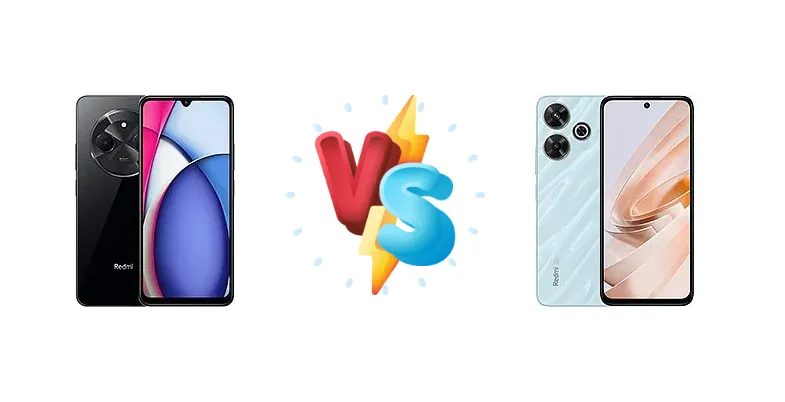
Xiaomi's Redmi series consistently delivers compelling value, but navigating the options can be tricky. The Redmi A3 Pro and Note 13R represent two distinct approaches to the budget segment: the A3 Pro focuses on a streamlined experience, while the Note 13R aims for a more robust feature set. This comparison dissects their core differences, focusing on the critical areas of performance and charging to determine which phone best suits your needs.
🏆 Quick Verdict
For most users, the Xiaomi Redmi Note 13R emerges as the stronger choice. Its Snapdragon 4+ Gen 2 chipset, built on a more efficient 4nm process, provides a noticeable performance advantage over the Helio G81 Ultra in the A3 Pro, alongside significantly faster 33W charging. While the A3 Pro is a capable device, the Note 13R offers a more future-proof and responsive experience.
| Network |
|---|
| 2G bands | GSM 850 / 900 / 1800 / 1900 | GSM 850 / 900 / 1800 / 1900 |
| 3G bands | HSDPA 850 / 900 / 2100 | HSDPA 850 / 900 / 2100 |
| 4G bands | LTE | 1, 3, 5, 8, 34, 38, 39, 40, 41 |
| 5G bands | - | 1, 5, 8, 28, 41, 78 SA/NSA |
| Speed | HSPA, LTE | HSPA, LTE, 5G |
| Technology | GSM / HSPA / LTE | GSM / CDMA / HSPA / EVDO / LTE / 5G |
| Launch |
|---|
| Announced | 2024, October | 2024, May 17 |
| Status | Available. Released 2024, October | Available. Released 2024, May 17 |
| Body |
|---|
| Build | - | Glass front, plastic frame, glass back |
| Dimensions | 171.9 x 77.8 x 8.2 mm (6.77 x 3.06 x 0.32 in) | 168.6 x 76.3 x 8.2 mm (6.64 x 3.00 x 0.32 in) |
| SIM | Nano-SIM + Nano-SIM | Nano-SIM + Nano-SIM |
| Weight | 204 g (7.20 oz) | 205 g (7.23 oz) |
| Display |
|---|
| Resolution | 720 x 1640 pixels (~260 ppi density) | 1080 x 2460 pixels (~396 ppi density) |
| Size | 6.88 inches, 112.4 cm2 (~84.0% screen-to-body ratio) | 6.79 inches, 109.5 cm2 (~85.1% screen-to-body ratio) |
| Type | IPS LCD, 90Hz | IPS LCD, 120Hz, 550 nits |
| Platform |
|---|
| CPU | Octa-core (2x2.0 GHz Cortex-A75 & 6x1.8 GHz Cortex-A55) | Octa-core (2x2.3 GHz Cortex-A78 & 6x1.95 GHz Cortex-A55) |
| Chipset | Mediatek Helio G81 Ultra | Qualcomm SM4450 Snapdragon 4+ Gen 2 (4 nm) |
| GPU | Mali-G52 MC2 | Adreno 613 |
| OS | Android 14, HyperOS | Android 14, HyperOS |
| Memory |
|---|
| Card slot | microSDXC (dedicated slot) | No |
| Internal | 128GB 4GB RAM | 128GB 6GB RAM, 128GB 8GB RAM, 256GB 8GB RAM, 256GB 12GB RAM, 512GB 12GB RAM |
| Main Camera |
|---|
| Dual | - | 50 MP, f/1.8, (wide), 1/2.76", 0.64µm, PDAF
2 MP (macro) |
| Features | LED flash, HDR | LED flash, HDR |
| Single | 50 MP, f/1.8, (wide)
Auxiliary lens | - |
| Video | 1080p@30fps | 1080p@30fps |
| Selfie camera |
|---|
| Single | Yes | 8 MP, (wide), 1/4.0", 1.12µm |
| Video | 1080p@30fps | 1080p@30fps |
| Sound |
|---|
| 35mm jack | Yes | Yes |
| Loudspeaker | Yes | Yes |
| Comms |
|---|
| Bluetooth | 5.4, A2DP, LE | 5.3, A2DP, LE |
| Infrared port | - | Yes |
| NFC | Yes (market/region dependent) | Yes |
| Positioning | GPS, GLONASS, GALILEO, BDS | GPS, GLONASS, GALILEO, BDS |
| Radio | Unspecified | No |
| USB | USB Type-C 2.0 | USB Type-C |
| WLAN | Wi-Fi 802.11 a/b/g/n/ac, dual-band | Wi-Fi 802.11 a/b/g/n/ac, dual-band |
| Features |
|---|
| Sensors | Fingerprint (side-mounted), accelerometer, compass | Fingerprint (side-mounted), accelerometer, compass |
| Battery |
|---|
| Charging | 10W wired | 33W wired |
| Type | 5160 mAh | 5030 mAh |
| Misc |
|---|
| Colors | Blue, Black | Black, Blue, Silver |
| Models | 2409BRN2CG | 2406ERN9CC |
| Price | About 100 EUR | About 180 EUR |
| SAR EU | 1.43 W/kg (head) 1.38 W/kg (body) | - |
Xiaomi Redmi A3 Pro
- Potentially more streamlined software experience.
- May be slightly more affordable.
- Decent performance for basic tasks.
- Significantly slower charging (10W).
- Less powerful chipset (Helio G81 Ultra).
- Likely inferior image processing.
Xiaomi Redmi Note 13R
- Faster and more efficient chipset (Snapdragon 4+ Gen 2).
- Significantly faster charging (33W).
- Improved image processing capabilities.
- Better sustained performance.
- May be slightly more expensive.
- Potentially more bloatware (typical for Xiaomi).
Display Comparison
Neither Xiaomi provided display specs beyond the device names. Assuming both utilize LCD panels common in this price bracket, the key differentiator will likely be peak brightness and color accuracy. Without specific data, it's difficult to declare a winner, but Xiaomi's tendency to use slightly higher quality panels in the Note series suggests a potential edge for the Note 13R. Bezels are also likely comparable, given the similar target price points.
Camera Comparison
Without detailed camera specifications, a direct comparison is challenging. However, given the price points, both phones likely feature a primary camera around the 50MP mark. The Note 13R, benefiting from the more powerful ISP within the Snapdragon 4+ Gen 2, will likely exhibit better image processing, particularly in low-light conditions. The A3 Pro’s Helio G81 Ultra may struggle with noise reduction and dynamic range in challenging lighting scenarios. The presence of a dedicated image signal processor (ISP) in the Snapdragon chipset will also contribute to faster image capture and processing speeds.
Performance
The core difference lies in the chipsets. The Redmi Note 13R’s Qualcomm Snapdragon 4+ Gen 2 (4nm) is a significant upgrade over the Redmi A3 Pro’s MediaTek Helio G81 Ultra. The 4nm fabrication process of the Snapdragon offers superior power efficiency, translating to less heat generation and sustained performance during demanding tasks. The Snapdragon’s CPU, featuring 2x2.3 GHz Cortex-A78 cores, also outperforms the A3 Pro’s 2x2.0 GHz Cortex-A75 cores in single-core and multi-core benchmarks. This means faster app loading times, smoother multitasking, and a more responsive user experience on the Note 13R. While both phones utilize 6x Cortex-A55 cores for efficiency, the Snapdragon’s architecture provides a clear advantage.
Battery Life
While battery capacity isn't specified, the charging speeds are a clear differentiator. The Redmi Note 13R’s 33W wired charging is a substantial improvement over the A3 Pro’s 10W charging. This translates to significantly faster top-up times – potentially reducing a full charge from over two hours on the A3 Pro to under an hour on the Note 13R. Even with a similar battery capacity, the Note 13R’s faster charging will provide a more convenient user experience, especially for users who frequently find themselves needing a quick power boost. The Snapdragon 4+ Gen 2’s efficiency also contributes to better battery life during typical usage.
Buying Guide
Buy the Xiaomi Redmi A3 Pro if you prioritize a minimalist software experience and are comfortable with slower charging speeds. It's ideal for users who primarily use their phone for basic communication, social media, and light web browsing. Buy the Xiaomi Redmi Note 13R if you value performance for gaming and multitasking, and demand faster charging. This phone is better suited for users who want a more responsive device that can handle demanding applications and longer usage sessions.
Frequently Asked Questions
❓ Will the Redmi Note 13R struggle with graphically intensive games like PUBG Mobile?
While not a dedicated gaming phone, the Snapdragon 4+ Gen 2 in the Redmi Note 13R is capable of running PUBG Mobile at medium settings with reasonable frame rates. The 4nm process helps mitigate thermal throttling, allowing for sustained performance during gaming sessions. However, users seeking the highest possible graphics settings should consider a more powerful device.
❓ Is the 10W charging on the Redmi A3 Pro realistically usable in 2024?
10W charging is becoming increasingly slow by modern standards. Expect a full charge to take well over two hours, making it inconvenient for users who need a quick top-up. It's best suited for overnight charging or situations where the phone isn't urgently needed.
❓ Does the Snapdragon 4+ Gen 2 in the Redmi Note 13R support 5G connectivity?
No, the Snapdragon 4+ Gen 2 is a 4G LTE chipset. The Redmi Note 13R does not support 5G connectivity. If 5G is a priority, you'll need to consider other devices.