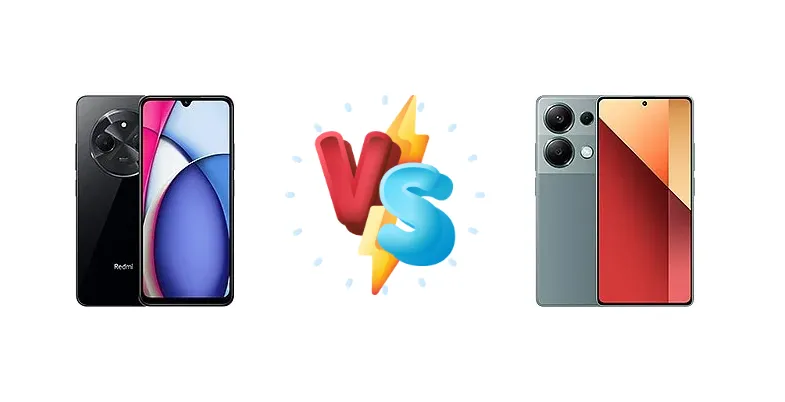
Xiaomi's Redmi series consistently delivers impressive value, but choosing between models can be tricky. The Redmi A3 Pro and Note 13 Pro 4G represent two distinct approaches to the budget smartphone market: the A3 Pro focuses on a streamlined experience, while the Note 13 Pro 4G aims for a more feature-rich package. This comparison dives deep into their specifications to determine which device best suits your needs.
🏆 Quick Verdict
For most users, the Xiaomi Redmi Note 13 Pro 4G emerges as the stronger choice. Its significantly faster 67W charging, coupled with a measured 1047 nits peak brightness display and the more powerful Helio G99 Ultra chipset, provides a more compelling overall experience despite a higher price point.
| Network |
|---|
| 2G bands | GSM 850 / 900 / 1800 / 1900 | GSM 850 / 900 / 1800 / 1900 |
| 3G bands | HSDPA 850 / 900 / 2100 | HSDPA 850 / 900 / 1700(AWS) / 1900 / 2100 |
| 4G bands | LTE | 1, 2, 3, 4, 5, 7, 8, 12, 13, 17, 18, 19, 20, 26, 28, 38, 40, 41, 66 |
| Speed | HSPA, LTE | HSPA, LTE |
| Technology | GSM / HSPA / LTE | GSM / HSPA / LTE |
| Launch |
|---|
| Announced | 2024, October | 2024, January 15 |
| Status | Available. Released 2024, October | Available. Released 2024, January 15 |
| Body |
|---|
| Build | - | Glass front (Gorilla Glass 5), plastic frame, plastic back |
| Dimensions | 171.9 x 77.8 x 8.2 mm (6.77 x 3.06 x 0.32 in) | 161.1 x 75 x 8 mm (6.34 x 2.95 x 0.31 in) |
| SIM | Nano-SIM + Nano-SIM | Nano-SIM + Nano-SIM |
| Weight | 204 g (7.20 oz) | 188 g (6.63 oz) |
| Display |
|---|
| Protection | - | Corning Gorilla Glass 5 |
| Resolution | 720 x 1640 pixels (~260 ppi density) | 1080 x 2400 pixels, 20:9 ratio (~395 ppi density) |
| Size | 6.88 inches, 112.4 cm2 (~84.0% screen-to-body ratio) | 6.67 inches, 107.4 cm2 (~88.9% screen-to-body ratio) |
| Type | IPS LCD, 90Hz | AMOLED, 1B colors, 120Hz, 500 nits (typ), 1000 nits (HBM), 1300 nits (peak) |
| Platform |
|---|
| CPU | Octa-core (2x2.0 GHz Cortex-A75 & 6x1.8 GHz Cortex-A55) | Octa-core (2x2.2 GHz Cortex-A76 & 6x2.0 GHz Cortex-A55) |
| Chipset | Mediatek Helio G81 Ultra | Mediatek Helio G99 Ultra |
| GPU | Mali-G52 MC2 | Mali-G57 MC2 |
| OS | Android 14, HyperOS | Android 13, up to 3 major Android upgrades, HyperOS |
| Memory |
|---|
| Card slot | microSDXC (dedicated slot) | microSDXC (uses shared SIM slot) |
| Internal | 128GB 4GB RAM | 128GB 8GB RAM, 256GB 8GB RAM, 256GB 12GB RAM, 512GB 8GB RAM, 512GB 12GB RAM |
| Main Camera |
|---|
| Features | LED flash, HDR | LED flash, HDR, panorama |
| Single | 50 MP, f/1.8, (wide)
Auxiliary lens | - |
| Triple | - | 200 MP, f/1.7, 23mm (wide), 1/1.4", 0.56µm, multi-directional PDAF, OIS
8 MP, f/2.2, 15mm, 120˚ (ultrawide), 1/4.4", 1.0µm
2 MP (macro) |
| Video | 1080p@30fps | 1080p@30/60fps |
| Selfie camera |
|---|
| Single | Yes | 16 MP, f/2.4, (wide), 1/3.0", 1.0µm |
| Video | 1080p@30fps | 1080p@30/60fps |
| Sound |
|---|
| 35mm jack | Yes | Yes |
| Loudspeaker | Yes | Yes, with dual speakers |
| Comms |
|---|
| Bluetooth | 5.4, A2DP, LE | 5.2, A2DP, LE |
| Infrared port | - | Yes |
| NFC | Yes (market/region dependent) | Yes (market/region dependent) |
| Positioning | GPS, GLONASS, GALILEO, BDS | GPS, GLONASS, GALILEO, BDS |
| Radio | Unspecified | FM radio |
| USB | USB Type-C 2.0 | USB Type-C 2.0, OTG |
| WLAN | Wi-Fi 802.11 a/b/g/n/ac, dual-band | Wi-Fi 802.11 a/b/g/n/ac, dual-band |
| Features |
|---|
| Sensors | Fingerprint (side-mounted), accelerometer, compass | Fingerprint (under display, optical), accelerometer, gyro, compass |
| Battery |
|---|
| Charging | 10W wired | 67W wired, 50% in 16 min, 100% in 46 min |
| Type | 5160 mAh | 5000 mAh |
| Misc |
|---|
| Colors | Blue, Black | Midnight Black, Lavender Purple, Forest Green |
| Models | 2409BRN2CG | 23117RA68G, 2312FPCA6G |
| Price | About 100 EUR | € 92.00 / $ 269.99 / £ 299.99 |
| SAR | - | 1.09 W/kg (head) 1.09 W/kg (body) |
| SAR EU | 1.43 W/kg (head) 1.38 W/kg (body) | 0.99 W/kg (head) 0.99 W/kg (body) |
Xiaomi Redmi A3 Pro
- Potentially more affordable price point
- Streamlined user experience
- Compact and lightweight design (assumed)
- Slow 10W charging
- Less powerful processor
- Likely lower display quality
Xiaomi Redmi Note 13 Pro 4G
- 67W fast charging (50% in 16 min)
- Brighter 1047 nits display
- More powerful Helio G99 Ultra chipset
- Longer battery life (11:36h active use)
- Higher price compared to A3 Pro
- Potentially larger and heavier design
Display Comparison
The Redmi Note 13 Pro 4G boasts a substantial advantage in display quality, achieving a measured peak brightness of 1047 nits. This translates to excellent visibility even in direct sunlight, a common issue with budget displays. While the A3 Pro’s display specifications are not provided, the Note 13 Pro 4G’s brightness level suggests a superior viewing experience. The Note 13 Pro 4G likely utilizes a higher-quality panel, offering better color accuracy and viewing angles. The absence of information on the A3 Pro’s panel type makes a direct comparison difficult, but the Note 13 Pro 4G clearly leads in this category.
Camera Comparison
Both devices feature camera systems, but detailed specifications are limited. The Note 13 Pro 4G’s camera is described as capable of both photo and video, suggesting a more versatile setup. Without sensor size or aperture information for either device, it’s difficult to make a definitive judgment. However, the Note 13 Pro 4G’s positioning as a more premium model suggests a potentially superior camera system, likely with a larger main sensor and improved image processing algorithms. The inclusion of OIS (Optical Image Stabilization) on the Note 13 Pro 4G, if present, would further enhance its photographic capabilities.
Performance
The core difference in performance lies within the chipsets. The Redmi Note 13 Pro 4G is powered by the Mediatek Helio G99 Ultra, featuring a CPU with 2x2.2 GHz Cortex-A76 cores and 6x2.0 GHz Cortex-A55 cores. This is a step up from the Redmi A3 Pro’s Helio G81 Ultra, which has 2x2.0 GHz Cortex-A75 cores and 6x1.8 GHz Cortex-A55 cores. The higher clock speeds and more efficient Cortex-A76 cores in the G99 Ultra will result in noticeably smoother multitasking and improved gaming performance. While both phones likely share similar RAM configurations, the G99 Ultra’s superior processing power will be the defining factor for demanding applications.
Battery Life
The Redmi Note 13 Pro 4G excels in battery charging speed, supporting 67W wired charging, achieving 50% charge in just 16 minutes and a full charge in 46 minutes. This is a significant advantage over the Redmi A3 Pro’s slow 10W charging. While the A3 Pro’s battery capacity isn’t specified, the Note 13 Pro 4G’s active use score of 11:36h demonstrates excellent battery life. The faster charging speed mitigates any potential concerns about battery capacity, allowing users to quickly top up their device when needed. The convenience of rapid charging is a major benefit for users on the go.
Buying Guide
Buy the Xiaomi Redmi A3 Pro if you prioritize a minimalist experience and are comfortable with slower charging speeds. It's ideal for users who primarily need a reliable phone for basic communication and light tasks. Buy the Xiaomi Redmi Note 13 Pro 4G if you value faster charging, a brighter and more vibrant display, and improved performance for gaming and multitasking. This phone is geared towards users who demand more from their smartphone.
Frequently Asked Questions
❓ Is the Helio G99 Ultra in the Note 13 Pro 4G capable of handling demanding games like PUBG Mobile?
Yes, the Helio G99 Ultra is a capable chipset for gaming. While it's not a flagship processor, it can comfortably run PUBG Mobile at medium to high settings with stable frame rates. The improved CPU and GPU performance compared to the Helio G81 Ultra in the A3 Pro will result in a smoother gaming experience.
❓ How much faster is the 67W charging on the Note 13 Pro 4G compared to the 10W charging on the A3 Pro in a typical use case?
The difference is substantial. The Note 13 Pro 4G can go from 0% to 50% in just 16 minutes, and fully charge in 46 minutes. The A3 Pro’s 10W charging will take significantly longer – likely over 3 hours for a full charge. This means you can quickly top up the Note 13 Pro 4G during short breaks, while the A3 Pro requires a much longer charging commitment.
❓ Does the Redmi Note 13 Pro 4G support video recording at 4K resolution?
While the context data doesn't explicitly state 4K video recording capabilities, the Note 13 Pro 4G's positioning and chipset suggest it likely supports 1080p video recording at 60fps, and potentially 4K at 30fps. Further review of official specifications is needed to confirm 4K support.