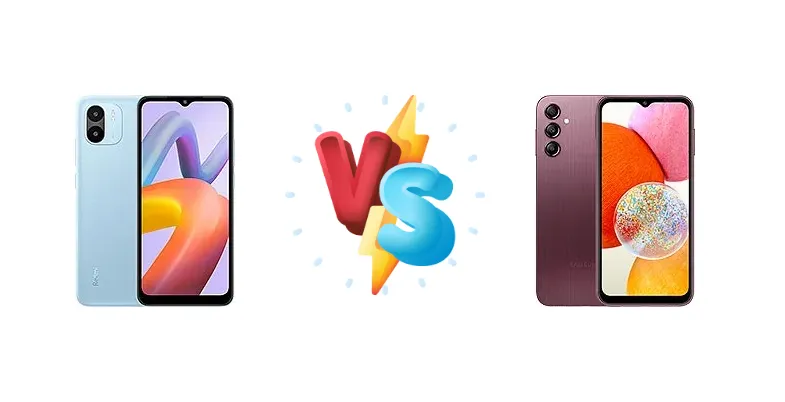
The sub-$150 smartphone market is fiercely competitive. The Xiaomi Redmi A2 and Samsung Galaxy A14 both aim to deliver essential smartphone functionality at an accessible price point. However, they take different approaches to achieving this, with variations in chipset architecture and charging capabilities. This comparison dissects these differences to determine which device offers the best value.
🏆 Quick Verdict
For most users, the Samsung Galaxy A14 emerges as the stronger choice. While the Redmi A2 offers a slightly lower entry price, the Galaxy A14’s more powerful Mediatek Helio G80 (or Exynos 850) chipset and faster 15W charging provide a noticeably smoother user experience and greater longevity.
| Network |
|---|
| 2G bands | GSM 850 / 900 / 1800 / 1900 | GSM 850 / 900 / 1800 / 1900 |
| 3G bands | HSDPA 850 / 900 / 2100 | HSDPA 850 / 900 / 2100 |
| 4G bands | 1, 3, 5, 7, 8, 20, 28, 38, 40, 41 - International | 1, 3, 5, 7, 8, 20, 28, 38, 40, 41 |
| Speed | HSPA, LTE | HSPA, LTE |
| Technology | GSM / HSPA / LTE | GSM / HSPA / LTE |
| | 1, 3, 5, 8, 40, 41 - India | - |
| Launch |
|---|
| Announced | 2023, March 24 | 2023, February 28 |
| Status | Available. Released 2023, March 24 | Available. Released 2023, March 27 |
| Body |
|---|
| Build | - | Glass front, plastic back, plastic frame |
| Dimensions | 164.9 x 76.8 x 9.1 mm (6.49 x 3.02 x 0.36 in) | 167.7 x 78 x 9.1 mm (6.60 x 3.07 x 0.36 in) |
| SIM | Nano-SIM + Nano-SIM | · Nano-SIM· Nano-SIM + Nano-SIM |
| Weight | 192 g (6.77 oz) | 201 g (7.09 oz) |
| Display |
|---|
| Resolution | 720 x 1600 pixels, 20:9 ratio (~269 ppi density) | 1080 x 2408 pixels, 20:9 ratio (~400 ppi density) |
| Size | 6.52 inches, 102.6 cm2 (~81.0% screen-to-body ratio) | 6.6 inches, 104.9 cm2 (~80.2% screen-to-body ratio) |
| Type | IPS LCD, 400 nits (typ) | PLS LCD |
| Platform |
|---|
| CPU | Octa-core (4x2.2 GHz Cortex-A53 & 4x1.7 GHz Cortex-A53) | Octa-core (2x2.0 GHz Cortex-A75 & 6x1.8 GHz Cortex-A55) - Version AOcta-core (4x2.0 GHz Cortex-A55 & 4x2.0 GHz Cortex-A55) - Version B |
| Chipset | Mediatek Helio G36 (12 nm) | Mediatek MT6769 Helio G80 (12 nm) - Version AExynos 850 (8 nm) - Version B |
| GPU | PowerVR GE8320 | Mali-G52 MC2 |
| OS | Android 12 or 13 (Go edition), MIUI | Android 13, upgradable to Android 15, One UI 7 |
| Memory |
|---|
| Card slot | microSDXC (dedicated slot) | microSDXC (dedicated slot) |
| Internal | 32GB 2GB RAM, 32GB 3GB RAM, 64GB 2GB RAM, 64GB 3GB RAM, 64GB 4GB RAM | 64GB 4GB RAM, 128GB 4GB RAM, 128GB 6GB RAM |
| | eMMC 5.1 | - |
| Main Camera |
|---|
| Dual | 8 MP, f/2.0, (wide)
0.08 MP (depth) | - |
| Features | Dual-LED flash, HDR | LED flash, panorama, HDR |
| Single | 8 MP, f/2.0, (wide)
Auxiliary lens | 13 MP, f/2.0, (wide) |
| Triple | - | 50 MP, f/1.8, 26mm (wide), 1/2.75", 0.64µm, PDAF
5 MP, f/2.2, 17mm (ultrawide), 1/5.0", 1.12µm
2 MP (macro) |
| Video | 1080p@30fps | 1080p@30fps |
| Selfie camera |
|---|
| Single | 5 MP, f/2.2 | 13 MP, f/2.0, 26mm (wide), 1/3.1", 1.12µm |
| Video | 1080p@30fps | 1080p@30fps |
| Sound |
|---|
| 3.5mm jack | Yes | Yes |
| 35mm jack | Yes | Yes |
| Loudspeaker | Yes | Yes |
| Comms |
|---|
| Bluetooth | 5.0, A2DP, LE | 5.1 or 5.3, A2DP, LE |
| NFC | No | Yes (market/region dependent) |
| Positioning | GPS, GLONASS, GALILEO, BDS | GPS, GALILEO, GLONASS, BDS, QZSS |
| Radio | FM radio | Unspecified |
| USB | microUSB 2.0 | USB Type-C 2.0 |
| WLAN | Wi-Fi 802.11 a/b/g/n | Wi-Fi 802.11 a/b/g/n/ac, dual-band, Wi-Fi Direct |
| Features |
|---|
| Sensors | Accelerometer | Fingerprint (side-mounted), accelerometer, proximity, compass |
| Battery |
|---|
| Charging | 10W wired | 15W wired |
| Type | Li-Po 5000 mAh | Li-Po 5000 mAh |
| Misc |
|---|
| Colors | Aqua Blue, Classic Black, Sea Green | Black, Dark Red, Silver, Green |
| Models | 23028RN4DG, 23026RN54G | SM-A145F, SM-A145F/DSN, SM-A145M, SM-A145M/DS, SM-A145P, SM-A145R |
| Price | € 59.00 / £ 54.95 | € 85.76 / $ 147.60 / £ 79.95 |
| SAR | 1.10 W/kg (head) 1.01 W/kg (body) | - |
| SAR EU | 0.90 W/kg (head) 1.00 W/kg (body) | 0.46 W/kg (head) 1.37 W/kg (body) |
Xiaomi Redmi A2
- Lowest possible price point
- Simple and easy-to-use interface
- Acceptable for basic communication
- Slow performance with demanding apps
- Slow 10W charging
- Limited multitasking capabilities
Samsung Galaxy A14
- More powerful processor for smoother performance
- Faster 15W charging
- Better multitasking capabilities
- Slightly higher price
- May still struggle with graphically intensive games
- Build quality may be similar to the Redmi A2
Display Comparison
Neither device boasts a standout display. Both likely utilize LCD panels, common in this price bracket. The key difference lies in processing power, which impacts UI smoothness. Display specs beyond resolution are not provided, so we can assume both offer standard 60Hz refresh rates. Bezels are likely comparable, prioritizing cost reduction over premium aesthetics. Color accuracy will likely be basic on both, geared towards acceptable viewing rather than professional color work.
Camera Comparison
Camera performance is likely to be similar in real-world usage, given the focus on cost savings. Both phones will likely feature a primary camera accompanied by lower-resolution auxiliary lenses (details not provided). The Redmi A2’s image processing will likely prioritize speed over detail, while the Galaxy A14 may offer slightly more refined results thanks to Samsung’s software optimizations. Without sensor size or aperture information, it’s difficult to definitively declare a winner, but the A14’s more powerful chipset allows for more complex image processing algorithms.
Performance
The performance gap is the most significant differentiator. The Samsung Galaxy A14, in its Helio G80 configuration, features a more modern CPU architecture with 2x Cortex-A75 cores alongside 6x Cortex-A55 cores, compared to the Redmi A2’s 4x Cortex-A53 and 4x Cortex-A53. This translates to a substantial advantage in multi-tasking and app launch speeds for the A14. The Exynos 850 variant of the A14, built on an 8nm process versus the G36’s 12nm, further enhances efficiency and sustained performance. The Redmi A2’s Helio G36 is adequate for basic tasks, but will struggle with demanding applications. The A14’s GPU will also provide a better gaming experience, even if limited to lower settings.
Battery Life
Both phones will likely offer all-day battery life with moderate usage. The Redmi A2’s 10W charging is significantly slower than the Galaxy A14’s 15W charging. This means the A14 will spend less time tethered to a power outlet, a crucial advantage for users who are frequently on the go. While battery capacity isn’t specified, the A14’s more efficient chipset (especially the Exynos 850 version) will contribute to longer runtimes.
Buying Guide
Buy the Xiaomi Redmi A2 if you prioritize absolute affordability and need a basic smartphone for calls, texts, and light social media use. It’s ideal for first-time smartphone owners or as a reliable backup device. Buy the Samsung Galaxy A14 if you value a more responsive experience, better multitasking capabilities, and faster charging, even if it means spending a bit more. It’s a better fit for users who stream videos, play casual games, or rely on their phone for daily productivity.
Frequently Asked Questions
❓ Does the Samsung Galaxy A14’s Exynos 850 chip overheat during prolonged gaming sessions?
The Exynos 850 is an 8nm chip, offering better thermal efficiency than the Redmi A2’s 12nm Helio G36. While it won’t deliver flagship-level gaming performance, it’s less prone to overheating during moderate gaming. Expect some throttling after extended play, but it should remain playable.
❓ Is the 2MP macro camera on either phone actually useful for taking detailed close-up photos?
Generally, 2MP macro cameras on budget phones offer limited detail. The small sensor size and lack of optical image stabilization result in soft, often blurry images. They are more of a marketing feature than a genuinely useful tool for serious photography.
❓ Can the Samsung Galaxy A14 run PUBG Mobile at 60fps?
While the Helio G80 can run PUBG Mobile, achieving a consistent 60fps will likely require lowering the graphics settings to the lowest possible level. The Exynos 850 version may offer slightly better performance, but don't expect a high-fidelity gaming experience.
❓ How long will it take to fully charge the Redmi A2 with its 10W charger?
With a 10W charger, expect the Redmi A2 to take approximately 3-4 hours to fully charge from 0% to 100%, depending on battery capacity. This is significantly slower than the Galaxy A14’s 15W charging.