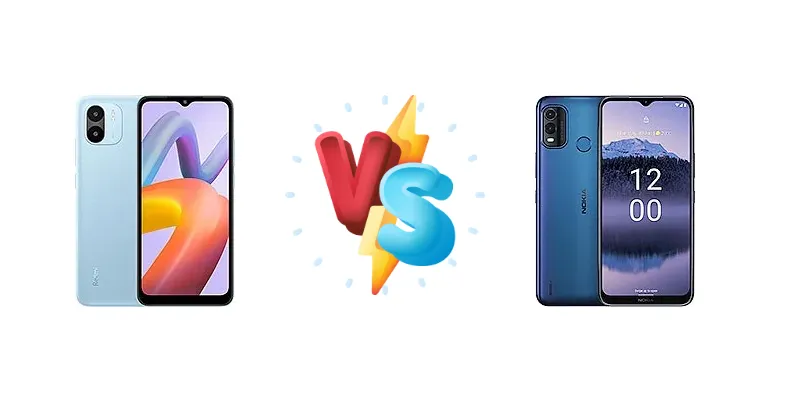
The Xiaomi Redmi A2 and Nokia G11 Plus represent the fiercely competitive sub-$150 smartphone market. Both devices aim to deliver essential smartphone functionality at an accessible price point, but they achieve this with different chipsets and design philosophies. This comparison dissects their key specifications to determine which offers the best value for budget-conscious consumers.
🏆 Quick Verdict
For most users, the Xiaomi Redmi A2 emerges as the slightly better choice. Its Mediatek Helio G36 chipset, while not a powerhouse, offers a more balanced CPU performance profile than the Unisoc T606 in the Nokia G11 Plus, translating to a smoother experience in everyday tasks. Both phones share the same slow 10W charging, making battery life a key consideration.
| Network |
|---|
| 2G bands | GSM 850 / 900 / 1800 / 1900 | GSM 850 / 900 / 1800 / 1900 |
| 3G bands | HSDPA 850 / 900 / 2100 | HSDPA 850 / 900 / 2100 - International |
| 4G bands | 1, 3, 5, 7, 8, 20, 28, 38, 40, 41 - International | 1, 3, 5, 7, 8, 20, 28, 38, 40, 41 - International |
| Speed | HSPA, LTE | HSPA 42.2/5.76 Mbps, LTE Cat4 150/50 Mbps |
| Technology | GSM / HSPA / LTE | GSM / HSPA / LTE |
| | 1, 3, 5, 8, 40, 41 - India | 1, 3, 5, 8, 40, 41 - India |
| Launch |
|---|
| Announced | 2023, March 24 | 2022, June 29 |
| Status | Available. Released 2023, March 24 | Available. Released 2022, July 20 |
| Body |
|---|
| Build | - | Glass front, plastic frame, plastic back |
| Dimensions | 164.9 x 76.8 x 9.1 mm (6.49 x 3.02 x 0.36 in) | 164.8 x 75.9 x 8.6 mm (6.49 x 2.99 x 0.34 in) |
| SIM | Nano-SIM + Nano-SIM | · Nano-SIM· Nano-SIM + Nano-SIM |
| Weight | 192 g (6.77 oz) | 192 g (6.77 oz) |
| | - | Splash protection |
| Display |
|---|
| Resolution | 720 x 1600 pixels, 20:9 ratio (~269 ppi density) | 720 x 1600 pixels, 20:9 ratio (~269 ppi density) |
| Size | 6.52 inches, 102.6 cm2 (~81.0% screen-to-body ratio) | 6.52 inches, 102.6 cm2 (~82.1% screen-to-body ratio) |
| Type | IPS LCD, 400 nits (typ) | IPS LCD, 90Hz, 400 nits (typ) |
| Platform |
|---|
| CPU | Octa-core (4x2.2 GHz Cortex-A53 & 4x1.7 GHz Cortex-A53) | Octa-core (2x1.6 GHz Cortex-A75 & 6x1.6 GHz Cortex-A55) |
| Chipset | Mediatek Helio G36 (12 nm) | Unisoc T606 (12 nm) |
| GPU | PowerVR GE8320 | Mali-G57 MP1 |
| OS | Android 12 or 13 (Go edition), MIUI | Android 12, upgradable to Android 13 |
| Memory |
|---|
| Card slot | microSDXC (dedicated slot) | microSDXC (dedicated slot) |
| Internal | 32GB 2GB RAM, 32GB 3GB RAM, 64GB 2GB RAM, 64GB 3GB RAM, 64GB 4GB RAM | 32GB 3GB RAM, 64GB 3GB RAM, 64GB 4GB RAM, 128GB 3GB RAM |
| | eMMC 5.1 | eMMC 5.1 |
| Main Camera |
|---|
| Dual | 8 MP, f/2.0, (wide)
0.08 MP (depth) | 50 MP, f/1.8, (wide), 1/2.67", PDAF
Auxiliary lens |
| Features | Dual-LED flash, HDR | LED flash |
| Single | 8 MP, f/2.0, (wide)
Auxiliary lens | 8 MP, f/2.0, (wide), 1/4.0" |
| Video | 1080p@30fps | 1080p@30fps |
| Selfie camera |
|---|
| Single | 5 MP, f/2.2 | 8 MP, f/2.0, (wide), 1/4.0" |
| Video | 1080p@30fps | 1080p@30fps |
| Sound |
|---|
| 3.5mm jack | Yes | Yes |
| 35mm jack | Yes | Yes |
| Loudspeaker | Yes | Yes |
| Comms |
|---|
| Bluetooth | 5.0, A2DP, LE | 5.0, A2DP, LE |
| NFC | No | No |
| Positioning | GPS, GLONASS, GALILEO, BDS | GPS |
| Radio | FM radio | FM radio |
| USB | microUSB 2.0 | USB Type-C 2.0, OTG |
| WLAN | Wi-Fi 802.11 a/b/g/n | Wi-Fi 802.11 a/b/g/n/ac, dual-band, Wi-Fi Direct |
| Features |
|---|
| Sensors | Accelerometer | Fingerprint (rear-mounted), accelerometer, proximity |
| Battery |
|---|
| Charging | 10W wired | 10W wired |
| Type | Li-Po 5000 mAh | Li-Ion 5000 mAh |
| Misc |
|---|
| Colors | Aqua Blue, Classic Black, Sea Green | Lake Blue, Charcoal Grey |
| Models | 23028RN4DG, 23026RN54G | - |
| Price | € 59.00 / £ 54.95 | About 130 EUR |
| SAR | 1.10 W/kg (head) 1.01 W/kg (body) | - |
| SAR EU | 0.90 W/kg (head) 1.00 W/kg (body) | - |
Xiaomi Redmi A2
- Potentially smoother CPU performance due to higher clocked cores.
- Likely more responsive app launching and multitasking.
- Competitive price point.
- Slow 10W charging.
- Basic camera system.
Nokia G11 Plus
- Potentially better software support from Nokia.
- More efficient CPU architecture (Unisoc T606).
- Competitive price point.
- Slightly less responsive CPU performance.
- Slow 10W charging.
Display Comparison
Neither the Redmi A2 nor the G11 Plus are display champions. Both are expected to feature LCD panels, typical for this price bracket. Detailed display specs (resolution, brightness) are missing, but we can infer that they will be 720p+ to maximize battery life. The absence of high refresh rates or advanced features like LTPO is standard. Bezels are likely to be substantial on both devices, contributing to a larger overall footprint. Color accuracy will likely be basic, prioritizing power efficiency over fidelity.
Camera Comparison
Camera performance on both devices will be modest. Detailed sensor information is unavailable, but it’s safe to assume both feature a primary camera around 13MP, accompanied by auxiliary sensors (likely 2MP macro/depth) of limited utility. Image processing will be basic, relying heavily on software algorithms to enhance photos. The absence of Optical Image Stabilization (OIS) means low-light photography will be challenging. The primary differentiator will likely be software tuning, with Nokia potentially offering a more natural color profile.
Performance
The core difference lies in the chipsets. The Redmi A2’s Mediatek Helio G36 utilizes a combination of Cortex-A53 cores clocked at 2.2 GHz and 1.7 GHz. This configuration, while based on older architecture, benefits from the higher clock speeds on the primary cores. The Nokia G11 Plus, powered by the Unisoc T606, employs a big.LITTLE architecture with 2x Cortex-A75 cores at 1.6 GHz and 6x Cortex-A55 cores at 1.6 GHz. The A75 cores are more efficient than the A53, but the lower clock speed and fewer high-performance cores suggest the Helio G36 will handle multi-tasking and app launches with slightly less lag. Both phones likely feature limited RAM (2GB or 3GB), further impacting performance.
Battery Life
Both the Redmi A2 and G11 Plus are equipped with 10W wired charging, a significant drawback in today’s market. Expect a full charge to take well over two hours. Battery capacity is not specified, but both are likely in the 5000mAh range, prioritizing longevity over quick top-ups. Real-world battery life will depend heavily on usage patterns, but both should comfortably last a full day with moderate use. The slower charging speed means users will need to plan ahead or charge overnight.
Buying Guide
Buy the Xiaomi Redmi A2 if you prioritize a slightly more responsive user experience for common tasks like browsing, social media, and messaging. Its CPU architecture is better suited for handling multiple apps simultaneously. Buy the Nokia G11 Plus if you value a potentially more stable software experience, given Nokia's commitment to Android updates, and prefer a design that may feel slightly more premium in hand, though this is subjective.
Frequently Asked Questions
❓ Will the Mediatek Helio G36 in the Redmi A2 struggle with popular apps like TikTok or Instagram?
While the Helio G36 isn't a high-end processor, it should be capable of running apps like TikTok and Instagram without major issues. Expect some occasional lag when switching between apps or loading content, but it should be usable for casual social media browsing. Optimizing app usage and limiting background processes will help improve performance.
❓ How reliable is Nokia's software update commitment for the G11 Plus, and will it receive Android version upgrades?
Nokia has a relatively good track record for providing software updates and security patches, even for their budget devices. The G11 Plus is likely to receive at least one major Android version upgrade (potentially to Android 13 or 14) and regular security updates for a period of two to three years. However, update timelines can vary, and it's not guaranteed to receive the latest Android features immediately.
❓ Is the 10W charging on either phone a dealbreaker for users who need quick top-ups?
Yes, the 10W charging is a significant limitation. It will take over two hours to fully charge either phone from 0%. If fast charging is a priority, these devices are not recommended. Users should consider alternative phones with at least 18W or 25W charging capabilities.