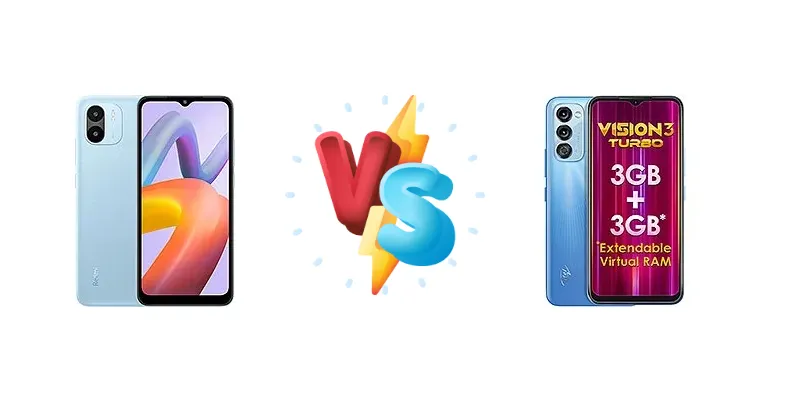
The ultra-budget smartphone segment is fiercely competitive, and the Xiaomi Redmi A2 and itel Vision 3 Turbo represent two compelling options for users prioritizing affordability. While both aim to deliver essential smartphone functionality at a low price point, they take different approaches to chipset selection and feature implementation. This comparison dissects their key specifications to determine which device offers the best value.
🏆 Quick Verdict
For most users, the Xiaomi Redmi A2 emerges as the slightly better choice. Its Mediatek Helio G36, built on a more modern 12nm process, provides a noticeable performance advantage over the itel Vision 3 Turbo’s older 28nm Unisoc SC9863A, translating to a smoother user experience despite the slower charging.
| Network |
|---|
| 2G bands | GSM 850 / 900 / 1800 / 1900 | GSM 850 / 900 / 1800 / 1900 |
| 3G bands | HSDPA 850 / 900 / 2100 | HSDPA 850 / 900 / 2100 |
| 4G bands | 1, 3, 5, 7, 8, 20, 28, 38, 40, 41 - International | LTE |
| Speed | HSPA, LTE | HSPA, LTE |
| Technology | GSM / HSPA / LTE | GSM / HSPA / LTE |
| | 1, 3, 5, 8, 40, 41 - India | - |
| Launch |
|---|
| Announced | 2023, March 24 | 2022 |
| Status | Available. Released 2023, March 24 | Available. Released 2022 |
| Body |
|---|
| Dimensions | 164.9 x 76.8 x 9.1 mm (6.49 x 3.02 x 0.36 in) | - |
| SIM | Nano-SIM + Nano-SIM | Dual SIM |
| Weight | 192 g (6.77 oz) | - |
| Display |
|---|
| Resolution | 720 x 1600 pixels, 20:9 ratio (~269 ppi density) | 720 x 1600 pixels, 20:9 ratio (~266 ppi density) |
| Size | 6.52 inches, 102.6 cm2 (~81.0% screen-to-body ratio) | 6.6 inches, 105.2 cm2 |
| Type | IPS LCD, 400 nits (typ) | IPS LCD |
| Platform |
|---|
| CPU | Octa-core (4x2.2 GHz Cortex-A53 & 4x1.7 GHz Cortex-A53) | Octa-core (4x1.6 GHz Cortex-A55 & 4x1.2 GHz Cortex-A55) |
| Chipset | Mediatek Helio G36 (12 nm) | Unisoc SC9863A (28 nm) |
| GPU | PowerVR GE8320 | IMG8322 |
| OS | Android 12 or 13 (Go edition), MIUI | Android 11 (Go edition) |
| Memory |
|---|
| Card slot | microSDXC (dedicated slot) | microSDXC |
| Internal | 32GB 2GB RAM, 32GB 3GB RAM, 64GB 2GB RAM, 64GB 3GB RAM, 64GB 4GB RAM | 64GB 3GB RAM |
| | eMMC 5.1 | - |
| Main Camera |
|---|
| Dual | 8 MP, f/2.0, (wide)
0.08 MP (depth) | - |
| Features | Dual-LED flash, HDR | LED flash |
| Single | 8 MP, f/2.0, (wide)
Auxiliary lens | 8 MP (wide)
Auxiliary lens |
| Video | 1080p@30fps | 1080p@30fps |
| Selfie camera |
|---|
| Single | 5 MP, f/2.2 | 5 MP |
| Video | 1080p@30fps | Yes |
| Sound |
|---|
| 3.5mm jack | Yes | - |
| 35mm jack | Yes | Yes |
| Loudspeaker | Yes | Yes |
| Comms |
|---|
| Bluetooth | 5.0, A2DP, LE | Yes |
| NFC | No | No |
| Positioning | GPS, GLONASS, GALILEO, BDS | GPS |
| Radio | FM radio | Unspecified |
| USB | microUSB 2.0 | microUSB |
| WLAN | Wi-Fi 802.11 a/b/g/n | Yes |
| Features |
|---|
| Sensors | Accelerometer | Fingerprint (rear-mounted), accelerometer |
| Battery |
|---|
| Charging | 10W wired | 18W wired |
| Type | Li-Po 5000 mAh | 5000 mAh |
| Misc |
|---|
| Colors | Aqua Blue, Classic Black, Sea Green | Blue |
| Models | 23028RN4DG, 23026RN54G | - |
| Price | € 59.00 / £ 54.95 | - |
| SAR | 1.10 W/kg (head) 1.01 W/kg (body) | - |
| SAR EU | 0.90 W/kg (head) 1.00 W/kg (body) | - |
Xiaomi Redmi A2
- More efficient processor (12nm vs 28nm)
- Potentially smoother performance for everyday tasks
- Likely better thermal management
- Slower charging speed (10W)
- Limited detailed specifications available
itel Vision 3 Turbo
- Faster charging (18W)
- Potentially longer battery life due to optimized power draw
- Competitive price point
- Less powerful and efficient processor
- Older chipset architecture
- Likely slower app loading and multitasking
Display Comparison
Neither Xiaomi nor itel provide detailed display specifications beyond resolution. However, given the price point, both likely utilize LCD panels. The absence of information regarding peak brightness, color gamut coverage, or PWM dimming rates suggests a focus on cost reduction. The display experience will likely be similar on both, prioritizing visibility over color accuracy or advanced features. Bezels are expected to be substantial on both devices, reflecting their budget nature.
Camera Comparison
Detailed camera specifications are unavailable. Given the target market, both devices likely feature basic camera setups focused on capturing acceptable images in good lighting conditions. The absence of OIS (Optical Image Stabilization) is almost certain on both. Image processing will likely be minimal, relying heavily on software algorithms to enhance image quality. Without sensor size or aperture information, it’s difficult to assess image quality definitively, but the Redmi A2’s slightly more powerful processor may allow for faster image processing.
Performance
The core difference lies in the chipsets. The Redmi A2’s Mediatek Helio G36, fabricated on a 12nm process, features an octa-core CPU with a split configuration of 4x2.2 GHz Cortex-A53 and 4x1.7 GHz Cortex-A53 cores. This contrasts with the itel Vision 3 Turbo’s Unisoc SC9863A, built on a significantly older 28nm process, and utilizing 4x1.6 GHz Cortex-A55 and 4x1.2 GHz Cortex-A55 cores. The 12nm process of the Helio G36 offers improved power efficiency and thermal performance, allowing for sustained performance under load. While both are octa-core, the Cortex-A55 cores in the Unisoc chip are generally less efficient than the A53 cores in the Helio G36, and the lower clock speeds further contribute to a performance deficit. This translates to faster app loading times and smoother multitasking on the Redmi A2.
Battery Life
Battery capacity is not specified for either device. However, the itel Vision 3 Turbo boasts 18W wired charging, a significant advantage over the Redmi A2’s 10W charging. This means the Vision 3 Turbo will replenish its battery much faster, a crucial benefit for users who frequently need to top up their charge. While a larger battery capacity on the Redmi A2 could partially offset the slower charging, the 18W charging on the Vision 3 Turbo provides a tangible, real-world benefit.
Buying Guide
Buy the Xiaomi Redmi A2 if you prioritize overall performance and responsiveness for everyday tasks like browsing, social media, and light gaming. It’s the better option for users who value a slightly snappier experience. Buy the itel Vision 3 Turbo if faster charging is a critical need, and you primarily use your phone for basic communication and media consumption, accepting a trade-off in processing power. The 18W charging is a significant advantage for those who frequently find themselves with low battery.
Frequently Asked Questions
❓ Will the Unisoc SC9863A in the itel Vision 3 Turbo struggle with popular apps like WhatsApp and Facebook?
While the Unisoc SC9863A can handle basic apps like WhatsApp and Facebook, users may experience occasional lag or slowdowns, especially with multiple apps open simultaneously. The Helio G36 in the Redmi A2 offers a smoother experience for these common tasks due to its more efficient architecture.
❓ How long will it take to fully charge the itel Vision 3 Turbo with the 18W charger?
While the exact 0-100% charging time isn't specified, the 18W charging should significantly reduce charging times compared to the Redmi A2. Expect a full charge in approximately 2-3 hours, depending on usage during charging. This is a key advantage for users who prioritize quick top-ups.
❓ Is the Redmi A2 a good option for playing casual games like Candy Crush or Subway Surfers?
Yes, the Redmi A2’s Helio G36 is capable of handling casual games like Candy Crush and Subway Surfers without significant issues. However, don’t expect to play graphically demanding games at high settings. The Vision 3 Turbo will likely struggle even with these lighter titles.