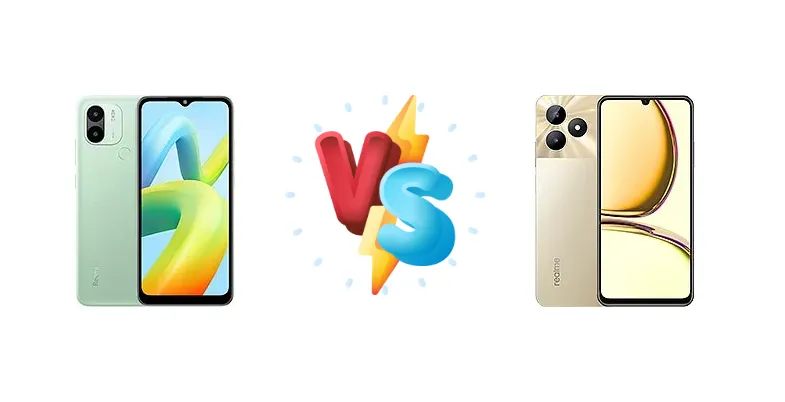
The sub-$150 smartphone market is fiercely competitive, and the Xiaomi Redmi A1+ and Realme C53 (India) are two contenders vying for dominance. While both aim to deliver essential smartphone functionality at an accessible price, they take distinctly different approaches to achieving this, primarily through their chipset choices. This comparison dissects those differences and determines which device offers the best value for your money.
🏆 Quick Verdict
For the average user prioritizing responsiveness and multitasking, the Realme C53 (India) is the clear winner. Its Unisoc Tiger T612 chipset, with its octa-core configuration, provides a significantly more fluid experience than the Redmi A1+'s quad-core Helio A22. While the Redmi A1+ may offer slightly better software optimization, the hardware gap is too substantial to ignore.
| Network |
|---|
| 2G bands | GSM 850 / 900 / 1800 / 1900 | GSM 850 / 900 / 1800 / 1900 |
| 3G bands | HSDPA 850 / 900 / 2100 | HSDPA 850 / 900 / 2100 |
| 4G bands | 1, 3, 5, 7, 8, 20, 28, 38, 40, 41 | 1, 3, 5, 8, 38, 40, 41 |
| Speed | HSPA, LTE | HSPA, LTE |
| Technology | GSM / HSPA / LTE | GSM / HSPA / LTE |
| Launch |
|---|
| Announced | 2022, September 23 | 2023, July 19 |
| Status | Available. Released 2022, September 23 | Available. Released 2023, July 26 |
| Body |
|---|
| Build | - | Glass front, plastic frame, plastic back |
| Dimensions | 164.9 x 76.8 x 9.1 mm (6.49 x 3.02 x 0.36 in) | 167.2 x 76.7 x 8 mm (6.58 x 3.02 x 0.31 in) |
| SIM | Nano-SIM + Nano-SIM | Nano-SIM + Nano-SIM |
| Weight | 192 g (6.77 oz) | 186 g (6.56 oz) |
| Display |
|---|
| Resolution | 720 x 1600 pixels, 20:9 ratio (~269 ppi density) | 1080 x 2400 pixels, 20:9 ratio (~390 ppi density) |
| Size | 6.52 inches, 102.6 cm2 (~81.0% screen-to-body ratio) | 6.74 inches, 109.7 cm2 (~85.5% screen-to-body ratio) |
| Type | IPS LCD, 400 nits (typ) | IPS LCD, 90Hz, 560 nits (peak) |
| Platform |
|---|
| CPU | Quad-core 2.0 GHz Cortex-A53 | Octa-core (2x1.8 GHz Cortex-A75 & 6x1.8 GHz Cortex-A55) |
| Chipset | Mediatek MT6761 Helio A22 (12 nm) | Unisoc Tiger T612 (12 nm) |
| GPU | PowerVR GE8320 | Mali-G57 |
| OS | Android 12 (Go edition), MIUI 12 | Android 13, Realme UI |
| Memory |
|---|
| Card slot | microSDXC (dedicated slot) | microSDXC (dedicated slot) |
| Internal | 32GB 2GB RAM, 32GB 3GB RAM | 64GB 6GB RAM, 128GB 4GB RAM, 128GB 6GB RAM |
| Main Camera |
|---|
| Dual | - | 108 MP, (wide), PDAF
Auxiliary lens |
| Features | Dual-LED flash, HDR | LED flash, HDR, panorama |
| Single | 8 MP, f/2.0, (wide)
Auxiliary lens | - |
| Video | 1080p@30fps | 1080p@30fps |
| Selfie camera |
|---|
| Features | - | HDR |
| Single | 5 MP, f/2.2 | 8 MP, (wide) |
| Video | 1080p@30fps | 720p@30fps |
| Sound |
|---|
| 35mm jack | Yes | Yes |
| Loudspeaker | Yes | Yes |
| Comms |
|---|
| Bluetooth | 5.0, A2DP, LE | 5.0, A2DP, LE |
| NFC | No | No |
| Positioning | GPS, GLONASS, GALILEO, BDS | GPS, GLONASS, GALILEO |
| Radio | FM radio | Unspecified |
| USB | microUSB 2.0 | USB Type-C 2.0 |
| WLAN | Wi-Fi 802.11 a/b/g/n | Wi-Fi 802.11 a/b/g/n/ac, dual-band |
| Features |
|---|
| Sensors | Fingerprint (rear-mounted), accelerometer | Fingerprint (side-mounted), accelerometer, gyro, proximity, compass |
| Battery |
|---|
| Charging | 10W wired | 18W wired |
| Type | Li-Po 5000 mAh | 5000 mAh |
| Misc |
|---|
| Colors | Light Green, Light Blue, Black | Gold, Black |
| Models | 220733SFG | RMX3762 |
| Price | About 80 EUR | About 110 EUR |
| SAR | 1.00 W/kg (head) 1.10 W/kg (body) | - |
| SAR EU | 0.91 W/kg (head) 1.00 W/kg (body) | - |
Xiaomi Redmi A1+
- Potentially lower price point
- Simple and straightforward software experience
- Acceptable battery life for basic use
- Significantly slower processor
- Laggy performance with multitasking
- Slow charging speed
Realme C53 (India)
- Faster and more responsive processor
- Faster 18W charging
- Better multitasking capabilities
- May be slightly more expensive
- Software experience could be bloated
- Camera performance likely similar to Redmi A1+
Display Comparison
Neither device boasts a standout display. Both are likely utilizing LCD panels, typical for this price bracket. Specifics like resolution and peak brightness are not provided, but we can assume they are similar – around 720p+ and adequate for indoor use. The Realme C53’s potential for a slightly higher peak brightness, given its more modern chipset, could translate to better visibility outdoors, but this is speculative without concrete data. Bezels are expected to be substantial on both devices, reflecting their budget positioning.
Camera Comparison
Camera performance is likely to be similar on both devices, leaning towards basic functionality. Without sensor size or aperture information, it’s difficult to make definitive claims. However, the Realme C53’s more powerful processor could enable slightly better image processing, potentially resulting in more detailed and vibrant photos. The prevalence of 2MP macro lenses on both devices suggests they are included for marketing purposes rather than practical use. Expect acceptable results in well-lit conditions, but struggles in low light.
Performance
This is where the Realme C53 truly shines. The Unisoc Tiger T612’s octa-core CPU (2x1.8 GHz Cortex-A75 & 6x1.8 GHz Cortex-A55) is a significant upgrade over the Redmi A1+'s MediaTek Helio A22’s quad-core 2.0 GHz Cortex-A53. The A75 cores in the T612 offer considerably more processing power for demanding tasks. While both chipsets are fabricated on a 12nm process, the architectural differences mean the C53 will handle multitasking, app loading, and even light gaming with far greater ease. The Helio A22 is known for feeling sluggish even with basic operations. The C53’s CPU configuration will benefit users who frequently use apps like WhatsApp, Facebook, and YouTube.
Battery Life
Both phones offer adequate battery capacity for all-day use with moderate usage. The Realme C53’s 18W wired charging is a key advantage over the Redmi A1+'s 10W charging. This translates to significantly faster charging times, reducing downtime. While battery capacity isn’t specified, the faster charging speed of the C53 is a tangible benefit for users who don’t want to wait hours for a full charge. The C53’s charging speed will appeal to users who frequently find themselves needing a quick power boost.
Buying Guide
Buy the Xiaomi Redmi A1+ if you absolutely need the lowest possible price and your smartphone usage is limited to basic tasks like calls, texts, and light social media. Buy the Realme C53 (India) if you value a smoother, more responsive user experience, enjoy occasional gaming, or frequently switch between applications. The C53’s processor provides a noticeable performance uplift for everyday tasks.
Frequently Asked Questions
❓ Will the Realme C53 (India) be able to run popular games like PUBG Mobile or Call of Duty Mobile?
While the Unisoc Tiger T612 isn't a gaming powerhouse, it *can* run PUBG Mobile and Call of Duty Mobile at lower settings. Expect frame rates around 30-40fps, which is playable but not ideal for competitive gaming. The Redmi A1+'s Helio A22 would struggle significantly with these titles.
❓ Is the Realme C53 (India) likely to overheat during extended use, like video recording or gaming?
The Unisoc Tiger T612 is a relatively efficient processor, and the Realme C53 (India) is unlikely to experience significant overheating during typical use. However, prolonged gaming sessions at higher settings could lead to some thermal throttling, reducing performance slightly. The Redmi A1+ might overheat less due to its lower performance ceiling, but it will also offer a much less enjoyable experience.
❓ How much storage does each phone offer, and is it expandable?
While not specified in the provided data, both phones likely offer 32GB or 64GB of internal storage, expandable via microSD card. This is standard for devices in this price range. Checking the specific retailer listing is crucial to confirm the storage configuration.
❓ What version of Android do these phones run, and will they receive software updates?
Both devices likely ship with Android Go Edition, a lightweight version of Android designed for entry-level smartphones. Software update support is typically limited on devices in this price segment, but Realme generally provides more consistent updates than Xiaomi for its budget offerings.