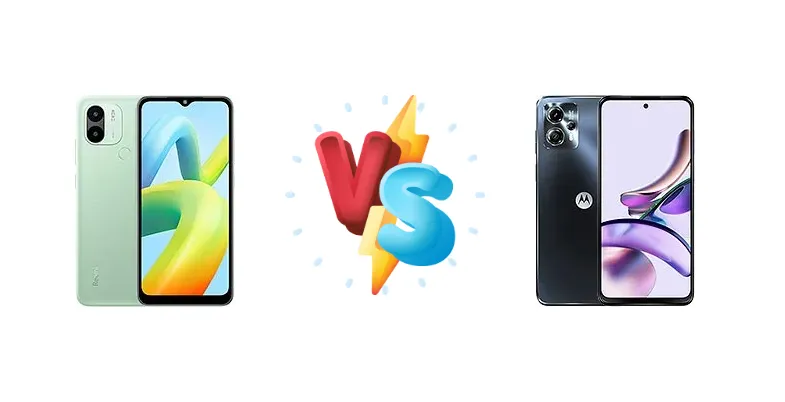
The sub-$150 smartphone market is fiercely competitive. The Xiaomi Redmi A1+ and Motorola Moto G13 represent two compelling options, but cater to slightly different priorities. The A1+ focuses on affordability, while the G13 attempts to deliver a more robust experience with a more powerful chipset and faster charging. This comparison dissects the key differences to help you choose the right device.
🏆 Quick Verdict
For most users, the Motorola Moto G13 is the superior choice. Its Helio G85 chipset provides a significantly more responsive experience for everyday tasks and light gaming, and the 20W charging support drastically reduces downtime. While the Redmi A1+ is cheaper, the performance trade-offs are substantial.
| Network |
|---|
| 2G bands | GSM 850 / 900 / 1800 / 1900 | GSM 850 / 900 / 1800 / 1900 |
| 3G bands | HSDPA 850 / 900 / 2100 | HSDPA 850 / 900 / 1900 / 2100 |
| 4G bands | 1, 3, 5, 7, 8, 20, 28, 38, 40, 41 | 1, 2, 3, 5, 7, 8, 20, 38, 40, 41 |
| Speed | HSPA, LTE | HSPA, LTE |
| Technology | GSM / HSPA / LTE | GSM / HSPA / LTE |
| Launch |
|---|
| Announced | 2022, September 23 | 2023, January 24 |
| Status | Available. Released 2022, September 23 | Available. Released 2023, January 24 |
| Body |
|---|
| Build | - | Glass front, plastic frame, plastic back |
| Dimensions | 164.9 x 76.8 x 9.1 mm (6.49 x 3.02 x 0.36 in) | 162.7 x 74.7 x 8.2 mm (6.41 x 2.94 x 0.32 in) |
| SIM | Nano-SIM + Nano-SIM | · Nano-SIM· Nano-SIM + Nano-SIM |
| Weight | 192 g (6.77 oz) | 183.5 g (6.49 oz) |
| | - | Water-resistant design |
| Display |
|---|
| Protection | - | Panda glass |
| Resolution | 720 x 1600 pixels, 20:9 ratio (~269 ppi density) | 720 x 1600 pixels, 20:9 ratio (~270 ppi density) |
| Size | 6.52 inches, 102.6 cm2 (~81.0% screen-to-body ratio) | 6.5 inches, 102.0 cm2 (~83.9% screen-to-body ratio) |
| Type | IPS LCD, 400 nits (typ) | IPS LCD, 90Hz, 400 nits (peak) |
| Platform |
|---|
| CPU | Quad-core 2.0 GHz Cortex-A53 | Octa-core (2x2.0 GHz Cortex-A75 & 6x1.8 GHz Cortex-A55) |
| Chipset | Mediatek MT6761 Helio A22 (12 nm) | Mediatek MT6769Z Helio G85 (12 nm) |
| GPU | PowerVR GE8320 | Mali-G52 MC2 |
| OS | Android 12 (Go edition), MIUI 12 | Android 13 |
| Memory |
|---|
| Card slot | microSDXC (dedicated slot) | microSDXC (dedicated slot) |
| Internal | 32GB 2GB RAM, 32GB 3GB RAM | 64GB 4GB RAM, 128GB 4GB RAM |
| Main Camera |
|---|
| Features | Dual-LED flash, HDR | LED flash, HDR, panorama |
| Single | 8 MP, f/2.0, (wide)
Auxiliary lens | - |
| Triple | - | 50 MP, f/1.8, (wide), 0.64µm, PDAF
2 MP (macro)
Auxiliary lens |
| Video | 1080p@30fps | 1080p@30fps |
| Selfie camera |
|---|
| Single | 5 MP, f/2.2 | 8 MP, f/2.0, (wide), 1/4.0", 1.12µm |
| Video | 1080p@30fps | 1080p@30fps |
| Sound |
|---|
| 3.5mm jack | - | Yes |
| 35mm jack | Yes | Yes |
| Loudspeaker | Yes | Yes, with stereo speakers |
| Comms |
|---|
| Bluetooth | 5.0, A2DP, LE | 5.1, A2DP, LE |
| NFC | No | Yes (market/region dependent) |
| Positioning | GPS, GLONASS, GALILEO, BDS | GPS, GLONASS, GALILEO |
| Radio | FM radio | Unspecified |
| USB | microUSB 2.0 | USB Type-C 2.0 |
| WLAN | Wi-Fi 802.11 a/b/g/n | Wi-Fi 802.11 a/b/g/n/ac, dual-band |
| Features |
|---|
| Sensors | Fingerprint (rear-mounted), accelerometer | Fingerprint (side-mounted), accelerometer, gyro, proximity |
| Battery |
|---|
| Charging | 10W wired | 20W or 10W wired |
| Type | Li-Po 5000 mAh | Li-Po 5000 mAh |
| Misc |
|---|
| Colors | Light Green, Light Blue, Black | Matte Charcoal, Blue Lavender, Rose Gold |
| Models | 220733SFG | - |
| Price | About 80 EUR | About 160 EUR |
| SAR | 1.00 W/kg (head) 1.10 W/kg (body) | - |
| SAR EU | 0.91 W/kg (head) 1.00 W/kg (body) | - |
Xiaomi Redmi A1+
- Lowest possible price point
- Acceptable for basic communication
- Potentially longer battery life due to less powerful chipset (speculative)
- Significantly slower performance
- Slow 10W charging
- Struggles with multitasking and demanding apps
Motorola Moto G13
- Faster and more responsive performance
- 20W fast charging
- Better suited for gaming and multitasking
- Slightly higher price
- Battery life may be marginally shorter than A1+ (speculative)
- Still a budget device with inherent limitations
Display Comparison
Neither device boasts a standout display. Both utilize 12nm chipsets, suggesting similar power constraints impacting display capabilities. While specific display specs (resolution, brightness) are not provided, the focus here is on performance. The lack of high refresh rates on either device is typical for this price bracket. Bezels are likely to be substantial on both, prioritizing cost reduction over premium aesthetics.
Camera Comparison
Without detailed camera specifications, a direct comparison is limited. However, it’s safe to assume both phones feature basic camera setups geared towards casual photography. The market segment suggests both will likely rely heavily on software processing to enhance image quality. The presence of a 2MP macro camera on either device is largely a marketing tactic, offering minimal practical benefit due to the small sensor size and limited detail capture. The G85’s ISP (Image Signal Processor) is likely more advanced, potentially leading to better image processing and low-light performance, but this is speculative without further data.
Performance
The core difference lies in the chipsets. The Motorola Moto G13’s MediaTek Helio G85 is a substantial upgrade over the Redmi A1+’s Helio A22. The G85’s octa-core configuration (2x2.0 GHz Cortex-A75 & 6x1.8 GHz Cortex-A55) provides significantly more processing power than the A1+’s quad-core 2.0 GHz Cortex-A53. The A75 cores in the G85 are architecturally superior, offering better single-core performance crucial for app responsiveness. This translates to faster app launches, smoother multitasking, and a more enjoyable overall user experience. The G85 also features a more capable GPU, making it suitable for light gaming, something the A22 would struggle with.
Battery Life
While battery capacity isn’t specified, the key differentiator is charging speed. The Moto G13 supports 20W wired charging, a significant advantage over the Redmi A1+’s 10W charging. This means the G13 can replenish its battery much faster, reducing downtime. Even if the G13 has a slightly smaller battery capacity, the faster charging can offset this, providing a more convenient user experience. The A1+'s 10W charging will require considerably longer to reach a full charge.
Buying Guide
Buy the Xiaomi Redmi A1+ if your absolute priority is minimizing upfront cost and you primarily need a phone for basic communication – calls, texts, and light social media. Buy the Motorola Moto G13 if you value a smoother user experience, faster app loading times, and the ability to enjoy occasional gaming or more demanding applications without significant lag. The G13 is the better all-rounder.
Frequently Asked Questions
❓ Will the Moto G13 struggle with popular apps like Facebook or WhatsApp?
No, the Helio G85 chipset in the Moto G13 is more than capable of handling everyday apps like Facebook, WhatsApp, and web browsing without significant lag. The Redmi A1+'s Helio A22 might exhibit noticeable slowdowns with these apps, especially when multitasking.
❓ Is the 20W charging on the Moto G13 a significant improvement over the Redmi A1+'s 10W charging?
Yes, it's a substantial improvement. 20W charging will significantly reduce the time it takes to fully charge the Moto G13, potentially cutting charging times in half compared to the Redmi A1+. This is particularly beneficial for users who rely heavily on their phones throughout the day.
❓ Can the Moto G13 handle basic mobile games like PUBG Mobile or Call of Duty Mobile?
The Moto G13 can handle basic mobile games, but you'll likely need to lower the graphics settings to achieve a playable frame rate. The Helio G85 is a gaming-focused chipset, but it's still an entry-level processor. The Redmi A1+ would struggle significantly with these titles.
❓ Does either phone support VoLTE or VoWiFi for improved call quality?
Support for VoLTE and VoWiFi depends on the carrier and region. Both phones are likely to support these features on compatible networks, but it's crucial to check with your mobile provider to confirm compatibility before purchasing.