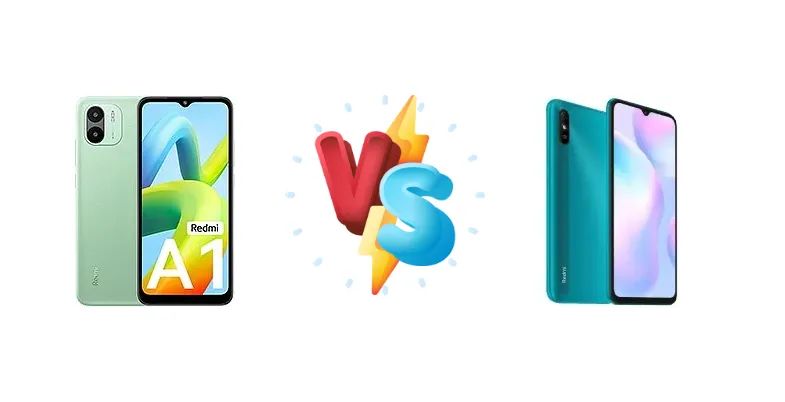
Looking for an affordable smartphone? The Xiaomi Redmi A1 and Redmi 9A are both contenders in the budget segment. But which one offers the best value for your money? This comprehensive comparison will help you decide.
🏆 Quick Verdict
The Redmi 9A edges out the A1 thanks to its octa-core processor and slightly better overall performance. While both offer basic functionality, the 9A provides a smoother experience for everyday tasks and light gaming. Both are excellent budget choices, but the 9A is the stronger performer.
| Network |
|---|
| 2G bands | GSM 850 / 900 / 1800 / 1900 | GSM 850 / 900 / 1800 / 1900 |
| 3G bands | HSDPA 850 / 900 / 2100 | HSDPA 850 / 900 / 1700(AWS) / 1900 / 2100 - International |
| 4G bands | 1, 3, 5, 7, 8, 20, 28, 38, 40, 41 - International | 1, 2, 3, 4, 5, 7, 8, 20, 28, 38, 40, 41 - International |
| Speed | HSPA, LTE | HSPA, LTE |
| Technology | GSM / HSPA / LTE | GSM / HSPA / LTE |
| | 1, 3, 5, 8, 40, 41 - India | 1, 3, 5, 8, 40, 41 - India |
| Launch |
|---|
| Announced | 2022, September 06 | 2020, June 30. Released 2020, July 07 |
| Status | Available. Released 2022, September 09 | Discontinued |
| Body |
|---|
| Dimensions | 164.9 x 76.8 x 9.1 mm (6.49 x 3.02 x 0.36 in) | 164.9 x 77.1 x 9 mm (6.49 x 3.04 x 0.35 in) |
| SIM | Nano-SIM + Nano-SIM | Nano-SIM + Nano-SIM |
| Weight | 192 g (6.77 oz) | 196 g (6.91 oz) |
| Display |
|---|
| Resolution | 720 x 1600 pixels, 20:9 ratio (~269 ppi density) | 720 x 1600 pixels, 20:9 ratio (~269 ppi density) |
| Size | 6.52 inches, 102.6 cm2 (~81.0% screen-to-body ratio) | 6.53 inches, 102.9 cm2 (~81.0% screen-to-body ratio) |
| Type | IPS LCD, 400 nits (typ) | IPS LCD, 400 nits (typ) |
| Platform |
|---|
| CPU | Quad-core 2.0 GHz Cortex-A53 | Octa-core (4x2.0 GHz Cortex-A53 & 4x1.5 GHz Cortex-A53) |
| Chipset | Mediatek MT6761 Helio A22 (12 nm) | Mediatek MT6762G Helio G25 (12 nm) |
| GPU | PowerVR GE8320 | PowerVR GE8320 |
| OS | Android 12 (Go edition), MIUI 12 | Android 10, upgradable to Android 11, MIUI 12 |
| Memory |
|---|
| Card slot | microSDXC (dedicated slot) | microSDXC (dedicated slot) |
| Internal | 32GB 2GB RAM, 32GB 3GB RAM | 32GB 2GB RAM, 32GB 3GB RAM, 64GB 4GB RAM, 128GB 4GB RAM, 128GB 6GB RAM |
| | eMMC 5.1 | eMMC 5.1 |
| Main Camera |
|---|
| Dual | 8 MP, f/2.0, (wide)
0.08 MP (depth) | - |
| Features | Dual-LED flash, HDR | LED flash, HDR |
| Single | 8 MP, f/2.0, (wide)
Auxiliary lens | 13 MP, f/2.2, 28mm (wide), 1.0µm, PDAF |
| Video | 1080p@30fps | 1080p@30/60fps |
| Selfie camera |
|---|
| Features | - | HDR |
| Single | 5 MP, f/2.2 | 5 MP, f/2.2, (wide), 1.12µm |
| Video | 1080p@30fps | 1080p@30fps |
| Sound |
|---|
| 3.5mm jack | Yes | Yes |
| 35mm jack | Yes | Yes |
| Loudspeaker | Yes | Yes |
| Comms |
|---|
| Bluetooth | 5.0, A2DP, LE | 5.0, A2DP, LE |
| NFC | No | No |
| Positioning | GPS, GLONASS, GALILEO, BDS | GPS, GLONASS, BDS |
| Radio | FM radio | FM radio |
| USB | microUSB 2.0 | microUSB 2.0, OTG |
| WLAN | Wi-Fi 802.11 a/b/g/n | Wi-Fi 802.11 b/g/n, Wi-Fi Direct |
| Features |
|---|
| Sensors | Accelerometer | Accelerometer, proximity |
| Battery |
|---|
| Charging | 10W wired | 10W wired |
| Type | Li-Po 5000 mAh | Li-Po 5000 mAh |
| Misc |
|---|
| Colors | Light Green, Light Blue, Black | Carbon Gray (Midnight Black), Sky Blue (Sea Blue), Ocean Green (Nature Green) |
| Models | 220733SI, 220733SG, 220733SL, 220743FI, 220733SH | M2006C3LG, M2006C3LI, M2006C3LC, M2004C3L |
| Price | About 170 EUR | € 64.30 / $ 56.50 / £ 95.56 |
| SAR | 1.10 W/kg (head) 1.03 W/kg (body) | 0.90 W/kg (head) 0.65 W/kg (body) |
| SAR EU | 0.85 W/kg (head) 1.00 W/kg (body) | 0.40 W/kg (head) 1.19 W/kg (body) |
Xiaomi Redmi A1
- Extremely affordable
- Large battery
- Simple and easy to use
- Limited performance
- Basic camera
- Slow charging
Xiaomi Redmi 9A
- Better performance than A1
- Slightly better camera
- Large battery
- Good value for money
- Still limited performance
- Slow charging
- Basic display
Display Comparison
Both phones feature a 6.53-inch IPS LCD display with a resolution of 1650 x 720 (HD+). While the quality is similar, the Redmi 9A's slightly brighter panel might offer a marginally better viewing experience in direct sunlight. Color accuracy is typical for budget phones – don't expect vibrant, professional-grade colors.
Camera Comparison
The Redmi 9A generally has a slightly better camera setup. It typically features a 13MP main camera with depth sensor, while the Redmi A1 often has a 8MP main camera. Image quality is decent in good lighting conditions, but expect noise and limited detail in low light. Both phones offer basic camera features like HDR and portrait mode.
Performance
This is where the Redmi 9A shines. Its Mediatek Helio G25 octa-core processor provides a noticeable performance boost over the Redmi A1's quad-core Helio A22. Expect smoother multitasking, faster app loading times, and slightly better gaming performance on the 9A. Both phones have limited RAM (typically 2GB or 3GB), so don't expect to run demanding applications.
Battery Life
Both phones offer a large 5000mAh battery, providing excellent battery life. Expect a full day of moderate use from either device. Charging is limited to 10W wired charging on both, so charging times will be relatively slow.
Buying Guide
The Redmi A1 is ideal for users who prioritize simplicity and affordability above all else. It's a great first smartphone or a backup device. The Redmi 9A is better suited for those who want a bit more performance and a slightly more feature-rich experience without breaking the bank.
Frequently Asked Questions
❓ Which phone is better for gaming?
The Redmi 9A is significantly better for gaming due to its octa-core processor. While neither phone is a gaming powerhouse, the 9A handles basic games more smoothly.
❓ Can I expand the storage on either phone?
Yes, both phones support microSD card expansion, allowing you to add more storage for photos, videos, and apps.