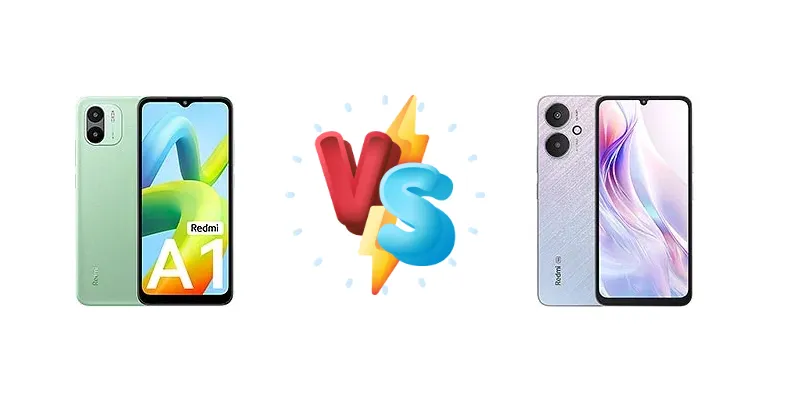
Xiaomi's Redmi series consistently delivers value, but navigating the options can be tricky. We pit the entry-level Redmi A1 against the newer, 5G-enabled Redmi 13C 5G to determine which offers the best experience for budget-conscious consumers. This comparison focuses on the core differences in performance, connectivity, and everyday usability.
🏆 Quick Verdict
For most users, the Redmi 13C 5G is the clear winner. Its Dimensity 6100+ chipset provides a significantly faster and more responsive experience than the A1's Helio A22, and the addition of 5G future-proofs the device. While the A1 remains a viable option for extremely basic use, the 13C 5G's performance gains justify the price difference.
| Network |
|---|
| 2G bands | GSM 850 / 900 / 1800 / 1900 | GSM 850 / 900 / 1800 / 1900 |
| 3G bands | HSDPA 850 / 900 / 2100 | HSDPA 800 / 850 / 900 / 1700(AWS) / 1900 / 2100 - International |
| 4G bands | 1, 3, 5, 7, 8, 20, 28, 38, 40, 41 - International | 1, 2, 3, 4, 5, 7, 8, 12, 13, 17, 18, 19, 20, 26, 28, 32, 38, 40, 41, 66 - International |
| 5G bands | - | 1, 3, 5, 7, 8, 20, 28, 38, 40, 41, 66, 77, 78 SA/NSA - International |
| Speed | HSPA, LTE | HSPA, LTE, 5G |
| Technology | GSM / HSPA / LTE | GSM / HSPA / LTE / 5G |
| | 1, 3, 5, 8, 40, 41 - India | - |
| Launch |
|---|
| Announced | 2022, September 06 | 2023, December 06 |
| Status | Available. Released 2022, September 09 | Available. Released 2023, December 16 |
| Body |
|---|
| Build | - | Glass front (Gorilla Glass 3), plastic frame, plastic back |
| Dimensions | 164.9 x 76.8 x 9.1 mm (6.49 x 3.02 x 0.36 in) | 168.1 x 77.9 x 8.2 mm (6.62 x 3.07 x 0.32 in) |
| SIM | Nano-SIM + Nano-SIM | Nano-SIM + Nano-SIM |
| Weight | 192 g (6.77 oz) | 192 g or 195 g (6.77 oz) |
| Display |
|---|
| Protection | - | Corning Gorilla Glass 3 |
| Resolution | 720 x 1600 pixels, 20:9 ratio (~269 ppi density) | 720 x 1600 pixels, 20:9 ratio (~260 ppi density) |
| Size | 6.52 inches, 102.6 cm2 (~81.0% screen-to-body ratio) | 6.74 inches, 109.7 cm2 (~83.8% screen-to-body ratio) |
| Type | IPS LCD, 400 nits (typ) | IPS LCD, 90Hz, 450 nits (typ), 600 nits (HBM) |
| Platform |
|---|
| CPU | Quad-core 2.0 GHz Cortex-A53 | Octa-core (2x2.2 GHz Cortex-A76 & 6x2.0 GHz Cortex-A55) |
| Chipset | Mediatek MT6761 Helio A22 (12 nm) | Mediatek Dimensity 6100+ (6 nm) |
| GPU | PowerVR GE8320 | Mali-G57 MC2 |
| OS | Android 12 (Go edition), MIUI 12 | Android 13, MIUI 14 |
| Memory |
|---|
| Card slot | microSDXC (dedicated slot) | microSDXC (dedicated slot) |
| Internal | 32GB 2GB RAM, 32GB 3GB RAM | 64GB 4GB RAM, 128GB 4GB RAM, 128GB 6GB RAM, 256GB 8GB RAM |
| | eMMC 5.1 | - |
| Main Camera |
|---|
| Dual | 8 MP, f/2.0, (wide)
0.08 MP (depth) | - |
| Features | Dual-LED flash, HDR | LED flash, HDR |
| Single | 8 MP, f/2.0, (wide)
Auxiliary lens | 50 MP, f/1.8, 28mm (wide), 1/2.76", 1.12µm, PDAF
Auxiliary lens |
| Video | 1080p@30fps | 1080p@30fps |
| Selfie camera |
|---|
| Features | - | HDR |
| Single | 5 MP, f/2.2 | 5 MP, f/2.2, (wide) |
| Video | 1080p@30fps | 1080p@30fps |
| Sound |
|---|
| 3.5mm jack | Yes | - |
| 35mm jack | Yes | Yes |
| Loudspeaker | Yes | Yes |
| Comms |
|---|
| Bluetooth | 5.0, A2DP, LE | 5.3, A2DP, LE |
| NFC | No | Yes (market/region dependent) |
| Positioning | GPS, GLONASS, GALILEO, BDS | GPS, GLONASS, GALILEO, BDS |
| Radio | FM radio | FM radio |
| USB | microUSB 2.0 | USB Type-C 2.0, OTG |
| WLAN | Wi-Fi 802.11 a/b/g/n | Wi-Fi 802.11 a/b/g/n/ac, dual-band |
| Features |
|---|
| Sensors | Accelerometer | Fingerprint (side-mounted), accelerometer, compass |
| Battery |
|---|
| Charging | 10W wired | 18W wired, PD |
| Type | Li-Po 5000 mAh | 5000 mAh |
| Misc |
|---|
| Colors | Light Green, Light Blue, Black | Starry Black, Twilight Blue, Starry Silver, Starlight Black, Startrail Green, Startrail Silver |
| Models | 220733SI, 220733SG, 220733SL, 220743FI, 220733SH | 23124RN87G, 23124RN87I, 23124RN87C |
| Price | About 170 EUR | $ 198.99 / £ 119.00 / € 116.99 / ₹ 10,895 |
| SAR | 1.10 W/kg (head) 1.03 W/kg (body) | 1.09 W/kg (head) 1.09 W/kg (body) |
| SAR EU | 0.85 W/kg (head) 1.00 W/kg (body) | 0.98 W/kg (head) 0.98 W/kg (body) |
Xiaomi Redmi A1
- Most affordable option
- Simple and easy to use
- Potentially longer battery life (depending on capacity)
- Very slow performance
- Limited multitasking capabilities
- No 5G connectivity
Xiaomi Redmi 13C 5G
- Significantly faster performance
- 5G connectivity for faster data speeds
- Faster 18W charging with PD
- Higher price point
- May have slightly shorter battery life (depending on capacity)
- Still a budget device with limitations
Display Comparison
Both devices likely feature LCD panels, typical for this price segment, but details like resolution and peak brightness are not provided. The key difference lies in the processing power driving them. While both will suffice for basic viewing, the 13C 5G’s more powerful chipset will contribute to smoother animations and faster app loading, improving the perceived visual experience. Bezels are expected to be similar, given the budget nature of both phones.
Camera Comparison
Without detailed camera specifications, a direct comparison is difficult. However, it's safe to assume both phones feature basic camera setups geared towards casual photography. The Redmi 13C 5G likely benefits from the improved image signal processor (ISP) within the Dimensity 6100+ chipset, potentially leading to better image quality and faster processing. The A1’s Helio A22 ISP is more limited. Expect both to struggle in low-light conditions, and any included 'macro' lenses are likely to be of minimal practical use.
Performance
The performance gap is substantial. The Redmi A1’s MediaTek Helio A22, a quad-core processor built on a 12nm process, is designed for minimal tasks. The Redmi 13C 5G, however, boasts the MediaTek Dimensity 6100+, an octa-core chip fabricated on a more efficient 6nm node. This translates to significantly faster CPU speeds (2.2 GHz Cortex-A76 vs 2.0 GHz Cortex-A53) and a more capable GPU. The 6nm process also implies better thermal efficiency, reducing the likelihood of throttling during sustained use. Users will notice a dramatic difference in app launch times, multitasking, and overall responsiveness with the 13C 5G.
Battery Life
Battery capacity isn't specified for either device, but both likely fall in the 5000mAh range, common for budget smartphones. The Redmi 13C 5G’s advantage lies in its 18W wired charging with Power Delivery (PD) support, offering significantly faster charging speeds compared to the A1’s 10W charging. This means the 13C 5G can replenish its battery much quicker, reducing downtime. While a larger battery capacity on the A1 *could* offset this, the faster charging of the 13C 5G is a more impactful real-world benefit.
Buying Guide
Buy the Xiaomi Redmi A1 if you need a phone for absolutely essential tasks – calls, texts, and very light app usage – and prioritize maximum affordability. It's suitable for first-time smartphone users or as a simple backup device. Buy the Xiaomi Redmi 13C 5G if you want a smoother, more capable experience with the benefit of 5G connectivity, allowing for faster downloads, streaming, and a more responsive overall user interface. It's ideal for users who want a phone that can handle more than just the basics.
Frequently Asked Questions
❓ Will the Redmi 13C 5G's Dimensity 6100+ handle demanding games like PUBG Mobile?
While the Dimensity 6100+ is a significant upgrade, PUBG Mobile will likely require reduced graphics settings for a smooth experience. It's capable of playing, but don't expect maximum fidelity. The A1's Helio A22 would struggle significantly with this title.
❓ Is the 5G connectivity on the Redmi 13C 5G actually useful if 5G coverage is limited in my area?
Even with limited 5G coverage, the Redmi 13C 5G will fall back to 4G LTE. However, the 5G modem provides future-proofing and potentially faster speeds when 5G is available. The A1 is limited to 4G, so the 13C 5G offers more flexibility.
❓ Does the Redmi A1 receive regular software updates and security patches?
Xiaomi's update policy for the A1 is limited. Expect fewer updates compared to the Redmi 13C 5G, which benefits from a more recent chipset and potentially longer software support. Security patches may also be less frequent on the A1.
❓ What type of charging cable and adapter does each phone include in the box?
Both phones include a USB-C charging cable. The Redmi A1 includes a 10W charger, while the Redmi 13C 5G includes an 18W charger. While the 13C 5G supports Power Delivery, the included charger may not fully utilize this feature.