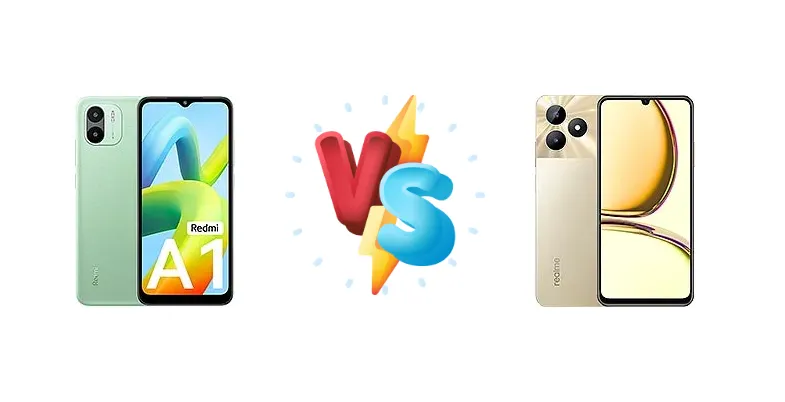
The sub-$150 smartphone market is fiercely competitive, and the Xiaomi Redmi A1 and Realme C53 (India) are key contenders. While both aim to deliver affordability, they take distinctly different approaches to achieving it. The Redmi A1 relies on a tried-and-true, if aging, MediaTek chipset, while the C53 opts for the newer Unisoc Tiger T612. This comparison dissects these choices, revealing which phone offers the best balance of performance, features, and value.
🏆 Quick Verdict
For most users, the Realme C53 (India) is the superior choice. Its Unisoc Tiger T612 chipset provides a significant performance uplift over the Redmi A1’s Helio A22, offering a smoother experience for everyday tasks and even some light gaming. The faster 18W charging is also a considerable advantage, mitigating the impact of a potentially similar battery capacity.
| Network |
|---|
| 2G bands | GSM 850 / 900 / 1800 / 1900 | GSM 850 / 900 / 1800 / 1900 |
| 3G bands | HSDPA 850 / 900 / 2100 | HSDPA 850 / 900 / 2100 |
| 4G bands | 1, 3, 5, 7, 8, 20, 28, 38, 40, 41 - International | 1, 3, 5, 8, 38, 40, 41 |
| Speed | HSPA, LTE | HSPA, LTE |
| Technology | GSM / HSPA / LTE | GSM / HSPA / LTE |
| | 1, 3, 5, 8, 40, 41 - India | - |
| Launch |
|---|
| Announced | 2022, September 06 | 2023, July 19 |
| Status | Available. Released 2022, September 09 | Available. Released 2023, July 26 |
| Body |
|---|
| Build | - | Glass front, plastic frame, plastic back |
| Dimensions | 164.9 x 76.8 x 9.1 mm (6.49 x 3.02 x 0.36 in) | 167.2 x 76.7 x 8 mm (6.58 x 3.02 x 0.31 in) |
| SIM | Nano-SIM + Nano-SIM | Nano-SIM + Nano-SIM |
| Weight | 192 g (6.77 oz) | 186 g (6.56 oz) |
| Display |
|---|
| Resolution | 720 x 1600 pixels, 20:9 ratio (~269 ppi density) | 1080 x 2400 pixels, 20:9 ratio (~390 ppi density) |
| Size | 6.52 inches, 102.6 cm2 (~81.0% screen-to-body ratio) | 6.74 inches, 109.7 cm2 (~85.5% screen-to-body ratio) |
| Type | IPS LCD, 400 nits (typ) | IPS LCD, 90Hz, 560 nits (peak) |
| Platform |
|---|
| CPU | Quad-core 2.0 GHz Cortex-A53 | Octa-core (2x1.8 GHz Cortex-A75 & 6x1.8 GHz Cortex-A55) |
| Chipset | Mediatek MT6761 Helio A22 (12 nm) | Unisoc Tiger T612 (12 nm) |
| GPU | PowerVR GE8320 | Mali-G57 |
| OS | Android 12 (Go edition), MIUI 12 | Android 13, Realme UI |
| Memory |
|---|
| Card slot | microSDXC (dedicated slot) | microSDXC (dedicated slot) |
| Internal | 32GB 2GB RAM, 32GB 3GB RAM | 64GB 6GB RAM, 128GB 4GB RAM, 128GB 6GB RAM |
| | eMMC 5.1 | - |
| Main Camera |
|---|
| Dual | 8 MP, f/2.0, (wide)
0.08 MP (depth) | 108 MP, (wide), PDAF
Auxiliary lens |
| Features | Dual-LED flash, HDR | LED flash, HDR, panorama |
| Single | 8 MP, f/2.0, (wide)
Auxiliary lens | - |
| Video | 1080p@30fps | 1080p@30fps |
| Selfie camera |
|---|
| Features | - | HDR |
| Single | 5 MP, f/2.2 | 8 MP, (wide) |
| Video | 1080p@30fps | 720p@30fps |
| Sound |
|---|
| 3.5mm jack | Yes | - |
| 35mm jack | Yes | Yes |
| Loudspeaker | Yes | Yes |
| Comms |
|---|
| Bluetooth | 5.0, A2DP, LE | 5.0, A2DP, LE |
| NFC | No | No |
| Positioning | GPS, GLONASS, GALILEO, BDS | GPS, GLONASS, GALILEO |
| Radio | FM radio | Unspecified |
| USB | microUSB 2.0 | USB Type-C 2.0 |
| WLAN | Wi-Fi 802.11 a/b/g/n | Wi-Fi 802.11 a/b/g/n/ac, dual-band |
| Features |
|---|
| Sensors | Accelerometer | Fingerprint (side-mounted), accelerometer, gyro, proximity, compass |
| Battery |
|---|
| Charging | 10W wired | 18W wired |
| Type | Li-Po 5000 mAh | 5000 mAh |
| Misc |
|---|
| Colors | Light Green, Light Blue, Black | Gold, Black |
| Models | 220733SI, 220733SG, 220733SL, 220743FI, 220733SH | RMX3762 |
| Price | About 170 EUR | About 110 EUR |
| SAR | 1.10 W/kg (head) 1.03 W/kg (body) | - |
| SAR EU | 0.85 W/kg (head) 1.00 W/kg (body) | - |
Xiaomi Redmi A1
- Established brand reputation
- Potentially longer software support (Xiaomi's track record)
- Simple and straightforward user experience
- Significantly weaker processor performance
- Slower 10W charging
- Likely to struggle with multitasking
Realme C53 (India)
- More powerful Unisoc Tiger T612 chipset
- Faster 18W charging
- Improved multitasking capabilities
- Less established brand (Unisoc)
- Potential for less refined software experience
- Long-term software support is uncertain
Display Comparison
Neither device boasts a standout display. Both are likely utilizing LCD panels, typical for this price bracket. However, detailed specifications regarding resolution, brightness, and color gamut are absent. The Realme C53’s potential for a slightly higher peak brightness, based on Unisoc’s chipset capabilities, could offer marginally better outdoor visibility. Bezels are expected to be substantial on both, prioritizing cost reduction over immersive viewing.
Camera Comparison
Camera performance is likely to be similar, leaning towards basic functionality. Both phones likely feature a primary camera and potentially a depth sensor. Detailed sensor sizes and apertures are unavailable, but given the price point, expectations should be tempered. The Realme C53 might benefit from slightly better image processing capabilities due to the more powerful chipset, potentially leading to improved dynamic range and noise reduction. The inclusion of a 2MP macro camera on either device is largely a marketing tactic, offering limited practical benefit due to the low resolution and lack of optical image stabilization.
Performance
The core difference lies in the chipsets. The Realme C53’s Unisoc Tiger T612, with its octa-core configuration (2x1.8 GHz Cortex-A75 & 6x1.8 GHz Cortex-A55), represents a substantial upgrade over the Redmi A1’s MediaTek Helio A22 (Quad-core 2.0 GHz Cortex-A53). The A75 cores in the T612 provide a noticeable boost in single-core performance, crucial for app launch speeds and general responsiveness. The six A55 cores enhance multi-tasking capabilities. While both are built on a 12nm process, the architectural advantages of the T612 translate to a smoother user experience, particularly when running multiple apps or navigating demanding interfaces. The Helio A22 is adequate for basic tasks, but will struggle with anything beyond simple operations.
Battery Life
Battery capacity details are missing for both devices, but they are likely in the 5000mAh range, standard for this segment. The Realme C53’s 18W wired charging is a significant advantage over the Redmi A1’s 10W charging. This translates to considerably faster charging times, reducing downtime and improving overall usability. While a larger battery capacity on the Redmi A1 could offset the slower charging, the convenience of quicker top-ups offered by the C53 is a compelling benefit.
Buying Guide
Buy the Xiaomi Redmi A1 if your primary need is an extremely basic smartphone for essential communication – calls, texts, and light app usage – and you prioritize a well-established brand with a mature software ecosystem. Buy the Realme C53 (India) if you want a more responsive experience, better multitasking capabilities, and faster charging, even if it means opting for a less-known chipset manufacturer. The C53 is the better option for users who want a phone that can handle more than just the bare minimum.
Frequently Asked Questions
❓ Will the Unisoc Tiger T612 in the Realme C53 handle popular apps like WhatsApp, Facebook, and YouTube smoothly?
Yes, the Unisoc Tiger T612 is significantly more capable than the Helio A22. It will handle these apps with ease, providing a smoother and more responsive experience, even with multiple apps open simultaneously. The octa-core architecture and more modern CPU cores contribute to this improved performance.
❓ How long will it take to fully charge the Realme C53 with the 18W charger compared to the Redmi A1?
While exact charge times depend on battery capacity (which is currently unknown for both), the Realme C53 will charge considerably faster. Expect a full charge in approximately 2-2.5 hours with the 18W charger, whereas the Redmi A1 with its 10W charger could take 3-4 hours or longer.
❓ Is the Realme C53 a good option for playing mobile games?
The Realme C53 is better suited for light gaming than the Redmi A1. While it won't handle graphically demanding titles at high settings, it can comfortably run less intensive games like PUBG Mobile (at lower settings) and casual games without significant lag. The Helio A22 in the Redmi A1 will struggle with even moderately demanding games.
❓ Does the Realme C53 support VoWiFi (WiFi Calling)?
This information is not readily available. However, given the increasing prevalence of VoWiFi support in India, it's likely the Realme C53 does support it, but it's best to confirm with Realme's official specifications or your carrier.