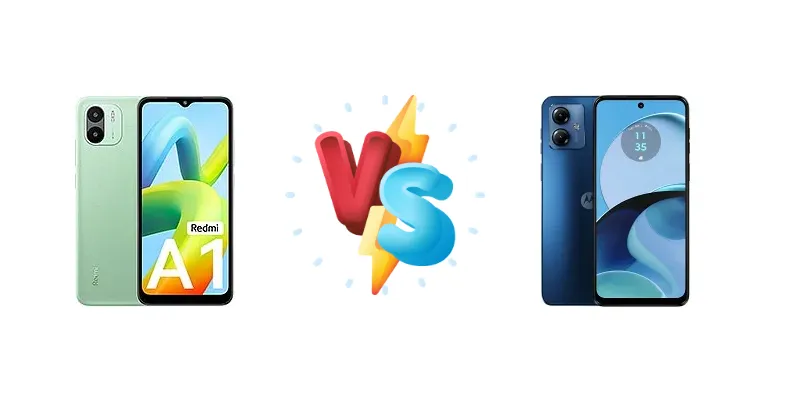
The sub-$150 smartphone market is fiercely competitive. The Xiaomi Redmi A1 and Motorola Moto G14 both aim to deliver essential smartphone functionality at an accessible price point. However, significant differences in their core hardware, particularly the chipset, dictate vastly different user experiences. This comparison dissects these differences to determine which device offers the best value.
🏆 Quick Verdict
For the average user, the Motorola Moto G14 is the superior choice. Its Unisoc Tiger T616 chipset, featuring a combination of Cortex-A75 and A55 cores, provides a noticeably smoother and more responsive experience than the Redmi A1’s aging Helio A22. While the A1 is cheaper, the G14’s performance uplift justifies the slight price premium.
| Network |
|---|
| 2G bands | GSM 850 / 900 / 1800 / 1900 | GSM 850 / 900 / 1800 / 1900 |
| 3G bands | HSDPA 850 / 900 / 2100 | HSDPA 850 / 900 / 1900 / 2100 |
| 4G bands | 1, 3, 5, 7, 8, 20, 28, 38, 40, 41 - International | 1, 2, 3, 5, 7, 8, 20, 28, 38, 40, 41 |
| Speed | HSPA, LTE | HSPA, LTE |
| Technology | GSM / HSPA / LTE | GSM / HSPA / LTE |
| | 1, 3, 5, 8, 40, 41 - India | - |
| Launch |
|---|
| Announced | 2022, September 06 | 2023, August 01 |
| Status | Available. Released 2022, September 09 | Available. Released 2023, August 08 |
| Body |
|---|
| Build | - | Glass front (Panda glass), plastic frame, plastic back |
| Dimensions | 164.9 x 76.8 x 9.1 mm (6.49 x 3.02 x 0.36 in) | 161.5 x 73.8 x 8 mm (6.36 x 2.91 x 0.31 in) |
| SIM | Nano-SIM + Nano-SIM | Nano-SIM + Nano-SIM |
| Weight | 192 g (6.77 oz) | 177 g (6.24 oz) |
| Display |
|---|
| Protection | - | Panda glass |
| Resolution | 720 x 1600 pixels, 20:9 ratio (~269 ppi density) | 1080 x 2400 pixels, 20:9 ratio (~405 ppi density) |
| Size | 6.52 inches, 102.6 cm2 (~81.0% screen-to-body ratio) | 6.5 inches, 102.0 cm2 (~85.6% screen-to-body ratio) |
| Type | IPS LCD, 400 nits (typ) | IPS LCD |
| Platform |
|---|
| CPU | Quad-core 2.0 GHz Cortex-A53 | Octa-core (2x2.0 GHz Cortex-A75 & 6x1.8 GHz Cortex-A55) |
| Chipset | Mediatek MT6761 Helio A22 (12 nm) | Unisoc Tiger T616 (12 nm) |
| GPU | PowerVR GE8320 | Mali-G57 MP1 |
| OS | Android 12 (Go edition), MIUI 12 | Android 13, planned upgrade to Android 14 |
| Memory |
|---|
| Card slot | microSDXC (dedicated slot) | microSDXC (dedicated slot) |
| Internal | 32GB 2GB RAM, 32GB 3GB RAM | 128GB 4GB RAM, 256GB 8GB RAM |
| | eMMC 5.1 | - |
| Main Camera |
|---|
| Dual | 8 MP, f/2.0, (wide)
0.08 MP (depth) | 50 MP, f/1.8, (wide), 0.64µm, PDAF
2 MP (macro) |
| Features | Dual-LED flash, HDR | LED flash, HDR, panorama |
| Single | 8 MP, f/2.0, (wide)
Auxiliary lens | - |
| Video | 1080p@30fps | 1080p@30fps |
| Selfie camera |
|---|
| Single | 5 MP, f/2.2 | 8 MP, f/2.0, (wide), 1/4.0", 1.12µm |
| Video | 1080p@30fps | 1080p@30fps |
| Sound |
|---|
| 3.5mm jack | Yes | - |
| 35mm jack | Yes | Yes |
| Loudspeaker | Yes | Yes, with stereo speakers |
| Comms |
|---|
| Bluetooth | 5.0, A2DP, LE | 5.0, A2DP, LE |
| NFC | No | Yes (market/region dependent) |
| Positioning | GPS, GLONASS, GALILEO, BDS | GPS, GLONASS, GALILEO |
| Radio | FM radio | FM radio |
| USB | microUSB 2.0 | USB Type-C 2.0 |
| WLAN | Wi-Fi 802.11 a/b/g/n | Wi-Fi 802.11 a/b/g/n/ac, dual-band |
| Features |
|---|
| Sensors | Accelerometer | Fingerprint (side-mounted), accelerometer, gyro, proximity, compass (market/region dependent) |
| Battery |
|---|
| Charging | 10W wired | 15W wired
20W wired (India) |
| Type | Li-Po 5000 mAh | Li-Po 5000 mAh |
| Misc |
|---|
| Colors | Light Green, Light Blue, Black | Steel Gray, Sky Blue, Butter Cream, Pale Lilac |
| Models | 220733SI, 220733SG, 220733SL, 220743FI, 220733SH | PAYF0010IN |
| Price | About 170 EUR | $ 190.00 / £ 89.99 / € 149.90 |
| SAR | 1.10 W/kg (head) 1.03 W/kg (body) | - |
| SAR EU | 0.85 W/kg (head) 1.00 W/kg (body) | - |
Xiaomi Redmi A1
- Lowest possible price point
- Simple and straightforward user experience
- Compact and lightweight design
- Significantly underpowered processor
- Slow charging speed
- Limited multitasking capabilities
Motorola Moto G14
- More powerful and efficient processor
- Faster charging speed (15W/20W)
- Smoother overall user experience
- Slightly higher price
- May still struggle with demanding games
- Display quality is likely basic
Display Comparison
Neither device boasts a standout display. Both are likely utilizing LCD panels, a common cost-saving measure in this segment. Specifics like resolution and peak brightness are not provided, but we can assume they are similar – adequate for basic viewing but lacking vibrancy. The focus here isn’t on visual fidelity, but on functionality. Bezels are likely to be substantial on both, maximizing screen real estate within a compact form factor.
Camera Comparison
Camera performance is likely to be similar in real-world usage – adequate for casual snapshots in good lighting conditions. Both devices likely feature a primary camera and potentially a depth or macro sensor (the Redmi A1’s specs are not detailed enough to confirm). Without sensor size or aperture information, it’s difficult to make a definitive statement. However, the G14’s more powerful chipset could enable slightly better image processing, resulting in marginally improved image quality. The inclusion of a 2MP macro camera on either device is largely a marketing gimmick, offering limited practical benefit.
Performance
The performance gap is the most significant differentiator. The Motorola Moto G14’s Unisoc Tiger T616, with its octa-core configuration (2x2.0 GHz Cortex-A75 & 6x1.8 GHz Cortex-A55), represents a substantial upgrade over the Redmi A1’s quad-core 2.0 GHz Cortex-A53-based MediaTek Helio A22. The A75 cores in the G14 provide a significant boost in single-core performance, crucial for app launch speeds and general responsiveness. The Helio A22, while sufficient for basic tasks, will struggle with multitasking and more demanding applications. The G14’s architecture is also more efficient, potentially leading to better sustained performance under load. The lack of LPDDR RAM specifications for either device suggests both are likely using slower RAM standards, further emphasizing the chipset’s importance.
Battery Life
Battery life will depend heavily on usage patterns. While the exact battery capacities aren’t specified, the Moto G14’s 15W (or 20W in India) wired charging offers a significant advantage over the Redmi A1’s 10W charging. This translates to faster top-ups, reducing downtime. The more efficient Unisoc T616 chipset in the G14 may also contribute to slightly better battery endurance, even with a similar capacity battery. The faster charging speed is a practical benefit for users who need to quickly replenish their battery throughout the day.
Buying Guide
Buy the Xiaomi Redmi A1 if your primary need is an extremely affordable smartphone for basic tasks like calls, texts, and light social media use, and you prioritize absolute minimum cost above all else. Buy the Motorola Moto G14 if you want a more capable device for everyday multitasking, occasional gaming, and a generally smoother user experience, even if it means spending a little more.
Frequently Asked Questions
❓ Will the Moto G14 handle popular games like PUBG Mobile or Call of Duty?
While the Moto G14 can *run* these games, don't expect a high-framerate experience. The Unisoc Tiger T616 is capable of handling them at lower settings and frame rates (likely medium graphics, 30fps). The Redmi A1’s Helio A22 will struggle significantly, making these games largely unplayable.
❓ Is the difference in charging speed between 10W and 15W/20W really noticeable?
Yes, the difference is quite noticeable. 15W/20W charging on the Moto G14 will significantly reduce the time it takes to fully charge the device compared to the Redmi A1’s 10W charging. This is especially beneficial for users who need to quickly top up their battery throughout the day.
❓ How much storage does each phone offer, and can it be expanded?
While specific storage configurations aren't provided, both phones likely offer base storage options of 32GB or 64GB. Both devices almost certainly include a microSD card slot for expandable storage, allowing users to add more space for photos, videos, and apps.
❓ Which phone is better for someone who primarily uses WhatsApp and Facebook?
The Motorola Moto G14 is the better choice. While both phones can handle these apps, the G14’s more powerful processor will ensure a smoother and more responsive experience when switching between apps and browsing social media feeds. The A1 may exhibit noticeable lag.