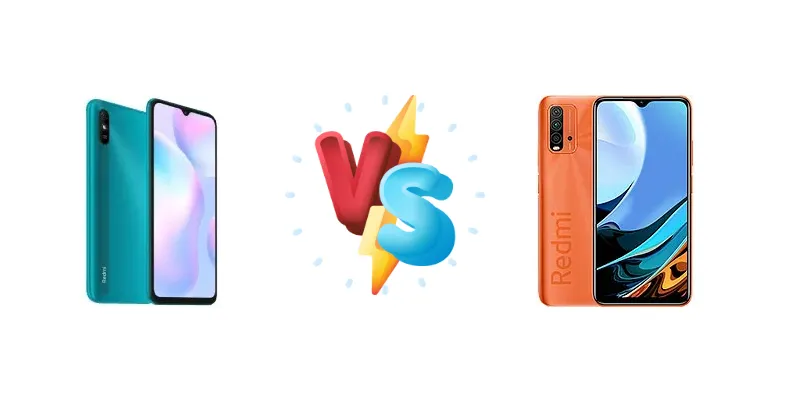
Xiaomi's Redmi series consistently delivers value, but navigating the options can be tricky. The Redmi 9i and Redmi 9 Power represent two distinct approaches to the budget smartphone market. The 9i focuses on affordability, while the 9 Power aims to offer a more robust experience with faster charging and a more modern chipset. This comparison dissects the key differences to help you choose the right phone for your needs.
🏆 Quick Verdict
For most users, the Xiaomi Redmi 9 Power is the better choice. Its Snapdragon 662 chipset, built on an 11nm process, provides a noticeable performance uplift over the Redmi 9i’s Helio G25, and the 18W fast charging significantly reduces downtime. While the 9i is cheaper, the 9 Power’s improvements justify the price difference.
| Network |
|---|
| 2G bands | GSM 850 / 900 / 1800 / 1900 | GSM 850 / 900 / 1800 / 1900 |
| 3G bands | HSDPA 850 / 900 / 1900 / 2100 | HSDPA 850 / 900 / 2100 |
| 4G bands | 1, 3, 5, 8, 40, 41 | 1, 3, 5, 8, 40, 41 |
| Speed | HSPA, LTE | HSPA, LTE |
| Technology | GSM / HSPA / LTE | GSM / HSPA / LTE |
| Launch |
|---|
| Announced | 2020, September 15. Released 2020, September 18 | 2020, December 17 |
| Status | Discontinued | Available. Released 2020, December 22 |
| Body |
|---|
| Build | - | Glass front (Gorilla Glass 3), plastic frame, plastic back |
| Dimensions | 164.9 x 77.1 x 9 mm (6.49 x 3.04 x 0.35 in) | 162.3 x 77.3 x 9.6 mm (6.39 x 3.04 x 0.38 in) |
| SIM | Nano-SIM + Nano-SIM | Nano-SIM + Nano-SIM |
| Weight | 194 g (6.84 oz) | 198 g (6.98 oz) |
| Display |
|---|
| Protection | - | Corning Gorilla Glass 3 |
| Resolution | 720 x 1600 pixels, 20:9 ratio (~269 ppi density) | 1080 x 2340 pixels, 19.5:9 ratio (~395 ppi density) |
| Size | 6.53 inches, 102.9 cm2 (~81.0% screen-to-body ratio) | 6.53 inches, 104.7 cm2 (~83.4% screen-to-body ratio) |
| Type | IPS LCD, 270 nits (typ) | IPS LCD, 400 nits (typ) |
| Platform |
|---|
| CPU | Octa-core (4x2.0 GHz Cortex-A53 & 4x1.5 GHz Cortex-A53) | Octa-core (4x2.0 GHz Kryo 260 Gold & 4x1.8 GHz Kryo 260 Silver) |
| Chipset | Mediatek MT6762G Helio G25 (12 nm) | Qualcomm SM6115 Snapdragon 662 (11 nm) |
| GPU | PowerVR GE8320 | Adreno 610 |
| OS | Android 10, MIUI 12 | Android 10, MIUI 12 |
| Memory |
|---|
| Card slot | microSDXC (dedicated slot) | microSDXC (dedicated slot) |
| Internal | 64GB 4GB RAM, 128GB 4GB RAM | 64GB 4GB RAM, 128GB 4GB RAM, 128GB 6GB RAM |
| | eMMC 5.1 | eMMC 4.5 |
| Main Camera |
|---|
| Features | LED flash, HDR | LED flash, HDR, panorama |
| Quad | - | 48 MP, f/1.8, 26mm (wide), 1/2.0", 0.8µm, PDAF
8 MP, f/2.2, 120˚ (ultrawide), 1/4.0", 1.12µm
2 MP (macro)
Auxiliary lens |
| Single | 13 MP, f/2.2, 28mm (wide), 1.0µm, PDAF | 5 MP, AF |
| Video | 1080p@30fps | 1080p@30fps |
| Selfie camera |
|---|
| Features | HDR | - |
| Single | 5 MP, f/2.2, (wide), 1.12µm | 8 MP, f/2.0, 27mm (wide), 1/4.0", 1.12µm |
| Video | 1080p@30fps | 1080p@30fps |
| Sound |
|---|
| 3.5mm jack | Yes | Yes |
| 35mm jack | Yes | Yes |
| Loudspeaker | Yes | Yes, with stereo speakers |
| Comms |
|---|
| Bluetooth | 5.0, A2DP, LE | 5.0, A2DP, LE |
| Infrared port | - | Yes |
| NFC | No | No |
| Positioning | GPS, GLONASS, BDS | GPS, GLONASS, BDS |
| Radio | FM radio | FM radio |
| USB | microUSB 2.0, OTG | USB Type-C 2.0, OTG |
| WLAN | Wi-Fi 802.11 b/g/n, Wi-Fi Direct | Wi-Fi 802.11 a/b/g/n/ac, dual-band, Wi-Fi Direct |
| Features |
|---|
| Sensors | Accelerometer, proximity, compass | Fingerprint (side-mounted), accelerometer, proximity, compass |
| Battery |
|---|
| Charging | 10W wired | 18W wired
2.5W reverse wired |
| Stand-by | - | Up to 350 h (3G) |
| Talk time | - | Up to 8 h (3G) |
| Type | Li-Po 5000 mAh | Li-Po 6000 mAh |
| Misc |
|---|
| Colors | Midnight Black, Sea Blue, Nature Green | Mighty Black, Fiery Red, Electric Green, Blazing Blue |
| Models | M2006C3LII | M2010J19SI, M2010J19SL |
| Price | About 100 EUR | About 120 EUR |
| SAR | - | 0.87 W/kg (head) 0.86 W/kg (body) |
| Pricing |
|---|
| 64GB 4GB RAM | ₹ 8,200 | - |
Xiaomi Redmi 9i
- Lower price point makes it highly accessible.
- Sufficient for basic smartphone tasks.
- Likely lighter due to simpler components.
- Helio G25 chipset offers limited performance.
- Slow 10W charging is a significant drawback.
- May struggle with demanding apps and games.
Xiaomi Redmi 9 Power
- Snapdragon 662 provides a smoother user experience.
- 18W fast charging significantly reduces charging time.
- More capable ISP for better photo quality.
- Slightly higher price compared to the Redmi 9i.
- May not be a substantial upgrade for very basic users.
- Potentially slightly heavier due to larger battery/components.
Display Comparison
Both phones likely feature similar LCD panels, but detailed display specs (resolution, brightness) are missing. However, the core difference lies in the processing power driving them. The chipset impacts UI responsiveness and video playback smoothness. While both will likely suffice for everyday use, the Snapdragon 662 in the 9 Power will handle graphically intensive tasks more effectively.
Camera Comparison
Without detailed camera specs beyond the presence of cameras, a direct comparison is difficult. However, the chipset’s image signal processor (ISP) plays a crucial role. The Snapdragon 662’s ISP is more advanced, enabling better image processing, noise reduction, and dynamic range. While both phones likely feature a primary camera, the 9 Power will likely produce more detailed and vibrant photos, especially in challenging lighting conditions. The 9i's ISP will struggle to keep up with the 9 Power's.
Performance
The Redmi 9 Power’s Qualcomm Snapdragon 662 (11nm) is a clear upgrade over the Redmi 9i’s MediaTek Helio G25 (12nm). The 11nm process node generally translates to better power efficiency and thermal performance. While both CPUs feature octa-core configurations, the Snapdragon 662 utilizes Qualcomm’s Kryo 260 cores – specifically, 4x2.0 GHz Kryo 260 Gold and 4x1.8 GHz Kryo 260 Silver – which offer a more refined architecture than the Cortex-A53 cores in the Helio G25 (4x2.0 GHz Cortex-A53 & 4x1.5 GHz Cortex-A53). This results in snappier app launches and smoother multitasking on the 9 Power.
Battery Life
The Redmi 9 Power’s 18W wired charging is a significant advantage over the Redmi 9i’s 10W charging. This translates to a much faster 0-100% charge time, reducing downtime. While battery capacity isn't specified, the faster charging speed of the 9 Power effectively mitigates any potential capacity difference. The 2.5W reverse wired charging on the 9 Power is a bonus, allowing it to act as a power bank for smaller devices.
Buying Guide
Buy the Xiaomi Redmi 9i if you prioritize absolute minimum cost and your usage is limited to basic tasks like calls, messaging, and light social media. You'll need to accept slower performance and longer charging times. Buy the Xiaomi Redmi 9 Power if you value smoother multitasking, occasional gaming, and faster charging. The Snapdragon 662 offers a more future-proof experience and reduces frustration with lag.
Frequently Asked Questions
❓ Will the Redmi 9 Power handle PUBG Mobile smoothly?
The Snapdragon 662 in the Redmi 9 Power is capable of running PUBG Mobile, but likely at medium settings to maintain a stable frame rate. The Helio G25 in the Redmi 9i will struggle with consistent performance, even on the lowest settings.
❓ Is the difference in charging speed between 10W and 18W really that noticeable?
Yes, the difference is substantial. 10W charging can take over 3 hours to fully charge a typical smartphone battery, while 18W charging can reduce that time to around 1.5-2 hours. This is a significant convenience factor for users who are frequently on the go.
❓ Does the Redmi 9 Power support VoWiFi (Wi-Fi Calling)?
Support for VoWiFi varies by region and carrier. While neither Xiaomi explicitly advertises VoWiFi support for these models, the Snapdragon 662 modem is generally compatible with VoWiFi, so it's possible depending on your carrier's implementation.
❓ Which phone is better for watching videos and streaming content?
The Redmi 9 Power is better suited for video consumption due to the Snapdragon 662’s more capable GPU and smoother playback capabilities. It will handle higher resolution videos and streaming apps with less lag.