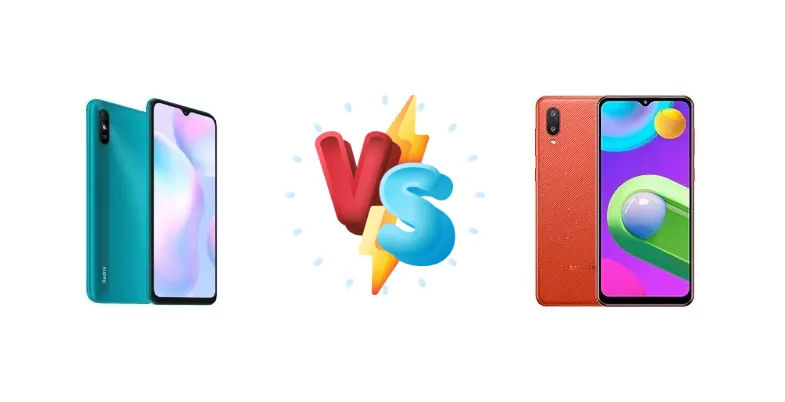
The Xiaomi Redmi 9i and Samsung Galaxy M02 represent the extreme end of the budget smartphone spectrum, targeting first-time smartphone buyers or those needing a reliable secondary device. Both aim to deliver essential functionality at the lowest possible price, but significant differences in their underlying hardware dictate vastly different user experiences. This comparison dissects those differences, focusing on performance, battery, and overall value.
🏆 Quick Verdict
For the average user, the Xiaomi Redmi 9i is the superior choice. Its Mediatek Helio G25 chipset, built on a more efficient 12nm process, provides a noticeable performance advantage over the Samsung Galaxy M02’s older 28nm Mediatek MT6739W, making it better suited for everyday tasks and light multitasking.
| Network |
|---|
| 2G bands | GSM 850 / 900 / 1800 / 1900 | GSM 850 / 900 / 1800 / 1900 |
| 3G bands | HSDPA 850 / 900 / 1900 / 2100 | HSDPA 850 / 900 / 2100 |
| 4G bands | 1, 3, 5, 8, 40, 41 | 1, 3, 5, 7, 8, 20, 28, 38, 40, 41 |
| Speed | HSPA, LTE | HSPA 42.2/5.76 Mbps, LTE Cat4 150/50 Mbps |
| Technology | GSM / HSPA / LTE | GSM / HSPA / LTE |
| Launch |
|---|
| Announced | 2020, September 15. Released 2020, September 18 | 2021, February 02 |
| Status | Discontinued | Available. Released 2021, February 09 |
| Body |
|---|
| Build | - | Glass front, plastic back, plastic frame |
| Dimensions | 164.9 x 77.1 x 9 mm (6.49 x 3.04 x 0.35 in) | 164 x 75.9 x 9.1 mm (6.46 x 2.99 x 0.36 in) |
| SIM | Nano-SIM + Nano-SIM | · Nano-SIM· Nano-SIM + Nano-SIM |
| Weight | 194 g (6.84 oz) | 206 g (7.27 oz) |
| Display |
|---|
| Resolution | 720 x 1600 pixels, 20:9 ratio (~269 ppi density) | 720 x 1600 pixels, 20:9 ratio (~270 ppi density) |
| Size | 6.53 inches, 102.9 cm2 (~81.0% screen-to-body ratio) | 6.5 inches, 102.0 cm2 (~81.9% screen-to-body ratio) |
| Type | IPS LCD, 270 nits (typ) | PLS LCD |
| Platform |
|---|
| CPU | Octa-core (4x2.0 GHz Cortex-A53 & 4x1.5 GHz Cortex-A53) | Quad-core 1.5 GHz Cortex-A53 |
| Chipset | Mediatek MT6762G Helio G25 (12 nm) | Mediatek MT6739W (28 nm) |
| GPU | PowerVR GE8320 | PowerVR GE8100 |
| OS | Android 10, MIUI 12 | Android 10, One UI 2.0 |
| Memory |
|---|
| Card slot | microSDXC (dedicated slot) | microSDXC (dedicated slot) |
| Internal | 64GB 4GB RAM, 128GB 4GB RAM | 32GB 2GB RAM, 32GB 3GB RAM |
| | eMMC 5.1 | - |
| Main Camera |
|---|
| Dual | - | 13 MP, f/1.9, (wide), AF
2 MP (macro) |
| Features | LED flash, HDR | LED flash |
| Single | 13 MP, f/2.2, 28mm (wide), 1.0µm, PDAF | - |
| Video | 1080p@30fps | 1080p@30fps |
| Selfie camera |
|---|
| Features | HDR | - |
| Single | 5 MP, f/2.2, (wide), 1.12µm | 5 MP, f/2.0 |
| Video | 1080p@30fps | - |
| Sound |
|---|
| 3.5mm jack | Yes | - |
| 35mm jack | Yes | Yes |
| Loudspeaker | Yes | Yes |
| Comms |
|---|
| Bluetooth | 5.0, A2DP, LE | 5.0, A2DP, LE |
| NFC | No | No |
| Positioning | GPS, GLONASS, BDS | GPS, GLONASS |
| Radio | FM radio | Unspecified |
| USB | microUSB 2.0, OTG | microUSB 2.0 |
| WLAN | Wi-Fi 802.11 b/g/n, Wi-Fi Direct | Wi-Fi 802.11 b/g/n, Wi-Fi Direct |
| Features |
|---|
| Sensors | Accelerometer, proximity, compass | Accelerometer |
| Battery |
|---|
| Charging | 10W wired | - |
| Type | Li-Po 5000 mAh | Li-Po 5000 mAh |
| Misc |
|---|
| Colors | Midnight Black, Sea Blue, Nature Green | Black, Gray, Blue, Red |
| Models | M2006C3LII | SM-M022F, SM-M022F/DS, SM-M022G, SM-M022G/DS |
| Price | About 100 EUR | About 80 EUR |
| SAR EU | - | 0.65 W/kg (head) 1.71 W/kg (body) |
| Pricing |
|---|
| 64GB 4GB RAM | ₹ 8,200 | - |
Xiaomi Redmi 9i
- Significantly faster processor for smoother performance
- More power-efficient chipset for potentially longer battery life
- Better suited for multitasking and light gaming
- 10W charging is slow
- Display details are unknown, potentially basic quality
Samsung Galaxy M02
- Extremely affordable price point
- Simple and easy-to-use interface
- Acceptable for basic calling and texting
- Very slow processor, struggles with most apps
- Inefficient chipset leads to shorter battery life
- Limited multitasking capabilities
Display Comparison
Neither device boasts a standout display. Both likely utilize LCD panels, though specific details like resolution and peak brightness are not provided. However, the focus here isn't display quality, but the impact of the chipset on rendering UI elements. The Redmi 9i’s more powerful GPU will contribute to smoother scrolling and faster app loading times, even on a similar-quality display.
Camera Comparison
Both phones likely feature basic camera setups, and detailed sensor information is lacking. Given the price point, image quality will be heavily reliant on software processing. However, the Redmi 9i’s superior processing power allows for more sophisticated image algorithms, potentially resulting in better dynamic range and noise reduction. The presence of a dedicated GPU in the Helio G25 aids in faster image processing. We can assume both phones will have limited low-light performance.
Performance
The core difference lies in the chipsets. The Redmi 9i’s Mediatek Helio G25, with its octa-core configuration (4x2.0 GHz Cortex-A53 & 4x1.5 GHz Cortex-A53), significantly outperforms the Galaxy M02’s quad-core 1.5 GHz Cortex-A53 Mediatek MT6739W. The Helio G25’s newer architecture and higher clock speeds translate to faster app launches, smoother multitasking, and a more responsive overall experience. Crucially, the Helio G25 is fabricated on a 12nm process, offering better power efficiency compared to the M02’s 28nm MT6739W, potentially leading to longer battery life under load. The M02 will struggle with even moderately demanding apps.
Battery Life
While battery capacity isn't specified, the Redmi 9i benefits from the more efficient 12nm Helio G25 chipset. This means it will consume less power during typical usage, potentially offsetting any capacity difference. Both phones feature 10W charging, indicating slow charging speeds – expect several hours to reach a full charge from empty. The M02’s less efficient chipset will likely require more frequent charging.
Buying Guide
Buy the Xiaomi Redmi 9i if you prioritize responsiveness and a smoother user experience, even for basic tasks. It’s the better option for those who occasionally browse social media, use messaging apps, or play less demanding mobile games. Buy the Samsung Galaxy M02 if your primary need is a very basic phone for calls and texts, and you are extremely budget-constrained, accepting significant performance limitations.
Frequently Asked Questions
❓ Will the Samsung Galaxy M02 struggle with WhatsApp and Facebook?
Yes, the Galaxy M02’s Mediatek MT6739W is a very basic processor. While it can *run* these apps, expect noticeable lag when opening them, switching between conversations, or loading images. The Redmi 9i will provide a much smoother experience with these commonly used social media applications.
❓ Can I play PUBG Mobile on either of these phones?
Playing PUBG Mobile on the Samsung Galaxy M02 is not recommended due to its extremely limited processing power. The Redmi 9i *might* be able to run PUBG Mobile at the lowest settings, but expect significant frame rate drops and a generally poor gaming experience. These phones are not designed for gaming.
❓ How long will it take to fully charge either phone?
Both phones support only 10W charging, which is very slow. Expect a full charge from 0% to take approximately 3-4 hours, potentially longer depending on usage during charging.
❓ Is the difference in chipsets really that noticeable in everyday use?
Absolutely. The Mediatek Helio G25 in the Redmi 9i is a generation ahead and significantly more powerful than the MT6739W in the Galaxy M02. This translates to faster app loading times, smoother scrolling, and a more responsive overall experience, even when performing simple tasks like browsing the web or checking email.