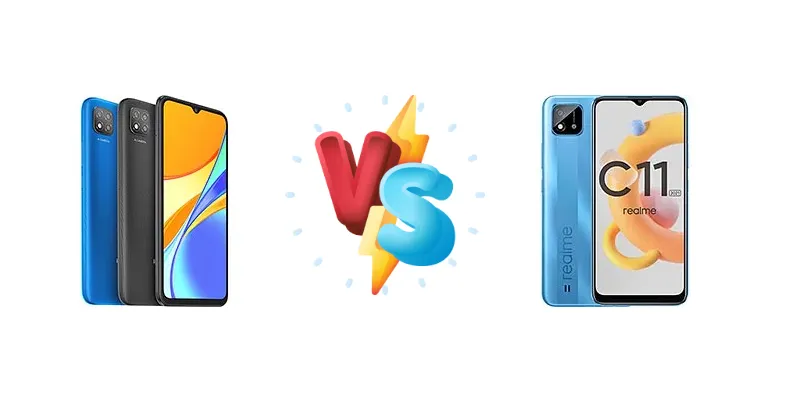
The Xiaomi Redmi 9C and Realme C11 (2021) represent the extreme end of the smartphone price spectrum, targeting first-time buyers or those needing a reliable secondary device. Both aim to deliver essential functionality at an incredibly low cost, but significant differences in their underlying hardware dictate which phone offers the better experience. This comparison focuses on the core performance and efficiency trade-offs between the Mediatek Helio G35 and Unisoc SC9863A chipsets.
🏆 Quick Verdict
For the average user prioritizing responsiveness and slightly better performance, the Xiaomi Redmi 9C is the stronger choice. Its Helio G35 chipset, built on a more modern 12nm process, offers a noticeable advantage in CPU performance over the Realme C11 (2021)'s older 28nm Unisoc SC9863A, despite the similar core count.
| Network |
|---|
| 2G bands | GSM 850 / 900 / 1800 / 1900 | GSM 850 / 900 / 1800 / 1900 |
| 3G bands | HSDPA 850 / 900 / 1700(AWS) / 1900 / 2100 | HSDPA 850 / 900 / 1900 / 2100 |
| 4G bands | 1, 2, 3, 4, 5, 7, 8, 20, 28, 38, 40, 41 | 1, 3, 5, 8, 38, 40, 41 |
| Speed | HSPA, LTE | HSPA, LTE |
| Technology | GSM / HSPA / LTE | GSM / HSPA / LTE |
| Launch |
|---|
| Announced | 2020, June 30. Released 2020, August 12 | 2021, June 28 |
| Status | Discontinued | Available. Released 2021, June 28 |
| Body |
|---|
| Build | - | Glass front, plastic frame, plastic back |
| Dimensions | 164.9 x 77 x 9 mm (6.49 x 3.03 x 0.35 in) | 165.2 x 76.4 x 8.9 mm (6.50 x 3.01 x 0.35 in) |
| SIM | Nano-SIM + Nano-SIM | Nano-SIM + Nano-SIM |
| Weight | 196 g (6.91 oz) | 190 g (6.70 oz) |
| | - | Splash resistant design |
| Display |
|---|
| Resolution | 720 x 1600 pixels, 20:9 ratio (~269 ppi density) | 720 x 1600 pixels, 20:9 ratio (~269 ppi density) |
| Size | 6.53 inches, 102.9 cm2 (~81.1% screen-to-body ratio) | 6.52 inches, 102.6 cm2 (~81.3% screen-to-body ratio) |
| Type | IPS LCD, 400 nits (typ) | IPS LCD, 400 nits (typ) |
| Platform |
|---|
| CPU | Octa-core (4x2.3 GHz Cortex-A53 & 4x1.8 GHz Cortex-A53) | Octa-core (4x1.6 GHz Cortex-A55 & 4x1.2 GHz Cortex-A55) |
| Chipset | Mediatek MT6765G Helio G35 (12 nm) | Unisoc SC9863A (28 nm) |
| GPU | PowerVR GE8320 | IMG8322 |
| OS | Android 10, MIUI 12 | Android 11, Realme Go UI |
| Memory |
|---|
| Card slot | microSDXC (dedicated slot) | microSDXC (dedicated slot) |
| Internal | 32GB 2GB RAM, 32GB 3GB RAM, 64GB 2GB RAM, 64GB 3GB RAM, 64GB 4GB RAM, 128GB 4GB RAM | 32GB 2GB RAM, 64GB 4GB RAM |
| | eMMC 5.1 | eMMC 5.1 |
| Main Camera |
|---|
| Features | LED flash, HDR | LED flash, HDR, panorama |
| Single | - | 8 MP, f/2.0, (wide), AF |
| Triple | 13 MP, f/2.2, 28mm (wide), 1.0µm, PDAF
2 MP (macro)
Auxiliary lens | - |
| Video | 1080p@30fps | 1080p@30fps |
| Selfie camera |
|---|
| Features | HDR | HDR, panorama |
| Single | 5 MP, f/2.2, (wide), 1.12µm | 5 MP, f/2.2, (wide) |
| Video | 1080p@30fps | 1080p@30fps |
| Sound |
|---|
| 3.5mm jack | Yes | Yes |
| 35mm jack | Yes | Yes |
| Loudspeaker | Yes | Yes |
| Comms |
|---|
| Bluetooth | 5.0, A2DP, LE | 4.2, A2DP |
| NFC | No | No |
| Positioning | GPS, GLONASS, BDS | GPS, GLONASS, GALILEO, BDS |
| Radio | FM radio | Unspecified |
| USB | microUSB 2.0, OTG | microUSB 2.0, OTG |
| WLAN | Wi-Fi 802.11 b/g/n, Wi-Fi Direct | Wi-Fi 802.11 b/g/n |
| Features |
|---|
| Sensors | Fingerprint (rear-mounted), accelerometer, proximity | Accelerometer, gyro, proximity, compass |
| Battery |
|---|
| Charging | 10W wired | 10W wired
Reverse wired |
| Type | Li-Po 5000 mAh | 5000 mAh |
| Misc |
|---|
| Colors | Midnight Gray, Sunrise Orange, Twilight Blue | Cool Blue, Cool Grey |
| Models | M2006C3MG, M2006C3MT | RMX3231 |
| Price | About 80 EUR | About 80 EUR |
| SAR | 0.73 W/kg (head) 0.52 W/kg (body) | - |
| SAR EU | 0.35 W/kg (head) 0.78 W/kg (body) | - |
Xiaomi Redmi 9C
- More powerful and efficient processor (Helio G35)
- Potentially longer battery life due to 12nm process
- Snappier performance for everyday tasks
- Lacks reverse wired charging
- Likely similar display quality to the Realme C11 (2021)
Realme C11 (2021)
- Reverse wired charging capability
- Potentially slightly more efficient CPU architecture (Cortex-A55)
- Competitive price point
- Less powerful processor (Unisoc SC9863A)
- Less efficient 28nm manufacturing process
- May exhibit more throttling under sustained load
Display Comparison
Neither device boasts a standout display. Both are likely to feature LCD panels, typical for this price point. Specifics like resolution and brightness are not provided, but we can assume they are similar, aiming for adequate readability rather than vibrant visuals. The absence of high refresh rates or advanced panel technologies like LTPO is expected. Bezels are likely to be substantial on both, maximizing screen real estate within a compact form factor.
Camera Comparison
Without detailed sensor information, a direct camera comparison is difficult. However, both phones likely employ basic camera setups focused on affordability. The absence of Optical Image Stabilization (OIS) is almost certain. Lens apertures are likely to be modest, resulting in limited low-light performance. Image processing will be heavily reliant on software algorithms to enhance image quality, but the processing power of the Unisoc chip may limit its effectiveness compared to the Redmi 9C. Any 2MP macro or depth sensors present on either device should be considered marketing features rather than significant photographic tools.
Performance
The core difference lies in the chipsets. The Redmi 9C’s Mediatek Helio G35 (12nm) utilizes Cortex-A53 cores clocked up to 2.3 GHz, while the Realme C11 (2021) features the Unisoc SC9863A (28nm) with Cortex-A55 cores clocked up to 1.6 GHz. While both are octa-core, the A55 architecture is more efficient than the A53, but the 28nm process of the Unisoc chip negates much of that benefit. The 12nm process of the Helio G35 provides a significant advantage in power efficiency and thermal management. This translates to better sustained performance and potentially less throttling during prolonged use. The Redmi 9C will likely feel snappier in app switching and general navigation.
Battery Life
Both devices feature 10W wired charging, indicating similar charging speeds – expect around 2-3 hours for a full charge. While battery capacity isn't specified, the more efficient Helio G35 in the Redmi 9C will likely result in longer real-world battery life, even with a similar capacity battery. The Realme C11 (2021) does offer reverse wired charging, allowing it to act as a power bank for other devices, a feature the Redmi 9C lacks. This is a key differentiator for users who frequently need to charge accessories on the go.
Buying Guide
Buy the Xiaomi Redmi 9C if you need a phone that feels more responsive for everyday tasks like browsing and social media, and if you anticipate light gaming. The more efficient processor also translates to potentially better battery life under sustained load. Buy the Realme C11 (2021) if you prioritize reverse wired charging – a feature absent on the Redmi 9C – and are willing to accept a slight performance compromise for that added convenience. It's a good option for those who want to use their phone as a power bank for other devices.
Frequently Asked Questions
❓ Will the Unisoc SC9863A in the Realme C11 (2021) struggle with popular apps like WhatsApp and Facebook?
While the Unisoc SC9863A can handle basic apps like WhatsApp and Facebook, it may exhibit noticeable lag when multitasking or running these apps alongside other background processes. The Redmi 9C’s Helio G35 will provide a smoother experience in these scenarios due to its more powerful CPU.
❓ Is the 10W charging speed on either phone sufficient for daily use?
10W charging is quite slow by modern standards. Expect a full charge to take around 2-3 hours. Neither phone is ideal for users who need quick top-ups. However, the Redmi 9C’s more efficient processor may mean you need to charge it less frequently.
❓ Can either of these phones handle basic mobile games like Candy Crush or Subway Surfers?
Both phones can handle less demanding games like Candy Crush or Subway Surfers, but don't expect high frame rates or detailed graphics. The Redmi 9C will likely offer a slightly smoother gaming experience due to its more capable GPU, but neither phone is designed for serious mobile gaming.