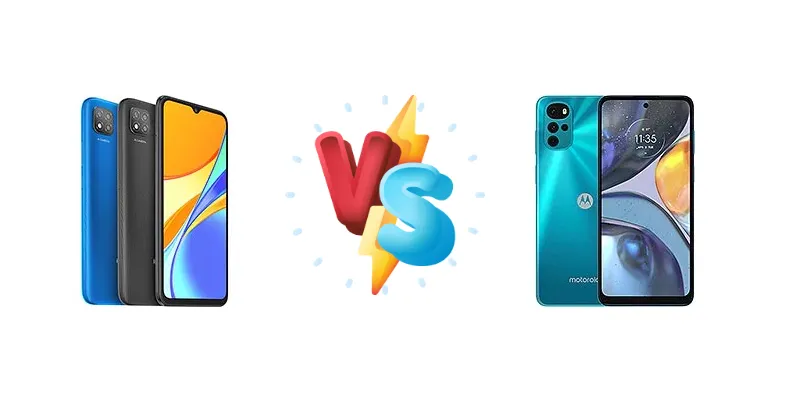
The Xiaomi Redmi 9C and Motorola Moto G22 represent the fiercely competitive sub-$150 smartphone market. Both devices aim to deliver essential functionality at an accessible price point, but they take slightly different approaches. This comparison dissects their core components – from chipsets and charging speeds to overall value – to determine which phone best suits your needs.
🏆 Quick Verdict
For the average user prioritizing faster charging and a slightly more modern feature set, the Motorola Moto G22 is the better choice. While the Redmi 9C remains a viable option, the G22’s 20W charging (in India, 15W globally) and Helio G37 chipset offer a tangible advantage in daily use and convenience.
| Network |
|---|
| 2G bands | GSM 850 / 900 / 1800 / 1900 | GSM 850 / 900 / 1800 / 1900 |
| 3G bands | HSDPA 850 / 900 / 1700(AWS) / 1900 / 2100 | HSDPA 850 / 900 / 1900 / 2100 |
| 4G bands | 1, 2, 3, 4, 5, 7, 8, 20, 28, 38, 40, 41 | 1, 3, 5, 7, 8, 20, 38, 40, 41 |
| Speed | HSPA, LTE | HSPA 42.2/5.76 Mbps, LTE Cat4 150/50 Mbps |
| Technology | GSM / HSPA / LTE | GSM / HSPA / LTE |
| Launch |
|---|
| Announced | 2020, June 30. Released 2020, August 12 | 2022, March 04 |
| Status | Discontinued | Available. Released 2022, March 04 |
| Body |
|---|
| Build | - | Glass front, plastic frame, plastic back |
| Dimensions | 164.9 x 77 x 9 mm (6.49 x 3.03 x 0.35 in) | 164 x 75 x 8.5 mm (6.46 x 2.95 x 0.33 in) |
| SIM | Nano-SIM + Nano-SIM | · Nano-SIM· Nano-SIM + Nano-SIM |
| Weight | 196 g (6.91 oz) | 185 g (6.53 oz) |
| | - | Water-repellent design |
| Display |
|---|
| Resolution | 720 x 1600 pixels, 20:9 ratio (~269 ppi density) | 720 x 1600 pixels, 20:9 ratio (~268 ppi density) |
| Size | 6.53 inches, 102.9 cm2 (~81.1% screen-to-body ratio) | 6.5 inches, 103.5 cm2 (~84.2% screen-to-body ratio) |
| Type | IPS LCD, 400 nits (typ) | IPS LCD, 90Hz |
| Platform |
|---|
| CPU | Octa-core (4x2.3 GHz Cortex-A53 & 4x1.8 GHz Cortex-A53) | Octa-core (4x2.3 GHz Cortex-A53 & 4x1.8 GHz Cortex-A53) |
| Chipset | Mediatek MT6765G Helio G35 (12 nm) | Mediatek MT6765V/CB Helio G37 (12 nm) |
| GPU | PowerVR GE8320 | PowerVR GE8320 |
| OS | Android 10, MIUI 12 | Android 12 |
| Memory |
|---|
| Card slot | microSDXC (dedicated slot) | microSDXC (dedicated slot) |
| Internal | 32GB 2GB RAM, 32GB 3GB RAM, 64GB 2GB RAM, 64GB 3GB RAM, 64GB 4GB RAM, 128GB 4GB RAM | 64GB 4GB RAM, 128GB 4GB RAM |
| | eMMC 5.1 | - |
| Main Camera |
|---|
| Features | LED flash, HDR | LED flash, HDR, panorama |
| Quad | - | 50 MP, f/1.8, (wide), 0.64µm, PDAF
8 MP, f/2.2, 118˚ (ultrawide), 1/4.0", 1.12µm
2 MP (macro)
Auxiliary lens |
| Triple | 13 MP, f/2.2, 28mm (wide), 1.0µm, PDAF
2 MP (macro)
Auxiliary lens | - |
| Video | 1080p@30fps | 1080p@30fps |
| Selfie camera |
|---|
| Features | HDR | HDR |
| Single | 5 MP, f/2.2, (wide), 1.12µm | 16 MP, f/2.5, (wide), 1.0µm |
| Video | 1080p@30fps | 1080p@30fps |
| Sound |
|---|
| 3.5mm jack | Yes | Yes |
| 35mm jack | Yes | Yes |
| Loudspeaker | Yes | Yes |
| Comms |
|---|
| Bluetooth | 5.0, A2DP, LE | 5.0, A2DP, LE |
| NFC | No | Yes (market/region dependent) |
| Positioning | GPS, GLONASS, BDS | GPS, GLONASS, GALILEO |
| Radio | FM radio | Unspecified |
| USB | microUSB 2.0, OTG | USB Type-C 2.0 |
| WLAN | Wi-Fi 802.11 b/g/n, Wi-Fi Direct | Wi-Fi 802.11 a/b/g/n/ac, dual-band, Wi-Fi Direct |
| Features |
|---|
| Sensors | Fingerprint (rear-mounted), accelerometer, proximity | Fingerprint (side-mounted), accelerometer, gyro, proximity, compass |
| Battery |
|---|
| Charging | 10W wired | 20W wired (India)
15W wired (Global) |
| Type | Li-Po 5000 mAh | Li-Po 5000 mAh |
| Misc |
|---|
| Colors | Midnight Gray, Sunrise Orange, Twilight Blue | Pearl White, Iceberg Blue, Cosmic Black, Mint Green |
| Models | M2006C3MG, M2006C3MT | XT2231-1, XT2231-2, XT2231-5 |
| Price | About 80 EUR | About 120 EUR |
| SAR | 0.73 W/kg (head) 0.52 W/kg (body) | - |
| SAR EU | 0.35 W/kg (head) 0.78 W/kg (body) | - |
Xiaomi Redmi 9C
- Potentially lower price point
- Reliable basic functionality
- Long battery life (estimated)
- Slow 10W charging
- Less powerful chipset
- Outdated design (likely)
Motorola Moto G22
- Faster 20W (India) / 15W (Global) charging
- Slightly more powerful Helio G37 chipset
- More modern design (likely)
- Potentially higher price
- Battery life may be slightly less than Redmi 9C
- Camera performance likely similar to Redmi 9C
Display Comparison
Neither the Redmi 9C nor the Moto G22 are display champions. Both are expected to feature LCD panels, typical for this price bracket. Specifics like resolution and peak brightness are not provided, but we can assume they are similar – around 720p+ and adequate for indoor use. The focus here isn't on visual fidelity, but on basic usability. Bezels are likely to be noticeable on both devices, contributing to a less immersive viewing experience.
Camera Comparison
Camera performance is likely to be similar on both devices, relying heavily on software processing. Details regarding sensor sizes and lens apertures are unavailable, but given the price point, expectations should be tempered. Both phones likely feature a primary camera accompanied by auxiliary sensors (often 2MP macro or depth sensors) that offer limited utility. Image quality will be acceptable in good lighting conditions, but struggle in low-light scenarios. The G37’s slightly improved ISP (Image Signal Processor) *may* result in marginally better dynamic range and noise reduction, but the difference will likely be subtle.
Performance
The core of the performance difference lies in the chipsets. Both phones utilize MediaTek Helio processors built on a 12nm process, but the Moto G22 boasts the Helio G37, a slight upgrade over the Redmi 9C’s Helio G35. While both CPUs share the same core configuration – octa-core with 4x2.3 GHz Cortex-A53 and 4x1.8 GHz Cortex-A53 – the G37 benefits from a more refined architecture and potentially higher clock speeds within the GPU. This translates to marginally smoother app launches and slightly better performance in less demanding games. Neither phone is a gaming powerhouse, but the G37 offers a small edge.
Battery Life
Battery capacity is not specified for either device, but both are expected to house around a 5000mAh battery, standard for this segment. The key differentiator is charging speed. The Redmi 9C is limited to 10W wired charging, resulting in a significantly longer charge time – likely exceeding 3 hours for a full charge. The Moto G22, however, supports 20W charging in India (15W globally), drastically reducing charging times. This faster charging capability is a significant convenience factor, especially for users who frequently find themselves needing to top up their battery throughout the day.
Buying Guide
Buy the Xiaomi Redmi 9C if you need a reliably basic smartphone for essential tasks like calls, messaging, and light social media use, and are comfortable with slower charging speeds. Buy the Motorola Moto G22 if you prefer a device with faster charging capabilities, a marginally more powerful chipset for smoother multitasking, and a more contemporary design, even if it means potentially paying a small premium.
Frequently Asked Questions
❓ Does the Motorola Moto G22's 20W charging actually make a noticeable difference in real-world use?
Yes, the 20W charging (or 15W globally) on the Moto G22 is a significant improvement over the Redmi 9C's 10W charging. It can reduce a full charge time from over 3 hours to around 2 hours, making it much more convenient for users who need to quickly top up their battery.
❓ Is the Helio G37 in the Moto G22 powerful enough for playing popular mobile games like PUBG or Call of Duty?
The Helio G37 can handle PUBG and Call of Duty, but you'll likely need to play on lower graphics settings to maintain a stable frame rate. It's not a gaming-focused chipset, so don't expect a high-end gaming experience. The Redmi 9C's Helio G35 will perform similarly, but potentially with slightly more stuttering.
❓ How does the software experience differ between the Xiaomi Redmi 9C and Motorola Moto G22?
The Redmi 9C runs Xiaomi's MIUI, which is heavily customized and often includes pre-installed apps (bloatware). The Moto G22 runs a near-stock version of Android, offering a cleaner and more streamlined user experience with fewer pre-installed apps. Motorola is known for providing timely software updates, while Xiaomi's update schedule can be less consistent.