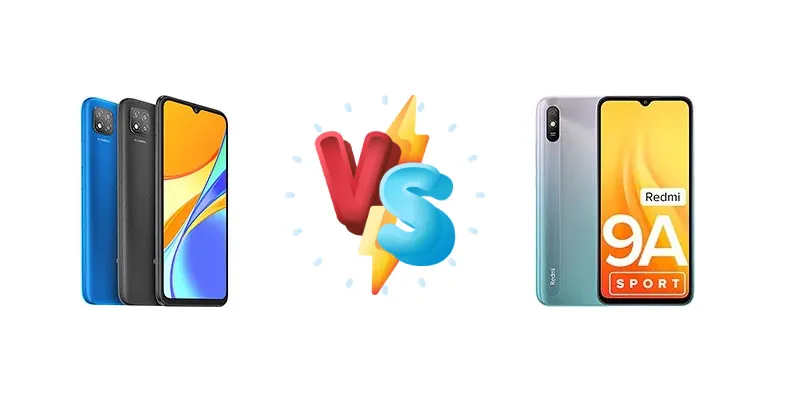
The Xiaomi Redmi series consistently delivers impressive value in the budget smartphone market. Two contenders vying for your attention are the Redmi 9C NFC and the Redmi 9A Sport. Both offer affordability, but which one provides the better overall experience? Let's dive in.
🏆 Quick Verdict
The Redmi 9C NFC edges out the 9A Sport thanks to its slightly more powerful chipset and NFC capabilities. While both are budget-friendly, the 9C NFC offers a noticeable performance boost for everyday tasks and added convenience with NFC for contactless payments. It's a worthwhile upgrade if your budget allows.
| Network |
|---|
| 2G bands | GSM 850 / 900 / 1800 / 1900 | GSM 850 / 900 / 1800 / 1900 |
| 3G bands | HSDPA 850 / 900 / 1700(AWS) / 1900 / 2100 | HSDPA 850 / 900 / 2100 |
| 4G bands | 1, 2, 3, 4, 5, 7, 8, 20, 38, 40 | 1, 3, 5, 8, 40, 41 |
| Speed | HSPA, LTE | HSPA, LTE |
| Technology | GSM / HSPA / LTE | GSM / HSPA / LTE |
| Launch |
|---|
| Announced | 2020, August 27. Released 2020, August 27 | 2021, September 28 |
| Status | Discontinued | Available. Released 2021, September 28 |
| Body |
|---|
| Dimensions | 164.9 x 77.1 x 9 mm (6.49 x 3.04 x 0.35 in) | 164.9 x 77.1 x 9 mm (6.49 x 3.04 x 0.35 in) |
| SIM | Nano-SIM + Nano-SIM | Nano-SIM + Nano-SIM |
| Weight | 196 g (6.91 oz) | 194 g (6.84 oz) |
| | - | Water-repellent coating |
| Display |
|---|
| Resolution | 720 x 1600 pixels, 20:9 ratio (~269 ppi density) | 720 x 1600 pixels, 20:9 ratio (~269 ppi density) |
| Size | 6.53 inches, 102.9 cm2 (~81.0% screen-to-body ratio) | 6.53 inches, 102.9 cm2 (~81.0% screen-to-body ratio) |
| Type | IPS LCD, 400 nits (typ) | IPS LCD, 400 nits (typ) |
| Platform |
|---|
| CPU | Octa-core (4x2.3 GHz Cortex-A53 & 4x1.8 GHz Cortex-A53) | Octa-core (4x2.0 GHz Cortex-A53 & 4x1.5 GHz Cortex-A53) |
| Chipset | Mediatek MT6765G Helio G35 (12 nm) | Mediatek MT6762G Helio G25 (12 nm) |
| GPU | PowerVR GE8320 | PowerVR GE8320 |
| OS | Android 10, MIUI 12 | Android 10, MIUI 12 |
| Memory |
|---|
| Card slot | microSDXC (dedicated slot) | microSDXC (dedicated slot) |
| Internal | 32GB 2GB RAM, 32GB 3GB RAM, 64GB 2GB RAM, 64GB 3GB RAM, 128GB 3GB RAM, 128GB 4GB RAM | 32GB 2GB RAM, 32GB 3GB RAM |
| | eMMC 5.1 | eMMC 5.1 |
| Main Camera |
|---|
| Dual | 13 MP, f/2.2, 28mm (wide), 1.0µm, PDAF
2 MP (macro) | - |
| Features | LED flash, HDR | LED flash, HDR |
| Single | - | 13 MP, f/2.2, 28mm (wide), 1.0µm, PDAF |
| Video | 1080p@30fps | 1080p@30/60fps |
| Selfie camera |
|---|
| Features | HDR | HDR |
| Single | 5 MP, f/2.2, (wide), 1.12µm | 5 MP, f/2.2, (wide), 1.12µm |
| Video | 1080p@30fps | 1080p@30fps |
| Sound |
|---|
| 3.5mm jack | Yes | Yes |
| 35mm jack | Yes | Yes |
| Loudspeaker | Yes | Yes |
| Comms |
|---|
| Bluetooth | 5.0, A2DP, LE | 5.0, A2DP, LE |
| NFC | Yes | No |
| Positioning | GPS, GLONASS, BDS | GPS, GLONASS, BDS |
| Radio | FM radio | FM radio |
| USB | microUSB 2.0, OTG | microUSB 2.0, OTG |
| WLAN | Wi-Fi 802.11 b/g/n, Wi-Fi Direct | Wi-Fi 802.11 a/b/g/n, Wi-Fi Direct |
| Features |
|---|
| Sensors | Fingerprint (rear-mounted), accelerometer, proximity | Accelerometer, proximity |
| Battery |
|---|
| Charging | 10W wired | 10W wired |
| Type | Li-Po 5000 mAh | Li-Po 5000 mAh |
| Misc |
|---|
| Colors | Midnight Gray, Sunshine Yellow, Twilight Blue | Carbon Black, Coral Green, Metallic Blue |
| Models | M2006C3MNG | - |
| Price | About 100 EUR | About 100 EUR |
| SAR | 0.57 W/kg (head) 0.90 W/kg (body) | - |
| SAR EU | 0.37 W/kg (head) 1.14 W/kg (body) | - |
Xiaomi Redmi 9C NFC
- More powerful chipset (Helio G35)
- NFC support
- Triple camera system
- Slightly better display (potentially)
- Slightly higher price
- 10W charging is slow
Xiaomi Redmi 9A Sport
- Lower price
- Long battery life (5000mAh)
- Decent display for the price
- Less powerful chipset (Helio G25)
- No NFC
- Dual camera system only
- Slow 10W charging
Display Comparison
Both phones feature a 6.53-inch IPS LCD display with a resolution of 1600 x 720 (HD+). While the size and resolution are similar, the 9C NFC might offer slightly better color accuracy due to its marginally more advanced panel, though this is difficult to definitively confirm without testing. Viewing angles and brightness are comparable across both devices.
Camera Comparison
The Redmi 9C NFC typically features a triple camera setup (13MP main + 2MP depth + 2MP macro) while the Redmi 9A Sport usually has a dual camera setup (13MP main + 2MP depth). The 9C NFC's additional macro lens provides more versatility. Image quality on both is decent for the price range, but don't expect flagship-level performance. Low-light performance will be a challenge on both.
Performance
The Redmi 9C NFC boasts the Mediatek Helio G35 chipset, a step up from the Redmi 9A Sport's Helio G25. This translates to a noticeable difference in performance, especially when handling multiple apps or playing less demanding games. The G35 offers a more responsive user experience and smoother navigation. The 9A Sport will handle basic tasks adequately, but may struggle with more intensive applications.
Battery Life
Both devices are equipped with a 5000mAh battery, promising all-day battery life under moderate usage. Charging speeds are identical at 10W wired, which is relatively slow by modern standards. Expect around 2-3 hours to fully charge either phone.
Buying Guide
The Xiaomi Redmi 9C NFC is ideal for users who need a bit more processing power for light gaming or multitasking and appreciate the convenience of NFC for mobile payments. The Redmi 9A Sport is a great choice for those prioritizing the absolute lowest price and primarily need a phone for basic calling, texting, and occasional social media browsing.
Frequently Asked Questions
❓ Is the Redmi 9C NFC worth the extra money over the Redmi 9A Sport?
If you can stretch your budget, the Redmi 9C NFC's improved performance and NFC capabilities make it a worthwhile upgrade. However, if you're on a tight budget and only need basic functionality, the 9A Sport remains a solid choice.
❓ What kind of games can I play on these phones?
Both phones can handle less demanding games at low to medium settings. The Redmi 9C NFC will provide a slightly smoother experience, but don't expect to play graphically intensive games without significant compromises.