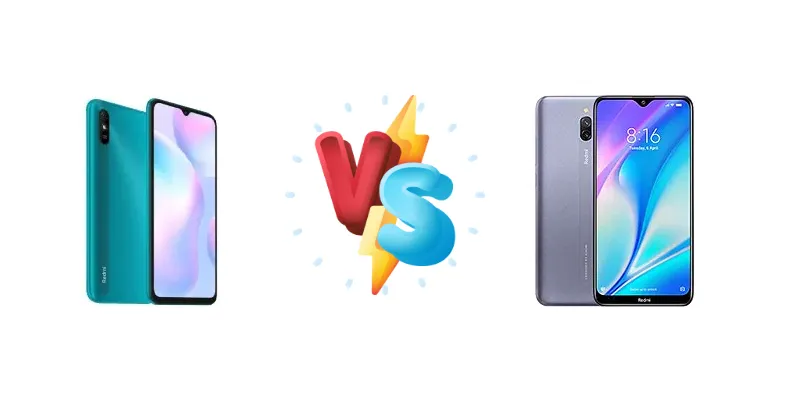
The Xiaomi Redmi 9AT and 8A Pro represent two compelling options in the ultra-budget smartphone space. While both aim to deliver essential smartphone functionality at a low price point, they diverge in key areas like chipset and charging capabilities. This comparison dissects these differences to determine which device offers the best value for specific user needs.
🏆 Quick Verdict
For most users, the Xiaomi Redmi 8A Pro is the better choice. Its 18W charging significantly reduces downtime compared to the 9AT’s 10W charging, and while the Snapdragon 439 isn't a powerhouse, it offers a slightly more refined experience than the Helio G25 in everyday tasks. However, the 9AT remains a viable option for those prioritizing absolute lowest cost.
| Network |
|---|
| 2G bands | GSM 850 / 900 / 1800 / 1900 | GSM 850 / 900 / 1800 / 1900 |
| 3G bands | HSDPA 850 / 900 / 1700(AWS) / 1900 / 2100 | HSDPA 850 / 900 / 1900 / 2100 |
| 4G bands | 1, 2, 3, 4, 5, 7, 8, 20, 28, 38, 40, 41 | 1, 3, 5, 8, 40, 41 |
| Speed | HSPA, LTE | HSPA, LTE |
| Technology | GSM / HSPA / LTE | GSM / HSPA / LTE |
| Launch |
|---|
| Announced | 2020, September 09. Released 2020, September 09 | 2020, April 02. Released 2020, April 02 |
| Status | Discontinued | Discontinued |
| Body |
|---|
| Build | - | Glass front (Gorilla Glass 5), plastic back, plastic frame |
| Dimensions | 164.9 x 77 x 9 mm (6.49 x 3.03 x 0.35 in) | 156.5 x 75.4 x 9.4 mm (6.16 x 2.97 x 0.37 in) |
| SIM | Nano-SIM + Nano-SIM | Nano-SIM + Nano-SIM |
| Weight | 194 g (6.84 oz) | 188 g (6.63 oz) |
| | - | Water-repellent coating |
| Display |
|---|
| Protection | - | Corning Gorilla Glass 5 |
| Resolution | 720 x 1600 pixels, 20:9 ratio (~269 ppi density) | 720 x 1520 pixels, 19:9 ratio (~270 ppi density) |
| Size | 6.53 inches, 102.9 cm2 (~81.1% screen-to-body ratio) | 6.22 inches, 96.6 cm2 (~81.8% screen-to-body ratio) |
| Type | IPS LCD, 400 nits (typ) | IPS LCD, 400 nits (typ) |
| Platform |
|---|
| CPU | Octa-core (4x2.0 GHz Cortex-A53 & 4x1.5 GHz Cortex-A53) | Octa-core (4x1.95 GHz Cortex-A53 & 4x1.45 GHz Cortex A53) |
| Chipset | Mediatek MT6762G Helio G25 (12 nm) | Qualcomm SDM439 Snapdragon 439 (12 nm) |
| GPU | PowerVR GE8320 | Adreno 505 |
| OS | Android 10, MIUI 12 | Android 9.0 (Pie), planned upgrade to Android 10, MIUI 12 |
| Memory |
|---|
| Card slot | microSDXC (dedicated slot) | microSDXC (dedicated slot) |
| Internal | 32GB 2GB RAM | 32GB 2GB RAM, 32GB 3GB RAM |
| | eMMC 5.1 | eMMC 5.1 |
| Main Camera |
|---|
| Dual | - | 13 MP, f/2.2, (wide), 1/3.1", 1.12µm, PDAF
Auxiliary lens |
| Features | LED flash, HDR | LED flash, HDR, panorama |
| Single | 13 MP, f/2.2, 28mm (wide), 1.0µm, PDAF | - |
| Video | 1080p@30/60fps | 1080p@30fps |
| Selfie camera |
|---|
| Features | HDR | HDR |
| Single | 5 MP, f/2.2, (wide), 1.12µm | 8 MP, f/2.0, 1/4.0", 1.12µm |
| Video | 1080p@30fps | 1080p@30fps |
| Sound |
|---|
| 3.5mm jack | Yes | Yes |
| 35mm jack | Yes | Yes |
| Loudspeaker | Yes | Yes |
| Comms |
|---|
| Bluetooth | 5.0, A2DP, LE | 4.2, A2DP, LE |
| NFC | No | No |
| Positioning | GPS, GLONASS, BDS | GPS, GLONASS, BDS |
| Radio | FM radio | FM Radio, built-in antenna |
| USB | microUSB 2.0, OTG | USB Type-C 2.0, OTG |
| WLAN | Wi-Fi 802.11 b/g/n, Wi-Fi Direct | Wi-Fi 802.11 b/g/n, Wi-Fi Direct |
| Features |
|---|
| Sensors | Accelerometer, proximity | Accelerometer, proximity, compass |
| Battery |
|---|
| Charging | 10W wired | 18W wired
2.5W reverse wired |
| Type | Li-Po 5000 mAh | Li-Po 5000 mAh |
| Misc |
|---|
| Colors | Carbon Gray, Sky Blue, Ocean Green | Sky White, Sea Blue, Midnight Grey |
| Models | M2006C3LVG | - |
| Price | About 80 EUR | About 90 EUR |
| SAR | 0.87 W/kg (head) 1.01 W/kg (body) | - |
| SAR EU | 0.78 W/kg (head) 1.03 W/kg (body) | - |
Xiaomi Redmi 9AT
- Potentially lower price point
- Large 5000mAh battery (estimated)
- Simple and straightforward user experience
- Slow 10W charging
- Less powerful Mediatek Helio G25 chipset
- Likely less refined software experience
Xiaomi Redmi 8A Pro
- Faster 18W charging with reverse charging
- More efficient Qualcomm Snapdragon 439 chipset
- Potentially better camera image processing
- Slightly higher price
- Battery life may not be significantly better despite faster charging
- Still an entry-level processor
Display Comparison
Both the Redmi 9AT and 8A Pro feature similar 6.2-inch LCD displays, but detailed specifications like resolution and brightness are not provided. Given their price point, expect 720p+ resolution and modest brightness levels. The lack of higher refresh rates is standard for this segment. The user experience will likely be comparable in terms of visual fidelity, with the display quality being adequate for basic consumption.
Camera Comparison
Camera details are limited, but both phones likely feature a primary camera and depth sensor. Without specific sensor sizes or aperture information, a direct comparison is difficult. However, the image processing capabilities of Qualcomm’s ISP (Image Signal Processor) in the Snapdragon 439 often result in slightly more natural-looking photos compared to Mediatek’s offerings. The absence of Optical Image Stabilization (OIS) on either device means low-light performance will be a challenge, relying heavily on software processing.
Performance
The core difference lies in the chipsets. The Redmi 9AT utilizes the Mediatek Helio G25, an octa-core processor with a split core configuration of 4x2.0 GHz Cortex-A53 and 4x1.5 GHz Cortex-A53. The Redmi 8A Pro, conversely, is powered by the Qualcomm Snapdragon 439, also an octa-core chip with 4x1.95 GHz Cortex-A53 and 4x1.45 GHz Cortex A53 cores. While both are entry-level, the Snapdragon 439 generally exhibits slightly better sustained performance and efficiency due to Qualcomm’s optimizations. The G25’s higher clock speeds on some cores don’t necessarily translate to a faster real-world experience, as the Snapdragon 439 benefits from a more mature architecture and software support. This means the 8A Pro will likely handle multitasking and app loading with a bit more fluidity.
Battery Life
Both devices likely house batteries around the 5000mAh capacity, typical for this price range. However, the Redmi 8A Pro boasts 18W wired charging, a significant advantage over the Redmi 9AT’s 10W charging. This translates to substantially faster charging times – potentially reducing a full charge from over 3 hours with the 9AT to around 2 hours with the 8A Pro. Furthermore, the 8A Pro includes 2.5W reverse wired charging, allowing it to act as a power bank for other devices, a feature absent on the 9AT.
Buying Guide
Buy the Xiaomi Redmi 9AT if you need a smartphone for extremely basic tasks – calls, texts, and light social media – and are on the tightest possible budget. The 9AT prioritizes affordability above all else. Buy the Xiaomi Redmi 8A Pro if you value faster charging, slightly smoother performance for multitasking, and the convenience of reverse wired charging, even if it means spending a little more upfront.
Frequently Asked Questions
❓ Will the Redmi 8A Pro’s Snapdragon 439 struggle with popular apps like WhatsApp and Facebook?
No, the Snapdragon 439 is perfectly capable of handling everyday apps like WhatsApp, Facebook, and web browsing. While it won’t excel at demanding tasks, it provides a smooth and responsive experience for typical smartphone usage.
❓ How much faster is the 18W charging on the Redmi 8A Pro compared to the 10W charging on the Redmi 9AT?
The 18W charging on the Redmi 8A Pro can reduce full charge times by approximately 60-90 minutes compared to the Redmi 9AT’s 10W charging. This is a substantial difference, especially for users who frequently need to top up their battery.
❓ Does the Redmi 9AT support fast charging at all, or is it limited to 10W?
The Redmi 9AT is limited to 10W charging. While it may technically accept a higher wattage charger, it will only draw power at 10W, meaning you won't see any faster charging speeds.
❓ Is the reverse charging feature on the Redmi 8A Pro useful for everyday use?
The 2.5W reverse charging is primarily useful in emergencies. It's slow and won't fully charge another device quickly, but it can provide a small boost to a friend's phone or wireless earbuds if you're in a pinch.