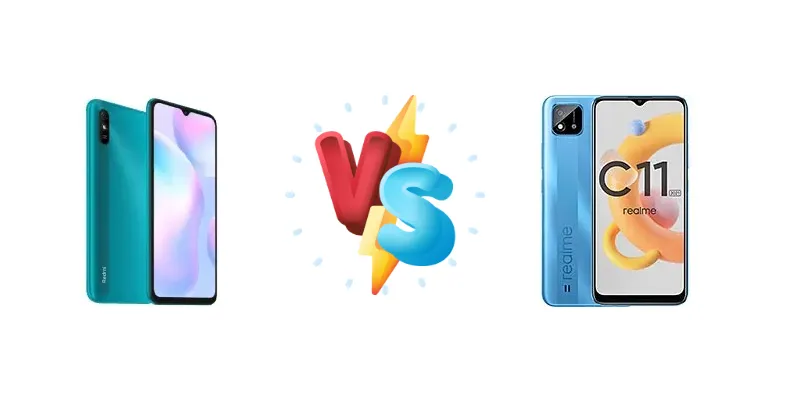
The Xiaomi Redmi 9AT and Realme C11 (2021) represent the absolute bottom end of the smartphone market, competing fiercely for buyers prioritizing affordability above all else. Both aim to deliver essential smartphone functionality at a price point that’s accessible to everyone, but significant differences in their underlying hardware dictate which device offers the better experience.
🏆 Quick Verdict
For the average user, the Xiaomi Redmi 9AT emerges as the slightly better choice. Its Mediatek Helio G25 chipset, built on a more efficient 12nm process, provides a noticeable performance edge over the Realme C11 (2021)'s Unisoc SC9863A, despite the latter's slightly higher clock speeds on some cores. This translates to smoother multitasking and a more responsive user interface.
| Network |
|---|
| 2G bands | GSM 850 / 900 / 1800 / 1900 | GSM 850 / 900 / 1800 / 1900 |
| 3G bands | HSDPA 850 / 900 / 1700(AWS) / 1900 / 2100 | HSDPA 850 / 900 / 1900 / 2100 |
| 4G bands | 1, 2, 3, 4, 5, 7, 8, 20, 28, 38, 40, 41 | 1, 3, 5, 8, 38, 40, 41 |
| Speed | HSPA, LTE | HSPA, LTE |
| Technology | GSM / HSPA / LTE | GSM / HSPA / LTE |
| Launch |
|---|
| Announced | 2020, September 09. Released 2020, September 09 | 2021, June 28 |
| Status | Discontinued | Available. Released 2021, June 28 |
| Body |
|---|
| Build | - | Glass front, plastic frame, plastic back |
| Dimensions | 164.9 x 77 x 9 mm (6.49 x 3.03 x 0.35 in) | 165.2 x 76.4 x 8.9 mm (6.50 x 3.01 x 0.35 in) |
| SIM | Nano-SIM + Nano-SIM | Nano-SIM + Nano-SIM |
| Weight | 194 g (6.84 oz) | 190 g (6.70 oz) |
| | - | Splash resistant design |
| Display |
|---|
| Resolution | 720 x 1600 pixels, 20:9 ratio (~269 ppi density) | 720 x 1600 pixels, 20:9 ratio (~269 ppi density) |
| Size | 6.53 inches, 102.9 cm2 (~81.1% screen-to-body ratio) | 6.52 inches, 102.6 cm2 (~81.3% screen-to-body ratio) |
| Type | IPS LCD, 400 nits (typ) | IPS LCD, 400 nits (typ) |
| Platform |
|---|
| CPU | Octa-core (4x2.0 GHz Cortex-A53 & 4x1.5 GHz Cortex-A53) | Octa-core (4x1.6 GHz Cortex-A55 & 4x1.2 GHz Cortex-A55) |
| Chipset | Mediatek MT6762G Helio G25 (12 nm) | Unisoc SC9863A (28 nm) |
| GPU | PowerVR GE8320 | IMG8322 |
| OS | Android 10, MIUI 12 | Android 11, Realme Go UI |
| Memory |
|---|
| Card slot | microSDXC (dedicated slot) | microSDXC (dedicated slot) |
| Internal | 32GB 2GB RAM | 32GB 2GB RAM, 64GB 4GB RAM |
| | eMMC 5.1 | eMMC 5.1 |
| Main Camera |
|---|
| Features | LED flash, HDR | LED flash, HDR, panorama |
| Single | 13 MP, f/2.2, 28mm (wide), 1.0µm, PDAF | 8 MP, f/2.0, (wide), AF |
| Video | 1080p@30/60fps | 1080p@30fps |
| Selfie camera |
|---|
| Features | HDR | HDR, panorama |
| Single | 5 MP, f/2.2, (wide), 1.12µm | 5 MP, f/2.2, (wide) |
| Video | 1080p@30fps | 1080p@30fps |
| Sound |
|---|
| 3.5mm jack | Yes | Yes |
| 35mm jack | Yes | Yes |
| Loudspeaker | Yes | Yes |
| Comms |
|---|
| Bluetooth | 5.0, A2DP, LE | 4.2, A2DP |
| NFC | No | No |
| Positioning | GPS, GLONASS, BDS | GPS, GLONASS, GALILEO, BDS |
| Radio | FM radio | Unspecified |
| USB | microUSB 2.0, OTG | microUSB 2.0, OTG |
| WLAN | Wi-Fi 802.11 b/g/n, Wi-Fi Direct | Wi-Fi 802.11 b/g/n |
| Features |
|---|
| Sensors | Accelerometer, proximity | Accelerometer, gyro, proximity, compass |
| Battery |
|---|
| Charging | 10W wired | 10W wired
Reverse wired |
| Type | Li-Po 5000 mAh | 5000 mAh |
| Misc |
|---|
| Colors | Carbon Gray, Sky Blue, Ocean Green | Cool Blue, Cool Grey |
| Models | M2006C3LVG | RMX3231 |
| Price | About 80 EUR | About 80 EUR |
| SAR | 0.87 W/kg (head) 1.01 W/kg (body) | - |
| SAR EU | 0.78 W/kg (head) 1.03 W/kg (body) | - |
Xiaomi Redmi 9AT
- Better CPU performance due to the Helio G25 chipset.
- More efficient 12nm manufacturing process.
- Potentially smoother multitasking experience.
- Lacks reverse wired charging.
- Camera performance likely similar to the Realme C11 (2021) without detailed specs.
Realme C11 (2021)
- Reverse wired charging for powering accessories.
- Potentially slightly lower price point.
- Acceptable battery life for basic usage.
- Less powerful Unisoc SC9863A chipset.
- Less efficient 28nm manufacturing process.
- Potentially slower app loading and multitasking.
Display Comparison
Neither device boasts a particularly impressive display. Both likely utilize LCD panels, a standard for this price bracket. However, detailed specifications regarding brightness and color accuracy are unavailable. The Realme C11 (2021) doesn't offer any standout display features, while the Redmi 9AT's display quality is likely similar, focusing on basic readability rather than visual fidelity. Bezels are expected to be substantial on both models, maximizing screen real estate within their budget constraints.
Camera Comparison
Camera performance on both devices will be limited. Detailed sensor information is lacking, but both likely feature a primary camera paired with basic auxiliary lenses (often 2MP depth or macro sensors of limited utility). The focus should be on the main sensor's capabilities, but without specific details, it's difficult to declare a clear winner. Image processing will likely be basic on both, prioritizing speed over detail and dynamic range. Expect acceptable results in good lighting conditions, but significant noise and softness in low light.
Performance
The core difference lies in the chipsets. The Redmi 9AT’s Mediatek Helio G25, fabricated on a 12nm process, offers a more modern architecture than the Realme C11 (2021)’s Unisoc SC9863A, which is built on a less efficient 28nm node. While the Unisoc chip has a similar octa-core configuration, the Cortex-A55 cores at 1.6GHz and 1.2GHz are less powerful than the Redmi 9AT’s 2.0GHz and 1.5GHz Cortex-A53 cores. This translates to a performance advantage for the Redmi 9AT in CPU-intensive tasks. The 12nm process also contributes to better thermal efficiency, potentially reducing throttling during sustained use. Neither phone is a gaming powerhouse, but the Redmi 9AT will handle lighter titles more smoothly.
Battery Life
Both phones feature 10W wired charging, indicating similar charging speeds – expect around 2.5 to 3 hours for a full charge. Battery capacity is not specified, but given the target market, both likely house batteries in the 4000-5000mAh range. The Realme C11 (2021) adds the convenience of reverse wired charging, allowing it to function as a power bank for other devices, a feature absent on the Redmi 9AT. This is a significant advantage for users who frequently rely on accessories or need to charge other devices on the go.
Buying Guide
Buy the Xiaomi Redmi 9AT if you prioritize a more fluid user experience and slightly better performance for basic tasks like social media and web browsing. It’s the better option for those who occasionally play light mobile games. Buy the Realme C11 (2021) if reverse wired charging is a must-have feature, allowing you to top up accessories or other devices, and if you are on an extremely tight budget where every dollar counts.
Frequently Asked Questions
❓ Will the Redmi 9AT handle popular games like PUBG Mobile or Call of Duty?
While the Redmi 9AT can *run* these games, expect to play them at the lowest graphics settings and potentially with frame rate drops. The Helio G25 isn't a gaming-focused chipset, and these titles are demanding. The Realme C11 (2021) will likely offer a similar, or slightly worse, gaming experience.
❓ Is the reverse charging feature on the Realme C11 (2021) fast enough to quickly charge my earbuds?
No, the 10W reverse charging on the Realme C11 (2021) is relatively slow. It's best suited for topping up small devices like earbuds or smartwatches over a longer period, rather than quickly charging a phone. Don't expect a significant charge boost in a short amount of time.
❓ How much storage space is realistically usable on each phone after the operating system and pre-installed apps are accounted for?
Both phones likely come with 32GB of storage, but realistically, you'll have around 20-22GB of usable space after the operating system and pre-installed apps. We strongly recommend using a microSD card to expand storage on either device.