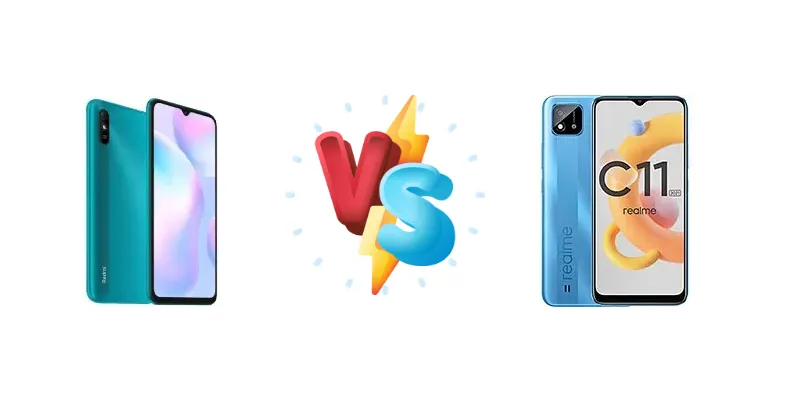
The Xiaomi Redmi 9A and Realme C11 (2021) represent the extreme end of the smartphone price spectrum. Both aim to deliver essential functionality at an incredibly low cost, but they achieve this with different hardware approaches. This comparison dissects the key differences between the Mediatek Helio G25-powered Redmi 9A and the Unisoc SC9863A-equipped Realme C11 (2021), helping you determine which offers the best value for your needs.
🏆 Quick Verdict
For the average user prioritizing slightly smoother performance in everyday tasks, the Xiaomi Redmi 9A emerges as the better choice. Its Helio G25 chipset, built on a more modern 12nm process, offers a tangible advantage over the older 28nm Unisoc SC9863A in the Realme C11 (2021), despite similar core counts.
| Network |
|---|
| 2G bands | GSM 850 / 900 / 1800 / 1900 | GSM 850 / 900 / 1800 / 1900 |
| 3G bands | HSDPA 850 / 900 / 1700(AWS) / 1900 / 2100 - International | HSDPA 850 / 900 / 1900 / 2100 |
| 4G bands | 1, 2, 3, 4, 5, 7, 8, 20, 28, 38, 40, 41 - International | 1, 3, 5, 8, 38, 40, 41 |
| Speed | HSPA, LTE | HSPA, LTE |
| Technology | GSM / HSPA / LTE | GSM / HSPA / LTE |
| | 1, 3, 5, 8, 40, 41 - India | - |
| Launch |
|---|
| Announced | 2020, June 30. Released 2020, July 07 | 2021, June 28 |
| Status | Discontinued | Available. Released 2021, June 28 |
| Body |
|---|
| Build | - | Glass front, plastic frame, plastic back |
| Dimensions | 164.9 x 77.1 x 9 mm (6.49 x 3.04 x 0.35 in) | 165.2 x 76.4 x 8.9 mm (6.50 x 3.01 x 0.35 in) |
| SIM | Nano-SIM + Nano-SIM | Nano-SIM + Nano-SIM |
| Weight | 196 g (6.91 oz) | 190 g (6.70 oz) |
| | - | Splash resistant design |
| Display |
|---|
| Resolution | 720 x 1600 pixels, 20:9 ratio (~269 ppi density) | 720 x 1600 pixels, 20:9 ratio (~269 ppi density) |
| Size | 6.53 inches, 102.9 cm2 (~81.0% screen-to-body ratio) | 6.52 inches, 102.6 cm2 (~81.3% screen-to-body ratio) |
| Type | IPS LCD, 400 nits (typ) | IPS LCD, 400 nits (typ) |
| Platform |
|---|
| CPU | Octa-core (4x2.0 GHz Cortex-A53 & 4x1.5 GHz Cortex-A53) | Octa-core (4x1.6 GHz Cortex-A55 & 4x1.2 GHz Cortex-A55) |
| Chipset | Mediatek MT6762G Helio G25 (12 nm) | Unisoc SC9863A (28 nm) |
| GPU | PowerVR GE8320 | IMG8322 |
| OS | Android 10, upgradable to Android 11, MIUI 12 | Android 11, Realme Go UI |
| Memory |
|---|
| Card slot | microSDXC (dedicated slot) | microSDXC (dedicated slot) |
| Internal | 32GB 2GB RAM, 32GB 3GB RAM, 64GB 4GB RAM, 128GB 4GB RAM, 128GB 6GB RAM | 32GB 2GB RAM, 64GB 4GB RAM |
| | eMMC 5.1 | eMMC 5.1 |
| Main Camera |
|---|
| Features | LED flash, HDR | LED flash, HDR, panorama |
| Single | 13 MP, f/2.2, 28mm (wide), 1.0µm, PDAF | 8 MP, f/2.0, (wide), AF |
| Video | 1080p@30/60fps | 1080p@30fps |
| Selfie camera |
|---|
| Features | HDR | HDR, panorama |
| Single | 5 MP, f/2.2, (wide), 1.12µm | 5 MP, f/2.2, (wide) |
| Video | 1080p@30fps | 1080p@30fps |
| Sound |
|---|
| 3.5mm jack | Yes | Yes |
| 35mm jack | Yes | Yes |
| Loudspeaker | Yes | Yes |
| Comms |
|---|
| Bluetooth | 5.0, A2DP, LE | 4.2, A2DP |
| NFC | No | No |
| Positioning | GPS, GLONASS, BDS | GPS, GLONASS, GALILEO, BDS |
| Radio | FM radio | Unspecified |
| USB | microUSB 2.0, OTG | microUSB 2.0, OTG |
| WLAN | Wi-Fi 802.11 b/g/n, Wi-Fi Direct | Wi-Fi 802.11 b/g/n |
| Features |
|---|
| Sensors | Accelerometer, proximity | Accelerometer, gyro, proximity, compass |
| Battery |
|---|
| Charging | 10W wired | 10W wired
Reverse wired |
| Type | Li-Po 5000 mAh | 5000 mAh |
| Misc |
|---|
| Colors | Carbon Gray (Midnight Black), Sky Blue (Sea Blue), Ocean Green (Nature Green) | Cool Blue, Cool Grey |
| Models | M2006C3LG, M2006C3LI, M2006C3LC, M2004C3L | RMX3231 |
| Price | € 64.30 / $ 56.50 / £ 95.56 | About 80 EUR |
| SAR | 0.90 W/kg (head) 0.65 W/kg (body) | - |
| SAR EU | 0.40 W/kg (head) 1.19 W/kg (body) | - |
Xiaomi Redmi 9A
- More efficient Helio G25 chipset
- Higher CPU clock speeds for better responsiveness
- Potentially better thermal management
- Lacks reverse wired charging
- Basic camera system
Realme C11 (2021)
- Convenient reverse wired charging
- Affordable price point
- Acceptable battery life
- Less powerful Unisoc SC9863A chipset
- Older 28nm manufacturing process
- Potentially more noticeable lag
Display Comparison
Neither device boasts a standout display. Both are likely to feature LCD panels with resolutions around 720p+, typical for this price point. However, the lack of detailed display specifications necessitates focusing on the chipset's impact on UI smoothness. A faster processor, like the Redmi 9A's Helio G25, can mitigate the perception of a lower-resolution display by ensuring quicker rendering of animations and transitions.
Camera Comparison
Both phones are expected to feature basic camera setups, likely headlined by a 13MP main sensor. However, without aperture or sensor size details, a direct comparison is difficult. The image processing capabilities of the respective chipsets will play a significant role. Given Mediatek’s generally more refined image signal processing (ISP), the Redmi 9A may produce slightly more detailed and vibrant photos, particularly in good lighting conditions. The presence of 2MP auxiliary lenses on both devices is largely marketing fluff and shouldn't heavily influence purchasing decisions.
Performance
The core difference lies in the chipsets. The Redmi 9A’s Mediatek Helio G25 (12nm) utilizes a more efficient manufacturing process than the Realme C11 (2021)’s Unisoc SC9863A (28nm). While both are octa-core CPUs, the Helio G25’s Cortex-A53 cores are clocked higher (2.0 GHz vs 1.6 GHz) and benefit from the smaller node size, resulting in better power efficiency and sustained performance. The Unisoc SC9863A’s lower clock speeds and older architecture will likely result in more noticeable lag during app switching and heavier tasks. The 12nm process of the Helio G25 also implies better thermal management, potentially reducing throttling during prolonged use.
Battery Life
Both devices feature 10W wired charging, indicating similar charging speeds (approximately 3-4 hours for a full charge). While battery capacity isn't specified, both are likely in the 5000mAh range, common for budget smartphones. The Realme C11 (2021) gains a unique advantage with reverse wired charging, allowing it to function as a power bank for other devices. However, the Helio G25’s improved power efficiency in the Redmi 9A could translate to slightly longer battery life during typical usage, offsetting the convenience of reverse charging for some users.
Buying Guide
Buy the Xiaomi Redmi 9A if you need a phone that feels a bit more responsive for basic multitasking, social media, and light gaming. The Helio G25 provides a small but noticeable performance edge. Buy the Realme C11 (2021) if you value the convenience of reverse wired charging, allowing you to top up accessories directly from your phone, and are willing to accept slightly slower performance in exchange.
Frequently Asked Questions
❓ Will the Unisoc SC9863A in the Realme C11 (2021) struggle with popular apps like WhatsApp and Facebook?
While the Realme C11 (2021) can run these apps, the Unisoc SC9863A’s lower processing power may result in noticeable lag when switching between apps or loading heavier content within them. The Redmi 9A’s Helio G25 will provide a smoother experience for these common tasks.
❓ Is the reverse charging feature on the Realme C11 (2021) fast enough to be useful?
The Realme C11 (2021)'s reverse charging, at 10W, is relatively slow. It's best suited for topping up accessories like wireless earbuds or smartwatches, rather than fully charging another phone. Expect a significant time investment to provide a substantial charge to another device.
❓ Can either of these phones handle basic mobile games like PUBG Mobile or Call of Duty Mobile?
Both phones will struggle with graphically demanding games like PUBG Mobile or Call of Duty Mobile. You'll likely need to play at the lowest settings and frame rates to achieve playable performance, and even then, expect stuttering and lag. The Helio G25 in the Redmi 9A will offer a slightly better experience, but neither phone is designed for serious gaming.