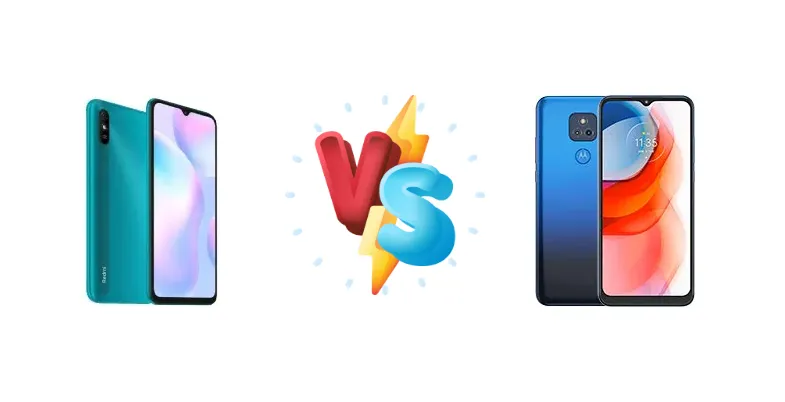
The sub-$150 smartphone market is fiercely competitive. Both the Xiaomi Redmi 9A and the Motorola Moto G Play (2021) aim to deliver essential smartphone functionality at an incredibly accessible price point. However, they take different approaches to achieving this, primarily through their chipset choices. This comparison dissects the key differences between the MediaTek Helio G25-powered Redmi 9A and the Qualcomm Snapdragon 460-equipped Moto G Play, helping you determine which device best suits your needs.
🏆 Quick Verdict
For most users, the Motorola Moto G Play (2021) is the better choice. While both phones offer similar 10W charging and basic functionality, the Snapdragon 460’s more efficient 11nm process and superior CPU architecture translate to a noticeably smoother user experience, particularly when multitasking or running slightly more demanding apps.
| Network |
|---|
| 2G bands | GSM 850 / 900 / 1800 / 1900 | GSM 850 / 900 / 1800 / 1900 |
| 3G bands | HSDPA 850 / 900 / 1700(AWS) / 1900 / 2100 - International | HSDPA 850 / 900 / 1700(AWS) / 1900 / 2100 |
| 4G bands | 1, 2, 3, 4, 5, 7, 8, 20, 28, 38, 40, 41 - International | 1, 2, 3, 4, 5, 7, 8, 12, 13, 17, 25, 26, 38, 41, 66, 71 |
| Speed | HSPA, LTE | HSPA, LTE |
| Technology | GSM / HSPA / LTE | GSM / CDMA / HSPA / LTE |
| | 1, 3, 5, 8, 40, 41 - India | 2, 4, 5, 12, 14, 30, 66 |
| Launch |
|---|
| Announced | 2020, June 30. Released 2020, July 07 | 2021, January 08 |
| Status | Discontinued | Available. Released 2021, January 14 |
| Body |
|---|
| Build | - | Plastic frame, plastic back |
| Dimensions | 164.9 x 77.1 x 9 mm (6.49 x 3.04 x 0.35 in) | 166.6 x 76 x 9.4 mm (6.56 x 2.99 x 0.37 in) |
| SIM | Nano-SIM + Nano-SIM | Nano-SIM |
| Weight | 196 g (6.91 oz) | 204 g (7.20 oz) |
| | - | Water-repellent coating |
| Display |
|---|
| Resolution | 720 x 1600 pixels, 20:9 ratio (~269 ppi density) | 720 x 1600 pixels, 20:9 ratio (~270 ppi density) |
| Size | 6.53 inches, 102.9 cm2 (~81.0% screen-to-body ratio) | 6.5 inches, 102.0 cm2 (~80.6% screen-to-body ratio) |
| Type | IPS LCD, 400 nits (typ) | IPS LCD |
| Platform |
|---|
| CPU | Octa-core (4x2.0 GHz Cortex-A53 & 4x1.5 GHz Cortex-A53) | Octa-core (4x1.8 GHz Kryo 240 & 4x1.6 GHz Kryo 240) |
| Chipset | Mediatek MT6762G Helio G25 (12 nm) | Qualcomm SM4250 Snapdragon 460 (11 nm) |
| GPU | PowerVR GE8320 | Adreno 610 |
| OS | Android 10, upgradable to Android 11, MIUI 12 | Android 10 |
| Memory |
|---|
| Card slot | microSDXC (dedicated slot) | microSDXC (dedicated slot) |
| Internal | 32GB 2GB RAM, 32GB 3GB RAM, 64GB 4GB RAM, 128GB 4GB RAM, 128GB 6GB RAM | 32GB 3GB RAM |
| | eMMC 5.1 | eMMC 5.1 |
| Main Camera |
|---|
| Dual | - | 13 MP, f/2.0, (wide), 1/3.1", 1.12µm, PDAF
Auxiliary lens |
| Features | LED flash, HDR | LED flash, HDR, panorama |
| Single | 13 MP, f/2.2, 28mm (wide), 1.0µm, PDAF | - |
| Video | 1080p@30/60fps | 1080p@30/60fps |
| Selfie camera |
|---|
| Features | HDR | HDR |
| Single | 5 MP, f/2.2, (wide), 1.12µm | 5 MP, f/2.2, (wide), 1.12µm |
| Video | 1080p@30fps | 1080p@30fps |
| Sound |
|---|
| 3.5mm jack | Yes | Yes |
| 35mm jack | Yes | Yes |
| Loudspeaker | Yes | Yes |
| Comms |
|---|
| Bluetooth | 5.0, A2DP, LE | 5.0, A2DP, LE |
| NFC | No | No |
| Positioning | GPS, GLONASS, BDS | GPS, GLONASS, GALILEO |
| Radio | FM radio | Unspecified |
| USB | microUSB 2.0, OTG | USB Type-C 2.0 |
| WLAN | Wi-Fi 802.11 b/g/n, Wi-Fi Direct | Wi-Fi 802.11 a/b/g/n/ac, dual-band, Wi-Fi Direct |
| Features |
|---|
| Sensors | Accelerometer, proximity | Fingerprint (rear-mounted), accelerometer, proximity |
| Battery |
|---|
| Charging | 10W wired | 10W wired |
| Type | Li-Po 5000 mAh | Li-Po 5000 mAh |
| Misc |
|---|
| Colors | Carbon Gray (Midnight Black), Sky Blue (Sea Blue), Ocean Green (Nature Green) | Misty Blue |
| Models | M2006C3LG, M2006C3LI, M2006C3LC, M2004C3L | XT2093-3, XT2093-7, XT2093-DL, XT2093DL |
| Price | € 64.30 / $ 56.50 / £ 95.56 | About 60 EUR |
| SAR | 0.90 W/kg (head) 0.65 W/kg (body) | - |
| SAR EU | 0.40 W/kg (head) 1.19 W/kg (body) | - |
Xiaomi Redmi 9A
- Potentially lower price point
- Larger battery capacity (5000mAh)
- Widely available
- Less efficient chipset (Helio G25)
- Slower app loading times
- Less responsive user interface
Motorola Moto G Play (2021)
- More efficient chipset (Snapdragon 460)
- Smoother multitasking experience
- Better CPU architecture (Kryo 240)
- Smaller battery capacity (4000mAh)
- May be slightly more expensive
- Motorola's software update track record can be inconsistent
Display Comparison
Neither device boasts a standout display. Both are likely to feature LCD panels, typical for this price bracket. The focus here isn't on visual fidelity, but on basic usability. Without specific display specs, it's difficult to declare a winner, but Motorola often prioritizes color accuracy even in budget models, potentially giving it a slight edge. Bezels are expected to be substantial on both devices, maximizing screen real estate within a compact form factor.
Camera Comparison
Both phones are expected to feature basic camera setups. Without detailed sensor information, it’s safe to assume both will rely on a primary sensor paired with auxiliary lenses of limited utility. The Redmi 9A is known to include a 13MP main camera, while the Moto G Play (2021) features a 13MP sensor as well. Image processing will likely be the differentiating factor, and Motorola’s software tends to lean towards more natural-looking images, while Xiaomi often employs more aggressive sharpening. Don't expect exceptional low-light performance from either device.
Performance
The core difference lies in the chipsets. The Motorola Moto G Play (2021) utilizes the Qualcomm Snapdragon 460, fabricated on an 11nm process. This process node is more efficient than the 12nm process used for the Xiaomi Redmi 9A’s MediaTek Helio G25. The Snapdragon 460’s Kryo 240 cores, while still entry-level, offer a more modern architecture than the Cortex-A53 cores in the Helio G25. The G25’s octa-core configuration (4x2.0 GHz & 4x1.5 GHz) is offset by the less efficient architecture and larger process node. This translates to the Moto G Play handling multitasking and app launches with less lag. While neither is a gaming powerhouse, the Snapdragon 460 will provide a more playable experience in less demanding titles.
Battery Life
Both devices are equipped with 10W wired charging, indicating similar charging speeds. The Redmi 9A typically features a 5000mAh battery, while the Moto G Play (2021) has a 4000mAh battery. While the Redmi 9A has a larger capacity, the Snapdragon 460’s superior power efficiency could result in comparable real-world battery life. The 11nm process allows the Moto G Play to sip power more efficiently during everyday tasks, potentially offsetting the smaller battery size. Expect both phones to last a full day with moderate use.
Buying Guide
Buy the Xiaomi Redmi 9A if you prioritize a potentially lower initial cost and are primarily focused on extremely basic tasks like calls, texts, and light social media use. Buy the Motorola Moto G Play (2021) if you value a more responsive user experience, slightly better performance for app switching and light gaming, and a chipset from a more established brand known for software support.
Frequently Asked Questions
❓ Will the Moto G Play (2021) struggle with popular apps like Facebook or WhatsApp?
The Snapdragon 460 in the Moto G Play (2021) is sufficiently capable of running apps like Facebook and WhatsApp smoothly. While it won't offer a blazing-fast experience, it will handle these everyday tasks without significant lag, unlike the Redmi 9A which may exhibit noticeable slowdowns when multiple apps are open.
❓ Is the Redmi 9A a good option for someone who primarily makes calls and sends texts?
Yes, the Redmi 9A is a perfectly adequate choice for basic communication. Its larger battery capacity ensures all-day battery life for calls and texts. However, if you anticipate using any apps beyond the basics, the Moto G Play (2021) will provide a more pleasant experience.
❓ Can either of these phones handle light gaming, like Candy Crush or Subway Surfers?
Both phones can handle light gaming, but the Moto G Play (2021) will offer a more consistent frame rate and less stuttering due to the Snapdragon 460’s superior GPU. The Helio G25 in the Redmi 9A may struggle with maintaining a smooth experience during more visually demanding moments in these games.
❓ How long will it take to fully charge either phone with the included 10W charger?
Expect a full charge to take approximately 3-4 hours with the included 10W charger for both devices. The Redmi 9A’s larger battery will likely take slightly longer, but the difference won’t be substantial.