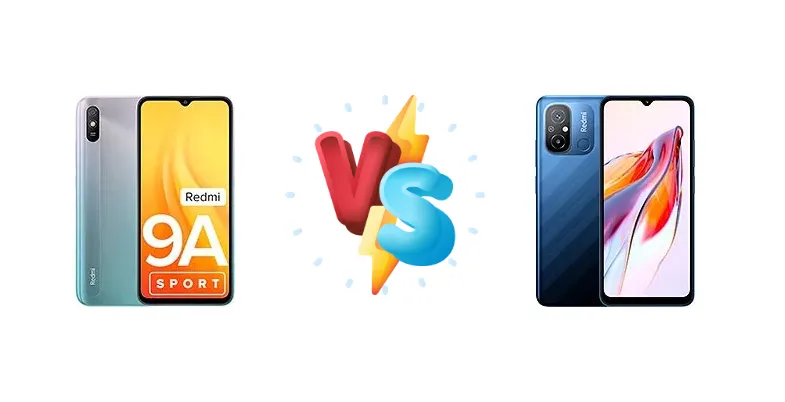
The Xiaomi Redmi series consistently delivers excellent value for money. Two contenders vying for your attention are the Redmi 9A Sport and the Redmi 12C. Both offer affordable entry points into the smartphone world, but significant differences exist. Let's dive into a comprehensive comparison to help you choose the right one.
🏆 Quick Verdict
The Redmi 12C is the clear winner. While the 9A Sport is a budget-friendly option, the 12C's significantly more powerful Helio G85 chipset, improved camera, and slightly better display make it a more compelling choice for most users, despite similar charging speeds.
| Network |
|---|
| 2G bands | GSM 850 / 900 / 1800 / 1900 | GSM 850 / 900 / 1800 / 1900 |
| 3G bands | HSDPA 850 / 900 / 2100 | HSDPA 850 / 900 / 2100 |
| 4G bands | 1, 3, 5, 8, 40, 41 | 1, 3, 5, 7, 8, 20, 28, 38, 40, 41 - International |
| Speed | HSPA, LTE | HSPA, LTE |
| Technology | GSM / HSPA / LTE | GSM / CDMA / HSPA / EVDO / LTE |
| | - | CDMA2000 1xEV-DO |
| Launch |
|---|
| Announced | 2021, September 28 | 2022, December 31 |
| Status | Available. Released 2021, September 28 | Available. Released 2023, January 01 |
| Body |
|---|
| Dimensions | 164.9 x 77.1 x 9 mm (6.49 x 3.04 x 0.35 in) | 168.8 x 76.4 x 8.8 mm (6.65 x 3.01 x 0.35 in) |
| SIM | Nano-SIM + Nano-SIM | Nano-SIM + Nano-SIM |
| Weight | 194 g (6.84 oz) | 192 g (6.77 oz) |
| | Water-repellent coating | - |
| Display |
|---|
| Resolution | 720 x 1600 pixels, 20:9 ratio (~269 ppi density) | 720 x 1650 pixels (~268 ppi density) |
| Size | 6.53 inches, 102.9 cm2 (~81.0% screen-to-body ratio) | 6.71 inches, 106.5 cm2 (~82.6% screen-to-body ratio) |
| Type | IPS LCD, 400 nits (typ) | IPS LCD, 500 nits (typ) |
| Platform |
|---|
| CPU | Octa-core (4x2.0 GHz Cortex-A53 & 4x1.5 GHz Cortex-A53) | Octa-core (2x2.0 GHz Cortex-A75 & 6x1.8 GHz Cortex-A55) |
| Chipset | Mediatek MT6762G Helio G25 (12 nm) | Mediatek MT6769Z Helio G85 (12 nm) |
| GPU | PowerVR GE8320 | Mali-G52 MC2 |
| OS | Android 10, MIUI 12 | Android 12, MIUI 13 |
| Memory |
|---|
| Card slot | microSDXC (dedicated slot) | microSDXC (dedicated slot) |
| Internal | 32GB 2GB RAM, 32GB 3GB RAM | 32GB 2GB RAM, 32GB 3GB RAM, 32GB 4GB RAM, 64GB 3GB RAM, 64GB 4GB RAM, 128GB 3GB RAM, 128GB 4GB RAM, 128GB 6GB RAM |
| | eMMC 5.1 | eMMC 5.1 |
| Main Camera |
|---|
| Dual | - | 50 MP, (wide), PDAF
0.08 MP (depth) |
| Features | LED flash, HDR | LED flash, HDR |
| Single | 13 MP, f/2.2, 28mm (wide), 1.0µm, PDAF | 50 MP, f/1.8, (wide), 1/2.76", PDAF
Auxiliary lens |
| Video | 1080p@30/60fps | 1080p@30fps |
| Selfie camera |
|---|
| Features | HDR | - |
| Single | 5 MP, f/2.2, (wide), 1.12µm | 5 MP, f/2.2, (wide) |
| Video | 1080p@30fps | 1080p@30fps |
| Sound |
|---|
| 3.5mm jack | Yes | Yes |
| 35mm jack | Yes | Yes |
| Loudspeaker | Yes | Yes |
| Comms |
|---|
| Bluetooth | 5.0, A2DP, LE | 5.1, A2DP, LE |
| NFC | No | Yes (market/region dependent) |
| Positioning | GPS, GLONASS, BDS | GPS, GLONASS, BDS, GALILEO |
| Radio | FM radio | FM radio |
| USB | microUSB 2.0, OTG | microUSB 2.0 |
| WLAN | Wi-Fi 802.11 a/b/g/n, Wi-Fi Direct | Wi-Fi 802.11 a/b/g/n/ac, dual-band, Wi-Fi Direct |
| Features |
|---|
| Sensors | Accelerometer, proximity | Fingerprint (rear-mounted), accelerometer |
| | - | Virtual proximity sensing |
| Battery |
|---|
| Charging | 10W wired | 10W wired |
| Type | Li-Po 5000 mAh | Li-Po 5000 mAh |
| Misc |
|---|
| Colors | Carbon Black, Coral Green, Metallic Blue | Graphite Gray, Ocean Blue, Mint Green, Lavender Purple |
| Models | - | 22120RN86G, 22120RN86I, 22126RN91Y, 2212ARNC4L |
| Price | About 100 EUR | £ 132.99 / € 107.41 |
| SAR | - | 1.08 W/kg (head) 0.64 W/kg (body) |
| SAR EU | - | 0.98 W/kg (head) 0.99 W/kg (body) |
Xiaomi Redmi 9A Sport
- Extremely affordable
- Large 5000mAh battery
- Decent for basic tasks
- Weak performance
- Subpar camera
- Slow charging
- Basic display
Xiaomi Redmi 12C
- Significantly better performance
- Improved camera quality
- Slightly better display
- Good value for money
- Still uses 10W charging
- Plastic build quality
Display Comparison
Both phones feature a 6.53-inch IPS LCD display with a 720 x 1600 resolution. However, the Redmi 12C generally offers slightly better color accuracy and brightness, resulting in a marginally more enjoyable viewing experience. The 9A Sport's display is perfectly adequate but lacks the vibrancy of the 12C.
Camera Comparison
The Redmi 12C boasts a more capable camera system. While both have a primary 50MP sensor, the 12C's image processing is superior, resulting in sharper, more detailed photos with better dynamic range. The 9A Sport's camera is functional but struggles in low-light conditions. The 12C also typically includes a depth sensor for improved portrait mode.
Performance
This is where the Redmi 12C truly shines. The Helio G85 chipset is a substantial upgrade over the Helio G25 in the 9A Sport. Expect noticeably faster app loading times, smoother multitasking, and a better overall responsiveness. The 12C can handle light gaming much better than the 9A Sport.
Battery Life
Both phones are equipped with a 5000mAh battery, promising all-day battery life. However, the Redmi 12C's more efficient chipset allows it to squeeze slightly more usage out of the same battery capacity. Both phones share the same 10W charging speed, which is relatively slow.
Buying Guide
The Xiaomi Redmi 9A Sport is ideal for users on the absolute tightest budget who prioritize basic functionality like calls, texts, and light social media use. The Redmi 12C is better suited for those who want a smoother experience for everyday tasks, occasional gaming, and improved photography.
Frequently Asked Questions
❓ Is the Redmi 9A Sport good for gaming?
The Redmi 9A Sport is not ideal for gaming. Its weak processor struggles with even light games, resulting in lag and stuttering.
❓ Which phone has better call quality?
Both phones offer comparable call quality. Network performance will be the primary factor affecting call quality, not the phone's hardware.
❓ Does the Redmi 12C support 5G?
No, neither the Redmi 9A Sport nor the Redmi 12C support 5G connectivity. They both rely on 4G LTE.