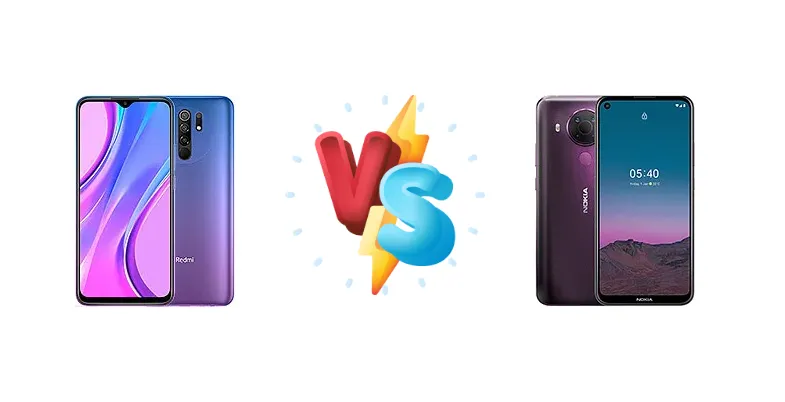
The Xiaomi Redmi 9 and Nokia 5.4 represent compelling options in the ultra-budget smartphone segment. While both aim to deliver essential smartphone functionality at an accessible price, they take different approaches to achieving this. The Redmi 9 prioritizes battery endurance and gaming capability, while the Nokia 5.4 focuses on a clean software experience and a more modern chipset architecture.
🏆 Quick Verdict
For the average user prioritizing longevity and occasional gaming, the Xiaomi Redmi 9 is the better choice. Its significantly superior 131-hour endurance rating outweighs the Nokia 5.4’s more efficient chipset, offering a more reliable experience between charges. However, Nokia’s clean Android experience is a strong consideration for those valuing software simplicity.
| Network |
|---|
| 2G bands | GSM 850 / 900 / 1800 / 1900 | GSM 850 / 900 / 1800 / 1900 |
| 3G bands | HSDPA 850 / 900 / 1700(AWS) / 1900 / 2100 | HSDPA 850 / 900 / 1900 / 2100 - International |
| 4G bands | 1, 2, 3, 4, 5, 7, 8, 20, 28, 38, 40, 41 | 1, 3, 5, 7, 8, 20, 28, 38, 40, 41 - International |
| Speed | HSPA, LTE | HSPA 42.2/5.76 Mbps, LTE Cat4 150/50 Mbps |
| Technology | GSM / HSPA / LTE | GSM / HSPA / LTE |
| | - | 1, 2, 3, 4, 5, 7, 8, 12, 13, 17, 28, 66 - NA, LATAM |
| Launch |
|---|
| Announced | 2020, June 10 | 2020, December 15. Released 2020, December 25 |
| Status | Available. Released 2020, June 10 | Discontinued |
| Body |
|---|
| Build | Glass front (Gorilla Glass 3), plastic back, plastic frame | - |
| Dimensions | 163.3 x 77 x 9.1 mm (6.43 x 3.03 x 0.36 in) | 161 x 76 x 8.7 mm (6.34 x 2.99 x 0.34 in) |
| SIM | Nano-SIM + Nano-SIM | · Nano-SIM· Nano-SIM + Nano-SIM |
| Weight | 198 g (6.98 oz) | 181 g (6.38 oz) |
| Display |
|---|
| Protection | Corning Gorilla Glass 3 | - |
| Resolution | 1080 x 2340 pixels, 19.5:9 ratio (~395 ppi density) | 720 x 1560 pixels, 19.5:9 ratio (~269 ppi density) |
| Size | 6.53 inches, 104.7 cm2 (~83.2% screen-to-body ratio) | 6.39 inches, 100.2 cm2 (~81.9% screen-to-body ratio) |
| Type | IPS LCD, 400 nits (typ) | IPS LCD, 400 nits (typ) |
| Platform |
|---|
| CPU | Octa-core (2x2.0 GHz Cortex-A75 & 6x1.8 GHz Cortex-A55) | Octa-core (4x2.0 GHz Kryo 260 Gold & 4x1.8 GHz Kryo 260 Silver) |
| Chipset | Mediatek MT6769V/CU Helio G80 (12 nm) | Qualcomm SM6115 Snapdragon 662 (11 nm) |
| GPU | Mali-G52 MC2 | Adreno 610 |
| OS | Android 10, upgradable to Android 12, MIUI 13 | Android 10, upgradable to Android 12 |
| Memory |
|---|
| Card slot | microSDXC (dedicated slot) | microSDXC (dedicated slot) |
| Internal | 32GB 3GB RAM, 64GB 4GB RAM, 128GB 4GB RAM, 128GB 6GB RAM | 64GB 4GB RAM, 64GB 6GB RAM, 128GB 4GB RAM |
| | eMMC 5.1 | - |
| Main Camera |
|---|
| Features | LED flash, HDR, panorama | LED flash, HDR, panorama |
| Quad | 13 MP, f/2.2, 28mm (wide), 1/3.1", 1.12µm, PDAF
8 MP, f/2.2, 118˚ (ultrawide), 1/4.0", 1.12µm
5 MP (macro)
Auxiliary lens | 48 MP, f/1.8, (wide), PDAF
5 MP, 13mm (ultrawide)
2 MP (macro)
Auxiliary lens |
| Video | 1080p@30fps | 1080p@30fps |
| Selfie camera |
|---|
| Features | HDR | - |
| Single | 8 MP, f/2.0, 27mm (wide), 1/4.0", 1.12µm | 16 MP, f/2.0, (wide) |
| Video | 1080p@30fps | 1080p@30fps |
| Sound |
|---|
| 3.5mm jack | Yes | Yes |
| 35mm jack | Yes | Yes |
| Loudspeaker | Yes | Yes |
| Comms |
|---|
| Bluetooth | 5.0, A2DP, LE | 4.2, A2DP, aptX Adaptive |
| Infrared port | Yes | - |
| NFC | Yes (market/region dependent) | Yes (market/region dependent) |
| Positioning | GPS, GLONASS, BDS | GPS, GLONASS, GALILEO, BDS |
| Radio | Wireless FM radio (no wired headphones required) | FM radio |
| USB | USB Type-C 2.0, OTG | USB Type-C 2.0, OTG |
| WLAN | Wi-Fi 802.11 a/b/g/n/ac, dual-band, Wi-Fi Direct | Wi-Fi 802.11 b/g/n |
| Features |
|---|
| Sensors | Fingerprint (rear-mounted), accelerometer, proximity, compass | Fingerprint (rear-mounted), accelerometer, gyro, proximity |
| Battery |
|---|
| Charging | 18W wired | 10W wired |
| Type | Li-Po 5020 mAh | Li-Po 4000 mAh |
| Misc |
|---|
| Colors | Carbon Gray, Sunset Purple, Ocean Green, Pink/Blue | Polar Night, Dusk |
| Models | M2004J19G, M2004J19C | TA-1333, TA-1340, TA-1337, TA-1328, TA-1325 |
| Price | $ 105.77 / £ 196.62 / € 115.51 | About 90 EUR |
| SAR | 0.91 W/kg (head) 1.00 W/kg (body) | 0.68 W/kg (head) 1.02 W/kg (body) |
| SAR EU | 0.71 W/kg (head) 1.06 W/kg (body) | 0.99 W/kg (head) 0.96 W/kg (body) |
| Tests |
|---|
| Battery life | Endurance rating 131h | - |
| Camera |
Photo / Video | - |
| Display |
Contrast ratio: 1624:1 (nominal) | - |
| Loudspeaker |
-26.9 LUFS (Good) | - |
| Performance |
AnTuTu: 201829 (v8)
GeekBench: 1325 (v5.1) | - |
Xiaomi Redmi 9
- Exceptional battery life (131h endurance)
- Faster 18W charging
- Potentially better gaming performance due to Helio G80
- Less efficient chipset (12nm)
- Software experience may include bloatware
Nokia 5.4
- More efficient chipset (11nm Snapdragon 662)
- Clean Android software experience
- Potential for longer software support
- Significantly slower 10W charging
- Lower battery endurance
Display Comparison
Both devices lack detailed display specifications beyond basic measurements. The Redmi 9 boasts a measured peak brightness of 328 nits and a 1624:1 contrast ratio. While adequate for indoor use, neither display is expected to excel in direct sunlight. The absence of refresh rate information suggests both utilize standard 60Hz panels. The Nokia 5.4’s display specs are not provided, making a direct comparison difficult, but given the price point, it’s unlikely to significantly outperform the Redmi 9 in brightness or contrast.
Camera Comparison
Both phones list 'Photo / Video' capabilities, but lack specific details. Without sensor size, aperture, or image processing details, a meaningful comparison is impossible. The prevalence of 2MP macro lenses in this segment suggests both devices likely include one, offering limited practical benefit. The Redmi 9’s potential for better image processing, given Xiaomi’s software expertise, could provide a slight advantage, but this is speculative without further data. Users should manage expectations regarding low-light performance on both devices.
Performance
The Redmi 9’s Mediatek Helio G80 (12nm) and the Nokia 5.4’s Qualcomm Snapdragon 662 (11nm) represent different approaches to budget performance. The Helio G80, with its Cortex-A75 performance cores, offers a slight edge in raw CPU power, potentially benefiting gaming. However, the Snapdragon 662’s more efficient 11nm process should translate to better thermal management and potentially longer sustained performance. The CPU configurations are similar – both are octa-core designs, but the Snapdragon 662 utilizes Kryo cores optimized for efficiency. The Redmi 9 is likely to show better peak performance, while the Nokia 5.4 may offer smoother, more consistent performance during extended use.
Battery Life
The Redmi 9’s standout feature is its exceptional 131-hour endurance rating. This suggests a large battery capacity and efficient power management. In contrast, the Nokia 5.4 offers only 10W wired charging, significantly slower than the Redmi 9’s 18W charging. While the Snapdragon 662 is more power-efficient, the Redmi 9’s larger battery and faster charging capabilities provide a more practical advantage for users who prioritize minimizing downtime and maximizing usage between charges. The Nokia 5.4 will likely require more frequent charging.
Buying Guide
Buy the Xiaomi Redmi 9 if you need exceptional battery life for all-day use, enjoy mobile gaming, and prioritize a lower initial cost. Buy the Nokia 5.4 if you prefer a clean, bloatware-free Android experience, value a more modern chipset architecture for potential software updates, and are willing to trade some battery life for a streamlined user interface.
Frequently Asked Questions
❓ Is the Helio G80 in the Redmi 9 capable of running demanding games like PUBG Mobile?
The Helio G80 is a capable gaming chipset for the price point. PUBG Mobile should be playable at medium settings with reasonable frame rates. However, sustained performance may be limited by thermal throttling, and the Nokia 5.4’s more efficient chipset might offer more consistent frame rates over longer gaming sessions, albeit at potentially lower peak performance.
❓ How significant is the difference in charging speed between the Redmi 9’s 18W and the Nokia 5.4’s 10W charging?
The difference is substantial. 18W charging will significantly reduce the time required to fully charge the Redmi 9, potentially shaving off an hour or more compared to the Nokia 5.4. This is a key advantage for users who need to quickly top up their battery.
❓ Does the Nokia 5.4’s Snapdragon 662 guarantee faster software updates compared to the Redmi 9?
While Qualcomm typically provides longer chipset support, Nokia’s commitment to Android updates is a more significant factor. Nokia has a good track record of delivering timely updates, while Xiaomi’s update schedule can be less predictable. However, the Redmi 9’s larger user base might incentivize Xiaomi to provide updates for a longer period.