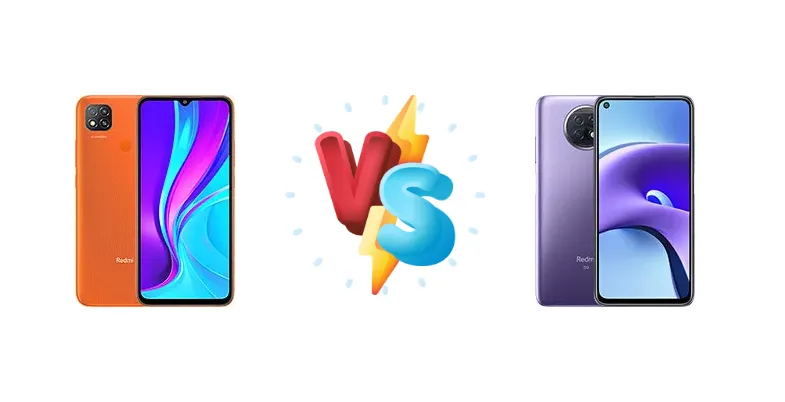
Xiaomi's Redmi series dominates the budget smartphone space in India, but navigating the model numbers can be tricky. We're pitting the Redmi 9 (India variant) against the Redmi Note 9T to determine which offers the best value. The Redmi 9 focuses on affordability, while the Note 9T brings 5G connectivity and a significantly more powerful processor to the table.
🏆 Quick Verdict
For most users, the Redmi Note 9T is the clear winner. Its Mediatek Dimensity 800U chipset delivers substantially better performance for gaming and demanding apps, and the 18W fast charging is a welcome upgrade. While the Redmi 9 remains a viable option for basic use, the Note 9T's extra features justify the price difference.
| Network |
|---|
| 2G bands | GSM 850 / 900 / 1800 / 1900 | GSM 850 / 900 / 1800 / 1900 |
| 3G bands | HSDPA 850 / 900 / 2100 | HSDPA 850 / 900 / 1700(AWS) / 1900 / 2100 |
| 4G bands | 1, 3, 5, 8, 40, 41 | 1, 2, 3, 4, 5, 7, 8, 12, 17, 18, 19, 20, 26, 28, 32, 38, 40, 41, 42 |
| 5G bands | - | 1, 3, 5, 7, 8, 20, 28, 38, 41, 77, 78, 79 SA/NSA/Sub6 |
| Speed | HSPA, LTE | HSPA, LTE, 5G |
| Technology | GSM / HSPA / LTE | GSM / HSPA / LTE / 5G |
| Launch |
|---|
| Announced | 2020, August 27. Released 2020, August 31 | 2021, January 08 |
| Status | Discontinued | Available. Released 2021, January 18 |
| Body |
|---|
| Build | - | Glass front (Gorilla Glass 5), plastic back, plastic frame |
| Dimensions | 164.9 x 77.1 x 9 mm (6.49 x 3.04 x 0.35 in) | 161.2 x 77.3 x 9.1 mm (6.35 x 3.04 x 0.36 in) |
| SIM | Nano-SIM + Nano-SIM | Nano-SIM + Nano-SIM |
| Weight | 194 g (6.84 oz) | 199 g (7.02 oz) |
| | Water-repellent coating | Water-repellent coating |
| Display |
|---|
| Protection | - | Corning Gorilla Glass 5 |
| Resolution | 720 x 1600 pixels, 20:9 ratio (~269 ppi density) | 1080 x 2340 pixels, 19.5:9 ratio (~395 ppi density) |
| Size | 6.53 inches, 102.9 cm2 (~81.0% screen-to-body ratio) | 6.53 inches, 104.7 cm2 (~84.0% screen-to-body ratio) |
| Type | IPS LCD, 400 nits (typ) | IPS LCD, 450 nits (typ) |
| Platform |
|---|
| CPU | Octa-core (4x2.3 GHz Cortex-A53 & 4x1.8 GHz Cortex-A53) | Octa-core (2x2.4 GHz Cortex-A76 & 6x2.0 GHz Cortex-A55) |
| Chipset | Mediatek MT6765G Helio G35 (12 nm) | Mediatek Dimensity 800U (7 nm) |
| GPU | PowerVR GE8320 | Mali-G57 MC3 |
| OS | Android 10, MIUI 12 | Android 10, MIUI 12 |
| Memory |
|---|
| Card slot | microSDXC (dedicated slot) | microSDXC (dedicated slot) |
| Internal | 64GB 4GB RAM, 128GB 4GB RAM, 128GB 6GB RAM | 64GB 4GB RAM, 128GB 4GB RAM, 128GB 6GB RAM |
| | eMMC 5.1 | UFS 2.1 - 64GB
UFS 2.2 - 128GB |
| Main Camera |
|---|
| Dual | 13 MP, f/2.2, (wide), PDAF
Auxiliary lens | - |
| Features | LED flash, HDR | LED flash, HDR, panorama |
| Triple | - | 48 MP, f/1.8, 26mm (wide), 1/2.0", 0.8µm, PDAF
2 MP (macro)
Auxiliary lens |
| Video | 1080p@30fps | 4K@30fps, 1080p@30/60fps |
| Selfie camera |
|---|
| Features | HDR | - |
| Single | 5 MP, f/2.2, (wide), 1.12µm | 13 MP, f/2.3, 29mm (standard), 1/3.1", 1.12µm |
| Video | 1080p@30fps | 1080p@30fps |
| Sound |
|---|
| 3.5mm jack | Yes | Yes |
| 35mm jack | Yes | Yes |
| Loudspeaker | Yes | Yes, with stereo speakers |
| | - | 24-bit/192kHz audio |
| Comms |
|---|
| Bluetooth | 5.0, A2DP, LE | 5.1, A2DP, LE |
| Infrared port | - | Yes |
| NFC | No | Yes |
| Positioning | GPS, GLONASS, BDS | GPS, GLONASS, GALILEO, BDS |
| Radio | FM radio | FM radio, recording |
| USB | microUSB 2.0, OTG | USB Type-C 2.0 |
| WLAN | Wi-Fi 802.11 b/g/n, Wi-Fi Direct | Wi-Fi 802.11 a/b/g/n/ac, dual-band, Wi-Fi Direct |
| Features |
|---|
| Sensors | Fingerprint (rear-mounted), accelerometer, proximity | Fingerprint (side-mounted), accelerometer, gyro, proximity, compass |
| Battery |
|---|
| Charging | 10W wired | 18W wired, 33% in 30 min |
| Type | Li-Po 5000 mAh | Li-Po 5000 mAh |
| Misc |
|---|
| Colors | Black, Sky Blue, Sporty Orange | Nightfall Black, Daybreak Purple |
| Models | M2004C3MI | M2007J22G, J22 |
| Price | About 110 EUR | About 130 EUR |
| SAR | 0.51 W/kg (head) 0.83 W/kg (body) | 1.07 W/kg (head) 1.05 W/kg (body) |
| SAR EU | - | 0.59 W/kg (head) 0.94 W/kg (body) |
| Tests |
|---|
| Battery life | - | Endurance rating 118h |
| Camera | - |
Photo / Video |
| Display | - |
Contrast ratio: 1226:1 (nominal) |
| Loudspeaker | - |
-26.3 LUFS (Good) |
| Performance | - |
AnTuTu: 288732 (v8)
GeekBench: 1775 (v5.1) |
Xiaomi Redmi 9 (India)
- Most affordable option
- Decent battery endurance
- Lightweight and easy to handle
- Weak processor for gaming
- Slow 10W charging
- Lacks 5G connectivity
Xiaomi Redmi Note 9T
- Powerful Dimensity 800U processor
- Fast 18W charging
- 5G connectivity for future-proofing
- Slightly higher price
- May have slightly lower battery life under heavy load
- Larger size and weight
Display Comparison
Both phones feature similar contrast ratios at 1226:1, suggesting comparable image quality in terms of black levels. However, the Redmi Note 9T boasts a measured peak brightness of 471 nits, which will provide a noticeably more visible display outdoors compared to the Redmi 9, which lacks published brightness data. While neither display is cutting-edge, the Note 9T’s higher brightness is a practical advantage for everyday use.
Camera Comparison
Both phones are listed as having 'Photo / Video' capabilities, but detailed camera specs are missing. Given the Redmi Note 9T’s positioning as a more premium device, it likely features a more capable camera system, potentially with a larger sensor and improved image processing. The Redmi 9, targeting a lower price point, likely utilizes a more basic camera setup. Without specific sensor details, it’s difficult to make a definitive judgment, but the Note 9T is expected to deliver superior image quality.
Performance
The performance gap between these two devices is substantial. The Redmi 9’s Mediatek Helio G35, with its Cortex-A53 cores, is designed for entry-level tasks. The Redmi Note 9T’s Dimensity 800U, built on a more efficient 7nm process versus the G35’s 12nm, features more powerful Cortex-A76 cores. This translates to a significant uplift in CPU and GPU performance, making the Note 9T far better suited for gaming and multitasking. The Dimensity 800U also supports 5G, a feature entirely absent in the Redmi 9.
Battery Life
Both devices achieve an endurance rating of 118 hours, suggesting similar overall battery life despite the Redmi Note 9T’s more powerful processor. This indicates efficient power management on the Note 9T. However, the Note 9T’s 18W wired charging is a significant advantage over the Redmi 9’s slow 10W charging. The Note 9T can achieve 33% charge in just 30 minutes, while the Redmi 9 will take considerably longer to fully charge.
Buying Guide
Buy the Xiaomi Redmi 9 (India) if you prioritize extreme affordability and only need a phone for basic tasks like calls, messaging, and light social media. You'll be sacrificing performance and future-proofing. Buy the Xiaomi Redmi Note 9T if you want a smoother user experience, 5G connectivity, faster charging, and the ability to play more demanding games without significant lag. It's a better long-term investment.
Frequently Asked Questions
❓ Is the Dimensity 800U in the Redmi Note 9T powerful enough for demanding games like PUBG or Call of Duty?
Yes, the Dimensity 800U is a capable chipset for gaming. It can handle PUBG and Call of Duty at medium to high settings with stable frame rates. While it won't match flagship-level performance, it provides a significantly smoother gaming experience than the Helio G35 in the Redmi 9.
❓ How much faster is the 18W charging on the Redmi Note 9T compared to the 10W charging on the Redmi 9?
The Redmi Note 9T can charge to 33% in just 30 minutes, while the Redmi 9 will take considerably longer to reach the same level with its 10W charger. A full charge on the Redmi 9 will likely take over 3 hours, whereas the Note 9T will be closer to 1.5-2 hours.
❓ Does the Redmi Note 9T support VoLTE on all Indian carriers?
The Redmi Note 9T generally supports VoLTE on major Indian carriers like Jio, Airtel, and Vi. However, it's always recommended to check carrier compatibility on their respective websites to ensure full functionality in your specific region.
❓ What type of USB port do both phones use?
Both the Redmi 9 and Redmi Note 9T utilize a USB Type-C port for charging and data transfer. This is a welcome feature for modern connectivity and convenience.