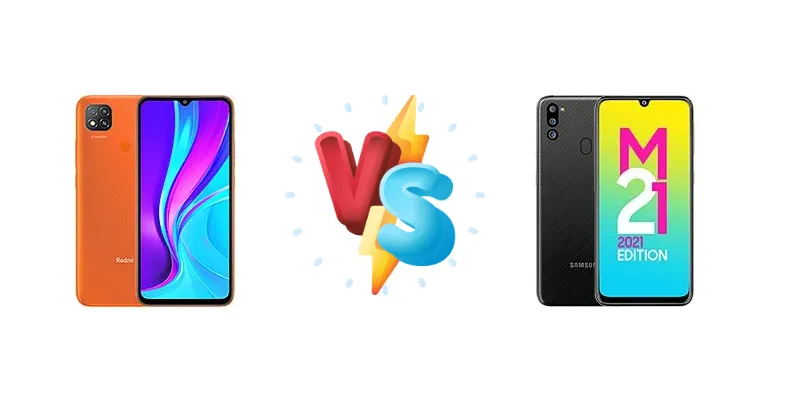
Both the Xiaomi Redmi 9 (India variant) and the Samsung Galaxy M21 2021 target the highly competitive budget smartphone segment. While both offer large displays and sizable batteries, they diverge significantly in their core processing power and charging capabilities, making the choice dependent on user priorities. This comparison dives deep into these differences to determine which device delivers the best value.
🏆 Quick Verdict
For the average user prioritizing basic tasks and extended battery life, the Samsung Galaxy M21 2021 is the better choice. Its Exynos 9611 chipset provides a noticeable performance uplift over the Redmi 9’s Helio G35, and the 15W charging offers faster top-ups, despite a similar battery capacity. However, the Redmi 9 remains a viable option for extremely budget-conscious buyers.
| Network |
|---|
| 2G bands | GSM 850 / 900 / 1800 / 1900 | GSM 850 / 900 / 1800 / 1900 |
| 3G bands | HSDPA 850 / 900 / 2100 | HSDPA 850 / 900 / 1900 / 2100 |
| 4G bands | 1, 3, 5, 8, 40, 41 | 1, 3, 5, 7, 8, 20, 38, 40, 41 |
| Speed | HSPA, LTE | HSPA, LTE |
| Technology | GSM / HSPA / LTE | GSM / HSPA / LTE |
| Launch |
|---|
| Announced | 2020, August 27. Released 2020, August 31 | 2021, July 21 |
| Status | Discontinued | Available. Released 2021, July 26 |
| Body |
|---|
| Build | - | Glass front, plastic back, plastic frame |
| Dimensions | 164.9 x 77.1 x 9 mm (6.49 x 3.04 x 0.35 in) | 159 x 75.1 x 9 mm (6.26 x 2.96 x 0.35 in) |
| SIM | Nano-SIM + Nano-SIM | Nano-SIM + Nano-SIM |
| Weight | 194 g (6.84 oz) | 192 g (6.77 oz) |
| | Water-repellent coating | - |
| Display |
|---|
| Resolution | 720 x 1600 pixels, 20:9 ratio (~269 ppi density) | 1080 x 2340 pixels, 19.5:9 ratio (~403 ppi density) |
| Size | 6.53 inches, 102.9 cm2 (~81.0% screen-to-body ratio) | 6.4 inches, 100.5 cm2 (~84.2% screen-to-body ratio) |
| Type | IPS LCD, 400 nits (typ) | Super AMOLED, 420 nits (peak) |
| Platform |
|---|
| CPU | Octa-core (4x2.3 GHz Cortex-A53 & 4x1.8 GHz Cortex-A53) | Octa-core (4x2.3 GHz Cortex-A73 & 4x1.7 GHz Cortex-A53) |
| Chipset | Mediatek MT6765G Helio G35 (12 nm) | Exynos 9611 (10 nm) |
| GPU | PowerVR GE8320 | Mali-G72 MP3 |
| OS | Android 10, MIUI 12 | Android 11, One UI 3.1 Core |
| Memory |
|---|
| Card slot | microSDXC (dedicated slot) | microSDXC (dedicated slot) |
| Internal | 64GB 4GB RAM, 128GB 4GB RAM, 128GB 6GB RAM | 64GB 4GB RAM, 128GB 6GB RAM |
| | eMMC 5.1 | - |
| Main Camera |
|---|
| Dual | 13 MP, f/2.2, (wide), PDAF
Auxiliary lens | - |
| Features | LED flash, HDR | LED flash, panorama, HDR |
| Triple | - | 48 MP, f/2.0, 26mm (wide), 1/2.0", 0.8µm, PDAF
8 MP, f/2.2, 123˚ (ultrawide), 1/4.0", 1.12µm
Auxiliary lens |
| Video | 1080p@30fps | 4K@30fps, 1080p@30fps, 720p@240fps, gyro-EIS |
| Selfie camera |
|---|
| Features | HDR | HDR |
| Single | 5 MP, f/2.2, (wide), 1.12µm | 20 MP, f/2.2, 26mm (wide) |
| Video | 1080p@30fps | 1080p@30fps |
| Sound |
|---|
| 3.5mm jack | Yes | Yes |
| 35mm jack | Yes | Yes |
| Loudspeaker | Yes | Yes |
| Comms |
|---|
| Bluetooth | 5.0, A2DP, LE | 5.0, A2DP, LE |
| NFC | No | Yes (market/region dependent) |
| Positioning | GPS, GLONASS, BDS | GPS, GLONASS, GALILEO, BDS |
| Radio | FM radio | FM radio, RDS, recording |
| USB | microUSB 2.0, OTG | USB Type-C 2.0 |
| WLAN | Wi-Fi 802.11 b/g/n, Wi-Fi Direct | Wi-Fi 802.11 a/b/g/n/ac, dual-band, Wi-Fi Direct |
| Features |
|---|
| Sensors | Fingerprint (rear-mounted), accelerometer, proximity | Fingerprint (rear-mounted), accelerometer, gyro, proximity, compass |
| Battery |
|---|
| Charging | 10W wired | 15W wired |
| Type | Li-Po 5000 mAh | Li-Po 6000 mAh |
| Misc |
|---|
| Colors | Black, Sky Blue, Sporty Orange | Charcoal Black, Arctic Blue |
| Models | M2004C3MI | SM-M215G, SM-M215G/DS |
| Price | About 110 EUR | About 130 EUR |
| SAR | 0.51 W/kg (head) 0.83 W/kg (body) | 0.47 W/kg (head) |
Xiaomi Redmi 9 (India)
- Potentially lower price point
- Acceptable for basic tasks
- Large battery capacity (implied)
- Significantly weaker processor
- Slow 10W charging
- Less responsive user experience
Samsung Galaxy M21 2021
- More powerful Exynos 9611 chipset
- Faster 15W charging
- Smoother multitasking and gaming
- Likely higher price
- Potentially slightly lower battery life (offset by charging speed)
- May experience some thermal throttling under sustained load
Display Comparison
Neither device boasts a particularly standout display. Both likely utilize IPS LCD panels, a common choice in this price bracket. However, detailed specs like resolution and peak brightness are missing. The focus here is on processing power, not visual fidelity. Bezels are expected to be relatively thick on both, reflecting their budget positioning. Color accuracy is likely to be standard for the segment, prioritizing saturation over precise calibration.
Camera Comparison
Without detailed camera specs beyond the presence of a 2MP macro lens (which is largely irrelevant), a direct comparison is difficult. However, the chipset’s image signal processor (ISP) plays a crucial role. The Exynos 9611 likely has a more capable ISP than the Helio G35, resulting in better image processing, particularly in low-light conditions. Sensor size and lens aperture are key factors missing from the data, but the Exynos’s overall processing power suggests a slight advantage in image quality for the M21 2021.
Performance
The core difference lies in the chipsets. The Samsung Galaxy M21 2021’s Exynos 9611, fabricated on a 10nm process, represents a significant step up from the Redmi 9’s Mediatek Helio G35 (12nm). The Exynos utilizes Cortex-A73 cores in its quad-performance cluster, offering substantially better single-core performance than the Redmi 9’s Cortex-A53 cores. While both are octa-core, the architectural advantage of the A73 translates to snappier app launches and smoother multitasking. The 12nm process of the Helio G35 suggests potentially higher power consumption for similar tasks, impacting battery life. This difference will be most noticeable when running demanding applications or games.
Battery Life
Both phones aim for all-day battery life. The impact of the chipset’s efficiency is crucial here. While battery capacity isn’t specified, the Exynos 9611’s 10nm process should contribute to better power management compared to the Helio G35’s 12nm node. More importantly, the Samsung Galaxy M21 2021 supports 15W wired charging, a significant improvement over the Redmi 9’s slow 10W charging. This translates to a faster 0-100% charge time, reducing downtime and improving usability.
Buying Guide
Buy the Xiaomi Redmi 9 (India) if you need a phone for extremely light usage – primarily calls, texts, and occasional social media – and are on the tightest of budgets. Buy the Samsung Galaxy M21 2021 if you prefer a smoother experience with multitasking, occasional gaming, and faster charging, even if it means spending a bit more.
Frequently Asked Questions
❓ Does the Exynos 9611 in the Galaxy M21 2021 overheat during prolonged gaming sessions?
While the Exynos 9611 isn't a flagship-level chip, it's generally well-behaved. Some thermal throttling is possible during extended, graphically intensive gaming, but it's unlikely to cause significant performance drops or discomfort. The 10nm process helps mitigate heat buildup compared to the Redmi 9's 12nm Helio G35.
❓ Is the 2MP macro camera on either phone actually useful for taking detailed close-up photos?
Generally, 2MP macro cameras on budget phones are more of a marketing feature than a genuinely useful tool. The low resolution results in images lacking detail and sharpness. Expect soft, often blurry, close-up shots. Don't rely on it for critical macro photography.
❓ Can the Redmi 9 handle PUBG Mobile at 60fps with smooth graphics?
The Redmi 9's Helio G35 will struggle to consistently maintain 60fps in PUBG Mobile even at lower graphics settings. Expect noticeable frame drops and stuttering, especially during intense firefights. The Galaxy M21 2021 will provide a significantly smoother experience, though still not ideal for maximum settings.
❓ How long does it realistically take to fully charge the Redmi 9 with its 10W charger?
With its 10W charging, the Redmi 9 will likely take over 3 hours to fully charge from 0% to 100%. This is a significant drawback compared to the Galaxy M21 2021's 15W charging, which can reduce charging time by at least 30-45 minutes.