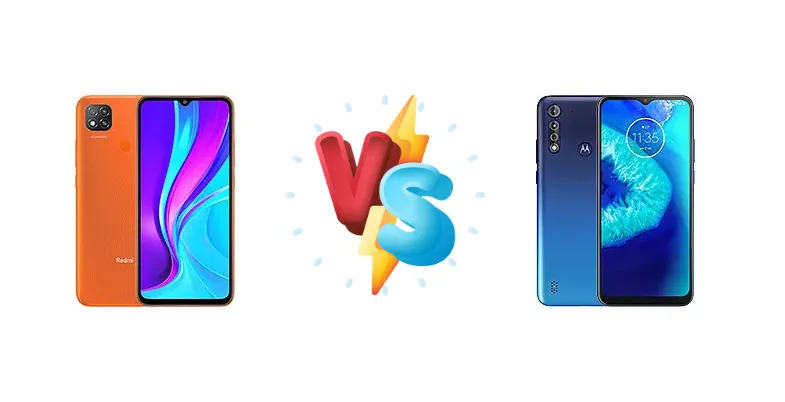
The sub-₹10,000 (approximately $120 USD) smartphone segment in India is fiercely competitive. Both the Xiaomi Redmi 9 (India variant) and the Motorola Moto G8 Power Lite aim to deliver essential smartphone functionality at an accessible price. This comparison dissects their key specifications to determine which device offers the best overall experience for the average Indian user.
🏆 Quick Verdict
For most users, the Xiaomi Redmi 9 (India) emerges as the slightly better choice. While both phones share a similar price point and 10W charging, the Redmi 9’s Helio G35 chipset offers a marginal performance advantage, making it more suitable for light gaming and multitasking. However, the Moto G8 Power Lite remains a viable option for those prioritizing a clean Android experience.
| Network |
|---|
| 2G bands | GSM 850 / 900 / 1800 / 1900 | GSM 850 / 900 / 1800 / 1900 |
| 3G bands | HSDPA 850 / 900 / 2100 | HSDPA 850 / 900 / 1900 / 2100 |
| 4G bands | 1, 3, 5, 8, 40, 41 | LTE |
| Speed | HSPA, LTE | HSPA, LTE |
| Technology | GSM / HSPA / LTE | GSM / HSPA / LTE |
| Launch |
|---|
| Announced | 2020, August 27. Released 2020, August 31 | 2020, April 03. Released 2020, April 03 |
| Status | Discontinued | Discontinued |
| Body |
|---|
| Build | - | Glass front, plastic back, plastic frame |
| Dimensions | 164.9 x 77.1 x 9 mm (6.49 x 3.04 x 0.35 in) | 164.9 x 75.8 x 9.2 mm (6.49 x 2.98 x 0.36 in) |
| SIM | Nano-SIM + Nano-SIM | · Nano-SIM· Nano-SIM + Nano-SIM |
| Weight | 194 g (6.84 oz) | 200 g (7.05 oz) |
| | Water-repellent coating | Water-repellent coating |
| Display |
|---|
| Resolution | 720 x 1600 pixels, 20:9 ratio (~269 ppi density) | 720 x 1600 pixels, 20:9 ratio (~269 ppi density) |
| Size | 6.53 inches, 102.9 cm2 (~81.0% screen-to-body ratio) | 6.5 inches, 102.8 cm2 (~82.2% screen-to-body ratio) |
| Type | IPS LCD, 400 nits (typ) | IPS LCD |
| Platform |
|---|
| CPU | Octa-core (4x2.3 GHz Cortex-A53 & 4x1.8 GHz Cortex-A53) | Octa-core (4x2.3 GHz Cortex-A53 & 4x1.8 GHz Cortex-A53) |
| Chipset | Mediatek MT6765G Helio G35 (12 nm) | Mediatek MT6765 Helio P35 (12 nm) |
| GPU | PowerVR GE8320 | PowerVR GE8320 |
| OS | Android 10, MIUI 12 | Android 9.0 (Pie) |
| Memory |
|---|
| Card slot | microSDXC (dedicated slot) | microSDXC (dedicated slot) |
| Internal | 64GB 4GB RAM, 128GB 4GB RAM, 128GB 6GB RAM | 64GB 4GB RAM |
| | eMMC 5.1 | eMMC 5.1 |
| Main Camera |
|---|
| Dual | 13 MP, f/2.2, (wide), PDAF
Auxiliary lens | - |
| Features | LED flash, HDR | LED flash, HDR, panorama |
| Triple | - | 16 MP, f/2.0, (wide), 1.0µm, PDAF
2 MP (macro)
Auxiliary lens |
| Video | 1080p@30fps | 1080p@30fps |
| Selfie camera |
|---|
| Features | HDR | HDR |
| Single | 5 MP, f/2.2, (wide), 1.12µm | 8 MP, f/2.0, (wide), 1.12µm |
| Video | 1080p@30fps | 1080p@30fps |
| Sound |
|---|
| 3.5mm jack | Yes | Yes |
| 35mm jack | Yes | Yes |
| Loudspeaker | Yes | Yes |
| Comms |
|---|
| Bluetooth | 5.0, A2DP, LE | 4.2, A2DP, LE |
| NFC | No | No |
| Positioning | GPS, GLONASS, BDS | GPS, GLONASS, GALILEO |
| Radio | FM radio | FM radio |
| USB | microUSB 2.0, OTG | microUSB 2.0 |
| WLAN | Wi-Fi 802.11 b/g/n, Wi-Fi Direct | Wi-Fi 802.11 b/g/n, Wi-Fi Direct |
| Features |
|---|
| Sensors | Fingerprint (rear-mounted), accelerometer, proximity | Fingerprint (rear-mounted), accelerometer, gyro, proximity |
| Battery |
|---|
| Charging | 10W wired | 10W wired |
| Type | Li-Po 5000 mAh | Li-Po 5000 mAh |
| Misc |
|---|
| Colors | Black, Sky Blue, Sporty Orange | Arctic Blue, Royal Blue |
| Models | M2004C3MI | XT2055-2 |
| Price | About 110 EUR | About 160 EUR |
| SAR | 0.51 W/kg (head) 0.83 W/kg (body) | - |
Xiaomi Redmi 9 (India)
- Slightly better performance with Helio G35
- Potential for smoother gaming experience
- More readily available in the Indian market
- MIUI software can be bloated with pre-installed apps
- 10W charging is slow
Motorola Moto G8 Power Lite
- Clean, near-stock Android experience
- Minimal bloatware
- Potentially larger battery capacity
- Helio P35 offers less performance than G35
- May receive fewer software updates
Display Comparison
Both the Redmi 9 and Moto G8 Power Lite likely feature LCD panels, typical for this price bracket. Specific details like resolution and peak brightness are not provided, but we can assume they are similar, aiming for a 720p+ resolution. The absence of higher refresh rates or advanced panel technologies like LTPO is expected. Bezels are likely to be substantial on both devices, contributing to a less immersive viewing experience. Color accuracy will likely be standard for the segment, prioritizing vibrancy over absolute fidelity.
Camera Comparison
Camera specifications are not detailed enough to draw strong conclusions. Both phones likely feature a primary camera alongside depth and macro sensors. However, the quality of the image processing and sensor size will be crucial. Given the price point, expect image quality to be acceptable in good lighting conditions but struggle in low light. The inclusion of a 2MP macro camera on both devices is largely a marketing tactic, offering limited practical benefit due to the low resolution and lack of autofocus. The aperture of the main sensor will be a key determinant of low-light performance, but this information is unavailable.
Performance
The core difference lies in the chipsets: the Redmi 9 utilizes the Mediatek MT6765G Helio G35, while the Moto G8 Power Lite employs the Mediatek MT6765 Helio P35. Both are 12nm chips with an octa-core CPU configuration (4x2.3 GHz Cortex-A53 & 4x1.8 GHz Cortex-A53). The 'G' in Helio G35 signifies a slight focus on gaming, suggesting a marginally higher GPU clock speed. While the CPU cores are identical, the G35’s GPU will likely offer a small performance uplift in graphics-intensive tasks. Neither chipset is designed for demanding games, but the Redmi 9 will handle lighter titles more smoothly. RAM configurations are not specified, but both will likely offer options around 3-4GB, impacting multitasking capabilities.
Battery Life
Both devices are equipped with 10W wired charging, indicating a similar charging speed – expect a full charge to take over 3 hours. Battery capacity is not specified, but given the 'Power' branding of the Moto G8 Power Lite, it likely has a slightly larger battery than the Redmi 9. However, the more efficient Helio G35 in the Redmi 9 might offset this difference, resulting in comparable real-world battery life. Users should expect a full day of moderate use from both devices, but heavy gaming or video streaming will drain the battery quickly.
Buying Guide
Buy the Xiaomi Redmi 9 (India) if you need a phone capable of handling slightly more demanding tasks like casual gaming and running multiple apps simultaneously. Its Helio G35 chipset provides a small but noticeable performance boost. Buy the Motorola Moto G8 Power Lite if you prefer a near-stock Android experience with minimal bloatware and prioritize simplicity over raw processing power. It’s a solid choice for basic communication and media consumption.
Frequently Asked Questions
❓ Will the Redmi 9's Helio G35 handle PUBG Mobile smoothly?
While the Helio G35 isn't a gaming powerhouse, it should be able to run PUBG Mobile at low to medium settings with a playable frame rate. Expect some occasional stuttering, especially in intense firefights. The Moto G8 Power Lite's Helio P35 will likely struggle more with the same settings.
❓ Is the software experience significantly different between the Redmi 9 and Moto G8 Power Lite?
Yes, the software experience is a key differentiator. The Redmi 9 runs Xiaomi's MIUI, which is heavily customized and often includes pre-installed apps (bloatware). The Moto G8 Power Lite offers a near-stock Android experience, providing a cleaner and more streamlined interface with fewer unnecessary apps.
❓ How long will it take to fully charge both phones with the 10W charger?
Expect both the Redmi 9 and Moto G8 Power Lite to take approximately 3 to 4 hours to fully charge from 0% to 100% using the included 10W charger. This is a relatively slow charging speed compared to modern smartphones.