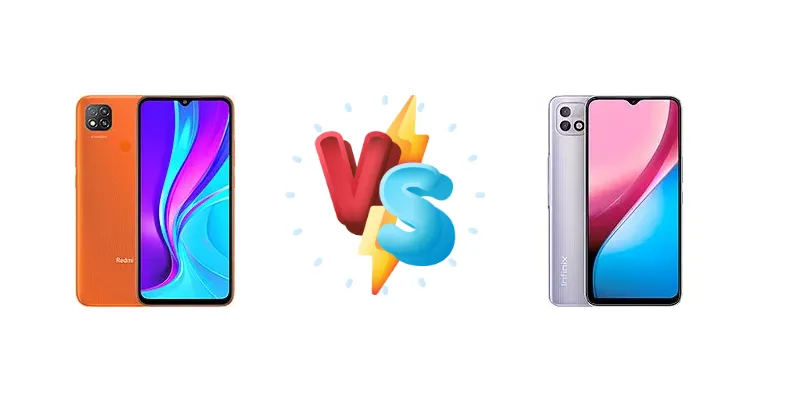
The sub-₹10,000 (approximately $120 USD) smartphone segment in India is fiercely competitive. Both the Infinix Hot 10i and Xiaomi Redmi 9 aim to deliver essential smartphone functionality at an accessible price. However, they take different approaches to achieving this, with the Hot 10i prioritizing raw processing power while the Redmi 9 leverages Xiaomi’s established ecosystem and software optimization. This comparison dissects their key differences to help you choose the right device.
🏆 Quick Verdict
For users prioritizing gaming and demanding applications, the Infinix Hot 10i is the clear winner thanks to its superior Helio G70 chipset. However, the Xiaomi Redmi 9 remains a solid choice for those valuing brand reliability, software updates, and a generally smoother, if less powerful, user experience.
| Network |
|---|
| 2G bands | GSM 850 / 900 / 1800 / 1900 | GSM 850 / 900 / 1800 / 1900 |
| 3G bands | HSDPA 850 / 900 / 2100 | HSDPA 850 / 900 / 1700(AWS) / 1900 / 2100 |
| 4G bands | 1, 3, 5, 8, 40, 41 | 1, 2, 3, 4, 5, 7, 8, 20, 28, 38, 40, 41, 66 |
| Speed | HSPA, LTE | HSPA 42.2/5.76 Mbps, LTE Cat4 150/50 Mbps |
| Technology | GSM / HSPA / LTE | GSM / HSPA / LTE |
| | - | 1, 3, 5, 8, 38, 40, 41 |
| Launch |
|---|
| Announced | 2020, August 27. Released 2020, August 31 | 2021, May 20 |
| Status | Discontinued | Available. Released 2021, May 20 |
| Body |
|---|
| Dimensions | 164.9 x 77.1 x 9 mm (6.49 x 3.04 x 0.35 in) | 164.3 x 76 x 9.6 mm (6.47 x 2.99 x 0.38 in) |
| SIM | Nano-SIM + Nano-SIM | Nano-SIM + Nano-SIM |
| Weight | 194 g (6.84 oz) | - |
| | Water-repellent coating | - |
| Display |
|---|
| Resolution | 720 x 1600 pixels, 20:9 ratio (~269 ppi density) | 720 x 1600 pixels, 20:9 ratio (~269 ppi density) |
| Size | 6.53 inches, 102.9 cm2 (~81.0% screen-to-body ratio) | 6.52 inches, 102.6 cm2 (~82.2% screen-to-body ratio) |
| Type | IPS LCD, 400 nits (typ) | IPS LCD, 500 nits (peak) |
| Platform |
|---|
| CPU | Octa-core (4x2.3 GHz Cortex-A53 & 4x1.8 GHz Cortex-A53) | Octa-core (2x2.0 GHz Cortex-A75 & 6x1.7 GHz Cortex-A55) |
| Chipset | Mediatek MT6765G Helio G35 (12 nm) | Mediatek MT6769V Helio G70 (12 nm) |
| GPU | PowerVR GE8320 | Mali-G52 MC2 |
| OS | Android 10, MIUI 12 | Android 11, XOS 7.5 |
| Memory |
|---|
| Card slot | microSDXC (dedicated slot) | microSDXC (dedicated slot) |
| Internal | 64GB 4GB RAM, 128GB 4GB RAM, 128GB 6GB RAM | 32GB 3GB RAM, 64GB 2GB RAM, 64GB 4GB RAM, 128GB 6GB RAM |
| | eMMC 5.1 | eMMC 5.1 |
| Main Camera |
|---|
| Dual | 13 MP, f/2.2, (wide), PDAF
Auxiliary lens | 13 MP, f/1.8, (wide), AF
Auxiliary lens |
| Features | LED flash, HDR | Quad-LED flash |
| Single | - | 5 MP, (wide) |
| Video | 1080p@30fps | 1440p@30fps |
| Selfie camera |
|---|
| Features | HDR | - |
| Single | 5 MP, f/2.2, (wide), 1.12µm | 5 MP, (wide) |
| Video | 1080p@30fps | Unspecified |
| Sound |
|---|
| 3.5mm jack | Yes | Yes |
| 35mm jack | Yes | Yes |
| Loudspeaker | Yes | Yes |
| Comms |
|---|
| Bluetooth | 5.0, A2DP, LE | Yes |
| NFC | No | No |
| Positioning | GPS, GLONASS, BDS | GPS |
| Radio | FM radio | FM radio |
| USB | microUSB 2.0, OTG | microUSB 2.0 |
| WLAN | Wi-Fi 802.11 b/g/n, Wi-Fi Direct | Wi-Fi 802.11 a/b/g/n/ac, dual-band, Wi-Fi Direct |
| Features |
|---|
| Sensors | Fingerprint (rear-mounted), accelerometer, proximity | Fingerprint (rear-mounted), accelerometer, proximity |
| Battery |
|---|
| Charging | 10W wired | 18W wired |
| Type | Li-Po 5000 mAh | 6000 mAh |
| Misc |
|---|
| Colors | Black, Sky Blue, Sporty Orange | Black, Purple, Morandi Green, Heart of Ocean |
| Models | M2004C3MI | X659B, PR652B, X658E, PR652C, X658B, X659 |
| Price | About 110 EUR | About 100 EUR |
| SAR | 0.51 W/kg (head) 0.83 W/kg (body) | - |
Xiaomi Redmi 9 (India)
- Established brand reputation (Xiaomi)
- Potentially better software optimization
- Likely more frequent software updates
- Inferior processor (Helio G35)
- Slower charging (10W)
Infinix Hot 10i
- More powerful processor (Helio G70)
- Faster charging (18W)
- Better gaming performance
- Less established brand (Infinix)
- Potentially less frequent software updates
Display Comparison
Neither device boasts a standout display. Both utilize 12nm chipsets, suggesting similar power constraints impacting display capabilities. While specific display specs (resolution, brightness) are missing, the focus here is on performance. The absence of high refresh rates on either device indicates a prioritization of battery life over visual fluidity. Bezels are likely comparable, typical for this price bracket.
Camera Comparison
Without detailed camera specifications, a direct comparison is difficult. However, given the price point, both phones likely feature similar primary camera sensors. The image processing algorithms will be a key differentiator. Xiaomi generally offers more refined image processing, resulting in more balanced and aesthetically pleasing photos. The Hot 10i may lean towards more vibrant, but potentially less accurate, colors. The presence of 2MP macro/depth sensors on both devices is largely marketing fluff; their image quality is typically underwhelming. The aperture of the main lens will be a critical factor, with a wider aperture (lower f-number) allowing for better low-light performance.
Performance
The core difference lies in the chipsets. The Infinix Hot 10i’s MediaTek Helio G70 (12nm) significantly outperforms the Redmi 9’s Helio G35 (12nm). The G70 features a dual-core Cortex-A75 setup clocked at 2.0 GHz alongside six Cortex-A55 cores at 1.7 GHz, offering a substantial boost in single-core and multi-core performance compared to the Redmi 9’s quad-core Cortex-A53 setup clocked at 2.3 GHz and 1.8 GHz. This architectural difference translates to faster app loading times, smoother multitasking, and a more enjoyable gaming experience on the Hot 10i. The G70’s GPU is also more capable, handling graphically demanding games with higher frame rates. While the Redmi 9’s 2.3 GHz clock speed *sounds* faster, the older Cortex-A53 architecture is less efficient per clock cycle.
Battery Life
The Infinix Hot 10i’s 18W wired charging is a significant advantage over the Redmi 9’s 10W charging. While battery capacity isn’t specified, the faster charging allows for quicker top-ups, reducing downtime. The Helio G70’s slightly higher power consumption will offset some of this advantage, but the 18W charging still provides a tangible benefit. Users who frequently use their phones throughout the day will appreciate the Hot 10i’s faster charging capabilities.
Buying Guide
Buy the Xiaomi Redmi 9 (India) if you need a dependable daily driver with a well-established software ecosystem and prioritize long-term software support. Buy the Infinix Hot 10i if you prefer a more powerful processor for gaming and resource-intensive apps, and are comfortable with a less refined software experience and potentially less frequent updates.
Frequently Asked Questions
❓ Will the Helio G70 in the Infinix Hot 10i overheat during prolonged gaming sessions?
While the Helio G70 is more powerful, it's still a 12nm chip. Thermal throttling is possible during extended gaming. However, the Hot 10i's larger surface area compared to some ultra-compact phones may aid in heat dissipation. Expect some performance reduction after 30-60 minutes of intensive gaming.
❓ Is the software experience on the Infinix Hot 10i significantly different from Xiaomi's MIUI?
Yes. Infinix uses XOS, which is generally less polished and feature-rich than Xiaomi's MIUI. XOS often includes more pre-installed apps (bloatware) and may have a different aesthetic. MIUI is known for its customization options and extensive feature set, while XOS prioritizes simplicity and speed.
❓ Can the Infinix Hot 10i handle games like PUBG Mobile at high settings?
The Helio G70 is capable of running PUBG Mobile at medium to high settings with playable frame rates. However, achieving consistently smooth performance at the highest settings may require reducing graphics options. The Redmi 9's Helio G35 will struggle to maintain stable frame rates at similar settings.
❓ How often can I expect software updates on the Redmi 9 compared to the Hot 10i?
Xiaomi generally provides more frequent and longer-term software support for its devices than Infinix. You can expect more security patches and potentially even major Android version updates on the Redmi 9. Infinix's update schedule is less predictable.