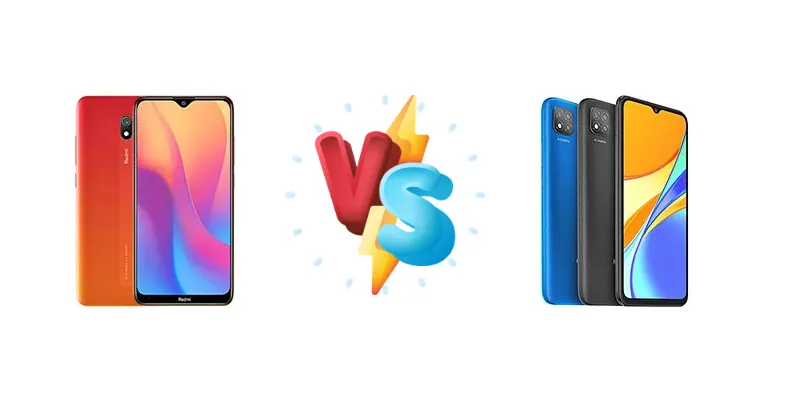
Xiaomi's Redmi series consistently delivers impressive value, but navigating the options can be tricky. The Redmi 8A and 9C NFC represent two distinct approaches to the ultra-budget segment. The 8A, a slightly older model, focuses on a streamlined experience, while the 9C NFC adds contactless payments and a newer chipset. This comparison dives deep into the specifications to determine which phone offers the best bang for your buck.
🏆 Quick Verdict
For most users, the Redmi 9C NFC is the better choice. While it sacrifices faster charging, the Helio G35 chipset provides a noticeable performance boost over the Snapdragon 439 in the 8A, and the inclusion of NFC adds significant convenience. The 9C NFC offers a more future-proof experience for a minimal price difference.
| Network |
|---|
| 2G bands | GSM 850 / 900 / 1800 / 1900 | GSM 850 / 900 / 1800 / 1900 |
| 3G bands | HSDPA 850 / 900 / 1900 / 2100 | HSDPA 850 / 900 / 1700(AWS) / 1900 / 2100 |
| 4G bands | 1, 2, 3, 4, 5, 7, 8, 20, 38, 40 - Global | 1, 2, 3, 4, 5, 7, 8, 20, 38, 40 |
| Speed | HSPA, LTE | HSPA, LTE |
| Technology | GSM / HSPA / LTE | GSM / HSPA / LTE |
| | 1, 3, 5, 8, 34, 38, 39, 40, 41 - China | - |
| Launch |
|---|
| Announced | 2019, September 25. Released 2019, September 30 | 2020, August 27. Released 2020, August 27 |
| Status | Discontinued | Discontinued |
| Body |
|---|
| Build | Glass front (Gorilla Glass 5), plastic back, plastic frame | - |
| Dimensions | 156.5 x 75.4 x 9.4 mm (6.16 x 2.97 x 0.37 in) | 164.9 x 77.1 x 9 mm (6.49 x 3.04 x 0.35 in) |
| SIM | Nano-SIM + Nano-SIM | Nano-SIM + Nano-SIM |
| Weight | 188 g (6.63 oz) | 196 g (6.91 oz) |
| | Water-repellent coating | - |
| Display |
|---|
| Protection | Corning Gorilla Glass 5 | - |
| Resolution | 720 x 1520 pixels, 19:9 ratio (~270 ppi density) | 720 x 1600 pixels, 20:9 ratio (~269 ppi density) |
| Size | 6.22 inches, 96.6 cm2 (~81.8% screen-to-body ratio) | 6.53 inches, 102.9 cm2 (~81.0% screen-to-body ratio) |
| Type | IPS LCD, 400 nits (typ) | IPS LCD, 400 nits (typ) |
| Platform |
|---|
| CPU | Octa-core (4x1.95 GHz Cortex-A53 & 4x1.45 GHz Cortex A53) | Octa-core (4x2.3 GHz Cortex-A53 & 4x1.8 GHz Cortex-A53) |
| Chipset | Qualcomm SDM439 Snapdragon 439 (12 nm) | Mediatek MT6765G Helio G35 (12 nm) |
| GPU | Adreno 505 | PowerVR GE8320 |
| OS | Android 9.0 (Pie), upgradable to Android 10, MIUI 12 | Android 10, MIUI 12 |
| Memory |
|---|
| Card slot | microSDXC (dedicated slot) | microSDXC (dedicated slot) |
| Internal | 32GB 2GB RAM, 32GB 3GB RAM, 64GB 4GB RAM | 32GB 2GB RAM, 32GB 3GB RAM, 64GB 2GB RAM, 64GB 3GB RAM, 128GB 3GB RAM, 128GB 4GB RAM |
| | eMMC 5.1 | eMMC 5.1 |
| Main Camera |
|---|
| Dual | - | 13 MP, f/2.2, 28mm (wide), 1.0µm, PDAF
2 MP (macro) |
| Features | LED flash, HDR, panorama | LED flash, HDR |
| Single | 12 MP, f/1.8, (wide), 1/2.55", 1.4µm, dual pixel PDAF | - |
| Video | 1080p@30fps | 1080p@30fps |
| Selfie camera |
|---|
| Features | HDR | HDR |
| Single | 8 MP, f/2.0, 1/4.0", 1.12µm | 5 MP, f/2.2, (wide), 1.12µm |
| Video | 1080p@30fps | 1080p@30fps |
| Sound |
|---|
| 3.5mm jack | Yes | Yes |
| 35mm jack | Yes | Yes |
| Loudspeaker | Yes | Yes |
| Comms |
|---|
| Bluetooth | 4.2, A2DP, LE | 5.0, A2DP, LE |
| NFC | No | Yes |
| Positioning | GPS, GLONASS, BDS | GPS, GLONASS, BDS |
| Radio | FM Radio, built-in antenna | FM radio |
| USB | USB Type-C 2.0, OTG | microUSB 2.0, OTG |
| WLAN | Wi-Fi 802.11 b/g/n, Wi-Fi Direct | Wi-Fi 802.11 b/g/n, Wi-Fi Direct |
| Features |
|---|
| Sensors | Accelerometer, proximity, compass | Fingerprint (rear-mounted), accelerometer, proximity |
| Battery |
|---|
| Charging | 18W wired | 10W wired |
| Type | Li-Po 5000 mAh, non-removable | Li-Po 5000 mAh |
| Misc |
|---|
| Colors | Midnight Black, Ocean Blue, Sunset Red | Midnight Gray, Sunshine Yellow, Twilight Blue |
| Models | MZB8458IN, M1908C3KG, M1908C3KH | M2006C3MNG |
| Price | About 120 EUR | About 100 EUR |
| SAR | 0.48 W/kg (head) 1.07 W/kg (body) | 0.57 W/kg (head) 0.90 W/kg (body) |
| SAR EU | 0.23 W/kg (head) 1.48 W/kg (body) | 0.37 W/kg (head) 1.14 W/kg (body) |
| Tests |
|---|
| Performance |
AnTuTu: 89901 (v8)
GeekBench: 3030 (v4.4)
GFXBench: 7fps (ES 3.1 onscreen) | - |
Xiaomi Redmi 8A
- Faster 18W charging for quicker top-ups.
- Simpler, streamlined software experience.
- Potentially lower price point (depending on retailer).
- Older, less powerful Snapdragon 439 chipset.
- Lacks NFC for contactless payments.
- Potentially slower app loading and multitasking.
Xiaomi Redmi 9C NFC
- More powerful MediaTek Helio G35 chipset for better performance.
- Integrated NFC for contactless payments and features.
- More modern and versatile overall experience.
- Slower 10W charging.
- May be slightly more expensive than the Redmi 8A.
- Image quality may not be significantly improved over the 8A.
Display Comparison
Both devices likely feature similar LCD panels, given their price points. However, detailed display specs (resolution, brightness) are unavailable. The focus here is on the internal hardware. The lack of information prevents a detailed comparison of color accuracy or viewing angles, but both will likely be adequate for basic usage.
Camera Comparison
Without detailed camera sensor information, a direct comparison is difficult. Both phones likely feature a primary camera and depth sensor, but the quality will heavily depend on the sensor size and image processing algorithms. The Redmi 9C NFC may benefit from slightly improved image processing capabilities due to its newer chipset. However, the presence of a 2MP macro camera on the 9C NFC is unlikely to significantly impact image quality; these sensors are often included for marketing purposes rather than practical benefit.
Performance
The core difference lies in the chipsets. The Redmi 9C NFC’s MediaTek Helio G35 (4x2.3 GHz Cortex-A53 & 4x1.8 GHz Cortex-A53) boasts higher clock speeds on its primary cores compared to the Redmi 8A’s Qualcomm Snapdragon 439 (4x1.95 GHz Cortex-A53 & 4x1.45 GHz Cortex A53). This translates to a more responsive user experience, particularly when multitasking or launching apps. While both utilize the Cortex-A53 architecture, the G35’s higher frequency provides a tangible performance advantage. The 12nm process node is shared, meaning thermal efficiency is comparable, but the G35 will likely handle sustained loads slightly better.
Battery Life
The Redmi 8A supports 18W wired charging, a clear advantage over the Redmi 9C NFC’s 10W charging. This means the 8A will charge significantly faster, reducing downtime. However, battery capacity isn't specified for either device. The faster charging of the 8A is beneficial for users who frequently need to top up their battery quickly, while the 9C NFC will require more patience. The performance gains of the 9C NFC may offset the slower charging for users who prioritize responsiveness over rapid charging.
Buying Guide
Buy the Xiaomi Redmi 8A if you prioritize simplicity and are comfortable foregoing NFC functionality. It's a solid option for first-time smartphone users or those needing a basic, reliable device. Buy the Xiaomi Redmi 9C NFC if you value performance for social media, light gaming, and the convenience of contactless payments. The slightly newer chipset and NFC support make it a more versatile and modern option.
Frequently Asked Questions
❓ Will the Helio G35 in the Redmi 9C NFC handle popular games like PUBG Mobile?
The Helio G35 is capable of running PUBG Mobile, but expect to play at lower graphics settings (balanced or low) to maintain a stable frame rate. It's not a gaming powerhouse, but it's a significant step up from the Snapdragon 439 for casual gaming.
❓ Is NFC on the Redmi 9C NFC useful for more than just payments?
Yes, NFC has several uses beyond contactless payments. It can be used for quickly pairing with Bluetooth devices, sharing files with other NFC-enabled phones, and even reading NFC tags for various applications like smart home automation.
❓ Does the slower charging on the Redmi 9C NFC significantly impact daily use?
It depends on your usage habits. If you typically charge your phone overnight, the slower charging won't be a major inconvenience. However, if you frequently need to quickly top up your battery during the day, the Redmi 8A's 18W charging is a clear advantage.