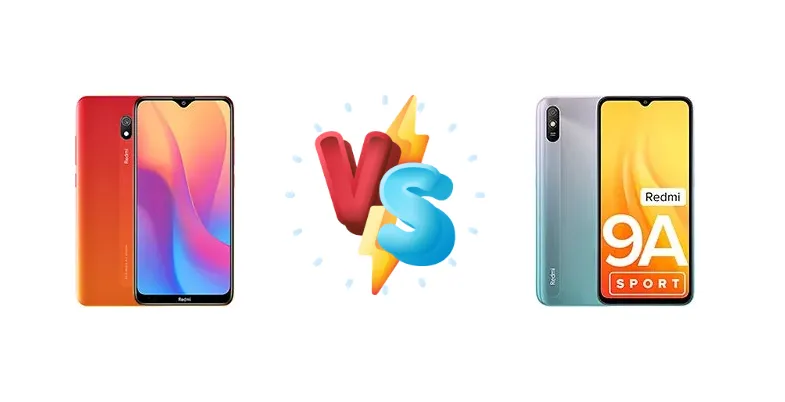
The Xiaomi Redmi 8A and Redmi 9A Sport represent Xiaomi's continued commitment to the ultra-budget smartphone market. While both aim to deliver essential smartphone functionality at a low price, they differ significantly in their internal hardware, particularly in their chipsets and charging capabilities. This comparison dissects these differences to determine which device offers the best value for users prioritizing performance or efficiency.
🏆 Quick Verdict
For most users, the Redmi 9A Sport offers a slight edge due to its newer MediaTek Helio G25 chipset, which provides a modest CPU performance boost. However, the Redmi 8A’s 18W charging is a significant advantage for those who value faster top-ups, making it a better choice for users constantly on the go.
| Network |
|---|
| 2G bands | GSM 850 / 900 / 1800 / 1900 | GSM 850 / 900 / 1800 / 1900 |
| 3G bands | HSDPA 850 / 900 / 1900 / 2100 | HSDPA 850 / 900 / 2100 |
| 4G bands | 1, 2, 3, 4, 5, 7, 8, 20, 38, 40 - Global | 1, 3, 5, 8, 40, 41 |
| Speed | HSPA, LTE | HSPA, LTE |
| Technology | GSM / HSPA / LTE | GSM / HSPA / LTE |
| | 1, 3, 5, 8, 34, 38, 39, 40, 41 - China | - |
| Launch |
|---|
| Announced | 2019, September 25. Released 2019, September 30 | 2021, September 28 |
| Status | Discontinued | Available. Released 2021, September 28 |
| Body |
|---|
| Build | Glass front (Gorilla Glass 5), plastic back, plastic frame | - |
| Dimensions | 156.5 x 75.4 x 9.4 mm (6.16 x 2.97 x 0.37 in) | 164.9 x 77.1 x 9 mm (6.49 x 3.04 x 0.35 in) |
| SIM | Nano-SIM + Nano-SIM | Nano-SIM + Nano-SIM |
| Weight | 188 g (6.63 oz) | 194 g (6.84 oz) |
| | Water-repellent coating | Water-repellent coating |
| Display |
|---|
| Protection | Corning Gorilla Glass 5 | - |
| Resolution | 720 x 1520 pixels, 19:9 ratio (~270 ppi density) | 720 x 1600 pixels, 20:9 ratio (~269 ppi density) |
| Size | 6.22 inches, 96.6 cm2 (~81.8% screen-to-body ratio) | 6.53 inches, 102.9 cm2 (~81.0% screen-to-body ratio) |
| Type | IPS LCD, 400 nits (typ) | IPS LCD, 400 nits (typ) |
| Platform |
|---|
| CPU | Octa-core (4x1.95 GHz Cortex-A53 & 4x1.45 GHz Cortex A53) | Octa-core (4x2.0 GHz Cortex-A53 & 4x1.5 GHz Cortex-A53) |
| Chipset | Qualcomm SDM439 Snapdragon 439 (12 nm) | Mediatek MT6762G Helio G25 (12 nm) |
| GPU | Adreno 505 | PowerVR GE8320 |
| OS | Android 9.0 (Pie), upgradable to Android 10, MIUI 12 | Android 10, MIUI 12 |
| Memory |
|---|
| Card slot | microSDXC (dedicated slot) | microSDXC (dedicated slot) |
| Internal | 32GB 2GB RAM, 32GB 3GB RAM, 64GB 4GB RAM | 32GB 2GB RAM, 32GB 3GB RAM |
| | eMMC 5.1 | eMMC 5.1 |
| Main Camera |
|---|
| Features | LED flash, HDR, panorama | LED flash, HDR |
| Single | 12 MP, f/1.8, (wide), 1/2.55", 1.4µm, dual pixel PDAF | 13 MP, f/2.2, 28mm (wide), 1.0µm, PDAF |
| Video | 1080p@30fps | 1080p@30/60fps |
| Selfie camera |
|---|
| Features | HDR | HDR |
| Single | 8 MP, f/2.0, 1/4.0", 1.12µm | 5 MP, f/2.2, (wide), 1.12µm |
| Video | 1080p@30fps | 1080p@30fps |
| Sound |
|---|
| 3.5mm jack | Yes | Yes |
| 35mm jack | Yes | Yes |
| Loudspeaker | Yes | Yes |
| Comms |
|---|
| Bluetooth | 4.2, A2DP, LE | 5.0, A2DP, LE |
| NFC | No | No |
| Positioning | GPS, GLONASS, BDS | GPS, GLONASS, BDS |
| Radio | FM Radio, built-in antenna | FM radio |
| USB | USB Type-C 2.0, OTG | microUSB 2.0, OTG |
| WLAN | Wi-Fi 802.11 b/g/n, Wi-Fi Direct | Wi-Fi 802.11 a/b/g/n, Wi-Fi Direct |
| Features |
|---|
| Sensors | Accelerometer, proximity, compass | Accelerometer, proximity |
| Battery |
|---|
| Charging | 18W wired | 10W wired |
| Type | Li-Po 5000 mAh, non-removable | Li-Po 5000 mAh |
| Misc |
|---|
| Colors | Midnight Black, Ocean Blue, Sunset Red | Carbon Black, Coral Green, Metallic Blue |
| Models | MZB8458IN, M1908C3KG, M1908C3KH | - |
| Price | About 120 EUR | About 100 EUR |
| SAR | 0.48 W/kg (head) 1.07 W/kg (body) | - |
| SAR EU | 0.23 W/kg (head) 1.48 W/kg (body) | - |
| Tests |
|---|
| Performance |
AnTuTu: 89901 (v8)
GeekBench: 3030 (v4.4)
GFXBench: 7fps (ES 3.1 onscreen) | - |
Xiaomi Redmi 8A
- Faster 18W charging for quicker top-ups.
- Established Qualcomm chipset with generally stable software support.
- Potentially better thermal management due to the Snapdragon 439's maturity.
- Slightly slower CPU performance compared to the Redmi 9A Sport.
- Potentially less capable GPU for light gaming.
Xiaomi Redmi 9A Sport
- Marginally faster CPU performance for smoother multitasking.
- Newer MediaTek Helio G25 chipset.
- Potentially better GPU performance for basic gaming.
- Slower 10W charging, resulting in longer charging times.
- MediaTek chipsets sometimes have less consistent software updates.
Display Comparison
Both devices likely feature similar LCD panels, given their price point. Detailed display specs (resolution, brightness, color gamut) are unavailable, but we can assume both offer a basic viewing experience. The focus here isn't on display quality, but rather on internal components. Bezels are likely comparable, reflecting the budget nature of both phones.
Camera Comparison
Camera performance on both devices is expected to be basic. Without detailed sensor information, it's difficult to make a definitive comparison. Both likely feature a primary camera and a depth sensor. The Redmi 9A Sport *may* have a slight edge due to potential software optimizations with the newer chipset, but image quality will largely depend on lighting conditions and software processing. The inclusion of a 2MP macro camera on either device is largely a marketing tactic and offers limited practical benefit.
Performance
The core difference lies in the chipsets. The Redmi 8A utilizes the Qualcomm Snapdragon 439 (12nm), while the Redmi 9A Sport features the MediaTek Helio G25 (also 12nm). While both are entry-level chips, the Helio G25 boasts a slightly higher CPU clock speed (2.0 GHz vs 1.95 GHz) in its high-performance cores. This translates to a small, but noticeable, improvement in application launch times and general responsiveness. The CPU architecture is identical (Cortex-A53), meaning the performance gain isn't dramatic, but it's present. The Snapdragon 439's GPU is likely less capable than the G25's, potentially impacting light gaming performance. However, neither phone is designed for demanding games.
Battery Life
Both phones likely have similar battery capacities (around 5000mAh, based on market segment). However, the Redmi 8A’s 18W wired charging is a significant advantage over the Redmi 9A Sport’s 10W charging. This means the Redmi 8A can replenish its battery much faster, reducing downtime. While a larger battery capacity is beneficial, faster charging can be more impactful for users who frequently need to top up their phone throughout the day.
Buying Guide
Buy the Xiaomi Redmi 8A if you prioritize faster charging and are willing to accept slightly lower CPU performance. This phone is ideal for users who frequently find themselves needing to quickly replenish their battery. Buy the Xiaomi Redmi 9A Sport if you prefer a marginally more responsive user experience and slightly better CPU performance for basic tasks, and aren't as concerned about charging speed. This is a good fit for users who primarily use their phone for communication and light social media.
Frequently Asked Questions
❓ Will the Helio G25 in the Redmi 9A Sport overheat during prolonged use of apps like WhatsApp or Facebook?
The Helio G25 is a low-power chipset designed for efficiency. While it can handle apps like WhatsApp and Facebook, prolonged use *may* lead to some warming, but it's unlikely to cause significant overheating or performance throttling. The Snapdragon 439 in the Redmi 8A is also efficient and will experience similar thermal behavior.
❓ How long will it take to fully charge the Redmi 8A with the included 18W charger?
While a precise 0-100% charge time isn't available, the Redmi 8A with its 18W charging should fully charge in approximately 2-2.5 hours, depending on usage during charging. This is significantly faster than the Redmi 9A Sport's 10W charging, which will likely take over 3.5-4 hours.
❓ Can the Redmi 9A Sport handle games like PUBG Mobile, even on low settings?
The Redmi 9A Sport *can* run PUBG Mobile, but only on the lowest possible settings (graphics and frame rate). Expect a choppy and less-than-ideal gaming experience. The Helio G25 isn't designed for demanding games, and the phone's limited RAM and processing power will be significant bottlenecks.