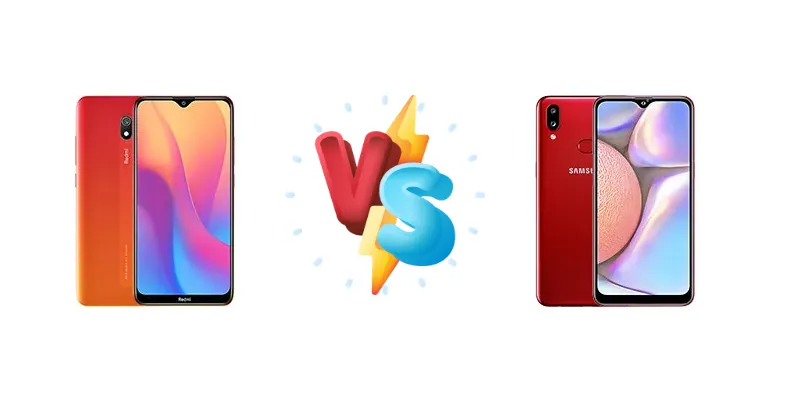
The Xiaomi Redmi 8A and Samsung Galaxy A10s represent the entry point for many into the Android ecosystem. Both phones aim to deliver essential smartphone functionality at an incredibly competitive price. This comparison dissects their core components to determine which device offers the best value for users prioritizing performance, battery life, and overall usability.
🏆 Quick Verdict
For the average user seeking a slightly more responsive experience, the Xiaomi Redmi 8A edges out the Samsung Galaxy A10s. While both phones are similarly priced, the Snapdragon 439 chipset provides a marginal performance advantage, making it better suited for multitasking and light gaming. However, the A10s offers a comparable experience for basic tasks.
| Network |
|---|
| 2G bands | GSM 850 / 900 / 1800 / 1900 | GSM 850 / 900 / 1800 / 1900 |
| 3G bands | HSDPA 850 / 900 / 1900 / 2100 | HSDPA 850 / 900 / 1900 / 2100 |
| 4G bands | 1, 2, 3, 4, 5, 7, 8, 20, 38, 40 - Global | 1, 2, 3, 5, 7, 8, 20, 38, 40, 41 |
| Speed | HSPA, LTE | HSPA 42.2/5.76 Mbps, LTE Cat4 150/50 Mbps |
| Technology | GSM / HSPA / LTE | GSM / HSPA / LTE |
| | 1, 3, 5, 8, 34, 38, 39, 40, 41 - China | 1, 2, 3, 5, 7, 8, 12, 17, 28 - SM-A107M/DS |
| Launch |
|---|
| Announced | 2019, September 25. Released 2019, September 30 | 2019, August 12. Released 2019, August 27 |
| Status | Discontinued | Discontinued |
| Body |
|---|
| Build | Glass front (Gorilla Glass 5), plastic back, plastic frame | Glass front, plastic back, plastic frame |
| Dimensions | 156.5 x 75.4 x 9.4 mm (6.16 x 2.97 x 0.37 in) | 156.9 x 75.8 x 7.8 mm (6.18 x 2.98 x 0.31 in) |
| SIM | Nano-SIM + Nano-SIM | · Nano-SIM· Nano-SIM + Nano-SIM |
| Weight | 188 g (6.63 oz) | 168 g (5.93 oz) |
| | Water-repellent coating | - |
| Display |
|---|
| Protection | Corning Gorilla Glass 5 | - |
| Resolution | 720 x 1520 pixels, 19:9 ratio (~270 ppi density) | 720 x 1520 pixels, 19:9 ratio (~271 ppi density) |
| Size | 6.22 inches, 96.6 cm2 (~81.8% screen-to-body ratio) | 6.2 inches, 95.9 cm2 (~80.7% screen-to-body ratio) |
| Type | IPS LCD, 400 nits (typ) | PLS LCD |
| Platform |
|---|
| CPU | Octa-core (4x1.95 GHz Cortex-A53 & 4x1.45 GHz Cortex A53) | Octa-core 2.0 GHz Cortex-A53 |
| Chipset | Qualcomm SDM439 Snapdragon 439 (12 nm) | Mediatek MT6762 Helio P22 (12 nm) |
| GPU | Adreno 505 | PowerVR GE8320 |
| OS | Android 9.0 (Pie), upgradable to Android 10, MIUI 12 | Android 9.0 (Pie), upgradable to Android 11, One UI 3.1 |
| Memory |
|---|
| Card slot | microSDXC (dedicated slot) | microSDXC (dedicated slot) |
| Internal | 32GB 2GB RAM, 32GB 3GB RAM, 64GB 4GB RAM | 32GB 2GB RAM, 32GB 3GB RAM |
| | eMMC 5.1 | eMMC 5.1 |
| Main Camera |
|---|
| Dual | - | 13 MP, f/1.8, 28mm (wide), AF
Auxiliary lens |
| Features | LED flash, HDR, panorama | LED flash, panorama, HDR |
| Single | 12 MP, f/1.8, (wide), 1/2.55", 1.4µm, dual pixel PDAF | - |
| Video | 1080p@30fps | 1080p@30fps |
| Selfie camera |
|---|
| Features | HDR | - |
| Single | 8 MP, f/2.0, 1/4.0", 1.12µm | 8 MP, f/2.0 |
| Video | 1080p@30fps | 1080p@30fps |
| Sound |
|---|
| 3.5mm jack | Yes | Yes |
| 35mm jack | Yes | Yes |
| Loudspeaker | Yes | Yes |
| Comms |
|---|
| Bluetooth | 4.2, A2DP, LE | 4.2, A2DP, LE |
| NFC | No | No |
| Positioning | GPS, GLONASS, BDS | GPS, GLONASS, GALILEO |
| Radio | FM Radio, built-in antenna | FM radio |
| USB | USB Type-C 2.0, OTG | microUSB 2.0, OTG |
| WLAN | Wi-Fi 802.11 b/g/n, Wi-Fi Direct | Wi-Fi 802.11 b/g/n, Wi-Fi Direct |
| Features |
|---|
| Sensors | Accelerometer, proximity, compass | Fingerprint (rear-mounted), accelerometer, proximity |
| Battery |
|---|
| Charging | 18W wired | - |
| Type | Li-Po 5000 mAh, non-removable | Li-Po 4000 mAh, non-removable |
| Misc |
|---|
| Colors | Midnight Black, Ocean Blue, Sunset Red | Blue, Green, Red, Black |
| Models | MZB8458IN, M1908C3KG, M1908C3KH | SM-A107F, SM-A107M |
| Price | About 120 EUR | About 180 EUR |
| SAR | 0.48 W/kg (head) 1.07 W/kg (body) | 0.25 W/kg (head) 1.06 W/kg (body) |
| SAR EU | 0.23 W/kg (head) 1.48 W/kg (body) | - |
| Tests |
|---|
| Performance |
AnTuTu: 89901 (v8)
GeekBench: 3030 (v4.4)
GFXBench: 7fps (ES 3.1 onscreen) | - |
Xiaomi Redmi 8A
- Faster charging (18W)
- Slightly better CPU performance due to Snapdragon 439 architecture
- Potentially more efficient chipset
- Xiaomi's MIUI software can be polarizing
- Camera performance may be average
Samsung Galaxy A10s
- Familiar Samsung brand and software experience
- Generally stable software updates
- Potentially better color accuracy in display
- Slower charging (likely 10W)
- Less powerful chipset (Helio P22)
- Potentially less responsive user interface
Display Comparison
Neither device boasts a standout display. Both likely utilize LCD panels, typical for this price bracket. The focus here isn't on visual fidelity, but on basic usability. While specific nit brightness isn't provided, both will struggle in direct sunlight. The absence of features like high refresh rates or HDR support is expected. The A10s may benefit from Samsung's color calibration, potentially offering slightly more accurate colors, but this is speculative without direct testing.
Camera Comparison
Both phones feature basic camera setups. Without detailed sensor information, it's difficult to make definitive claims. However, the market positioning suggests both will rely on a primary sensor paired with depth or macro sensors of limited utility. Image processing will likely be the differentiating factor, with Samsung historically offering more vibrant, albeit sometimes over-saturated, images. The Redmi 8A may lean towards a more natural color profile. The absence of Optical Image Stabilization (OIS) on either device means low-light performance will be heavily reliant on software processing.
Performance
The core difference lies in the chipsets. The Xiaomi Redmi 8A features the Qualcomm Snapdragon 439, a 12nm process chipset with an octa-core CPU split into two clusters: 4x1.95 GHz Cortex-A53 and 4x1.45 GHz Cortex-A53. The Samsung Galaxy A10s utilizes the MediaTek Helio P22, also a 12nm chip, but with a uniform octa-core 2.0 GHz Cortex-A53 configuration. The Snapdragon 439's architecture, with faster cores, suggests a slight edge in single-core performance, translating to snappier app launches and smoother transitions. While both rely on the Cortex-A53 architecture, the clock speed difference and Qualcomm's optimizations give the Redmi 8A a performance advantage, particularly in tasks that benefit from single-core speed.
Battery Life
Battery capacity isn't specified, but both phones likely house around 4000-5000mAh batteries, standard for this segment. The Redmi 8A's 18W wired charging is a significant advantage over the A10s, which likely supports standard 10W charging. This translates to considerably faster charging times, reducing downtime and improving overall usability. While a larger battery capacity on the A10s could offset the slower charging, the 18W support on the Redmi 8A provides a tangible benefit for users who frequently need to top up their phones.
Buying Guide
Buy the Xiaomi Redmi 8A if you need a phone that can handle slightly more demanding tasks like occasional gaming or running multiple apps simultaneously. Its 18W charging is also a plus for quicker top-ups. Buy the Samsung Galaxy A10s if you prioritize a familiar brand experience and a generally stable software environment, and your usage is primarily focused on calls, messaging, and basic social media.
Frequently Asked Questions
❓ Does the MediaTek Helio P22 in the Galaxy A10s struggle with multitasking?
The Helio P22 is a capable chipset for basic tasks, but it can exhibit slowdowns when running multiple apps simultaneously. Users who frequently switch between applications or use demanding apps may experience lag. The Redmi 8A's Snapdragon 439 handles multitasking slightly better due to its architecture.
❓ Is the 18W charging on the Redmi 8A a significant improvement over the A10s' charging speed?
Yes, the 18W charging on the Redmi 8A is a substantial improvement. It can reduce charging times by 30-50% compared to the A10s' likely 10W charging, meaning you'll spend less time tethered to a wall outlet.
❓ Will either phone be able to run PUBG Mobile smoothly?
Both phones will likely struggle to run PUBG Mobile at high settings. You'll likely need to lower the graphics settings to the lowest possible level and accept lower frame rates for a playable experience. The Redmi 8A may offer slightly better performance, but neither phone is ideal for serious gaming.