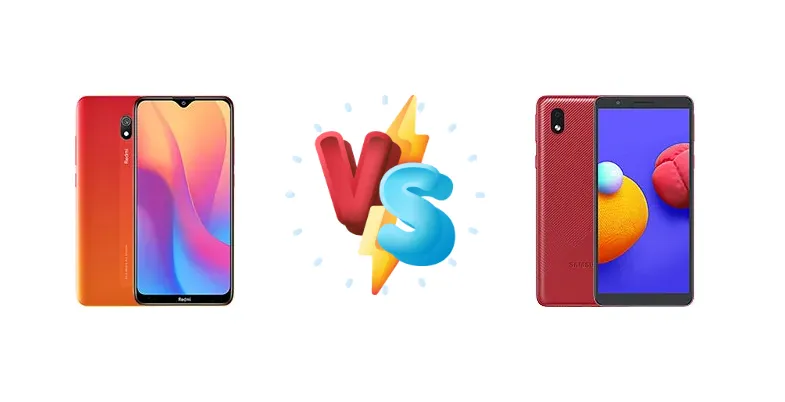
The Xiaomi Redmi 8A and Samsung Galaxy A01 Core represent the absolute entry point into smartphone ownership. Both devices target first-time smartphone buyers or those seeking a very affordable secondary device. However, beneath the similar price points lie significant differences in processing power and efficiency, making one a considerably better value proposition than the other.
🏆 Quick Verdict
For the average user prioritizing responsiveness and future-proofing, the Xiaomi Redmi 8A is the clear winner. Its Qualcomm Snapdragon 439 chipset, built on a more efficient 12nm process, delivers significantly better performance than the Samsung Galaxy A01 Core’s Mediatek MT6739. While both phones offer basic functionality, the Redmi 8A handles multitasking and app loading with noticeably less lag.
| Network |
|---|
| 2G bands | GSM 850 / 900 / 1800 / 1900 | GSM 850 / 900 / 1800 / 1900 |
| 3G bands | HSDPA 850 / 900 / 1900 / 2100 | HSDPA 850 / 900 / 2100 |
| 4G bands | 1, 2, 3, 4, 5, 7, 8, 20, 38, 40 - Global | 1, 3, 5, 7, 8, 20, 28, 38, 40, 41 |
| Speed | HSPA, LTE | HSPA 21.1/5.76 Mbps, LTE |
| Technology | GSM / HSPA / LTE | GSM / HSPA / LTE |
| | 1, 3, 5, 8, 34, 38, 39, 40, 41 - China | - |
| Launch |
|---|
| Announced | 2019, September 25. Released 2019, September 30 | 2020, July 21. Released 2020, August 06 |
| Status | Discontinued | Discontinued |
| Body |
|---|
| Build | Glass front (Gorilla Glass 5), plastic back, plastic frame | Plastic back, plastic frame |
| Dimensions | 156.5 x 75.4 x 9.4 mm (6.16 x 2.97 x 0.37 in) | 141.7 x 67.5 x 8.6 mm (5.58 x 2.66 x 0.34 in) |
| SIM | Nano-SIM + Nano-SIM | · Nano-SIM· Nano-SIM + Nano-SIM |
| Weight | 188 g (6.63 oz) | 150 g (5.29 oz) |
| | Water-repellent coating | - |
| Display |
|---|
| Protection | Corning Gorilla Glass 5 | - |
| Resolution | 720 x 1520 pixels, 19:9 ratio (~270 ppi density) | 720 x 1480 pixels, 18.5:9 ratio (~311 ppi density) |
| Size | 6.22 inches, 96.6 cm2 (~81.8% screen-to-body ratio) | 5.3 inches, 71.3 cm2 (~74.5% screen-to-body ratio) |
| Type | IPS LCD, 400 nits (typ) | PLS LCD |
| Platform |
|---|
| CPU | Octa-core (4x1.95 GHz Cortex-A53 & 4x1.45 GHz Cortex A53) | Quad-core 1.5 GHz Cortex-A53 |
| Chipset | Qualcomm SDM439 Snapdragon 439 (12 nm) | Mediatek MT6739 (28 nm) |
| GPU | Adreno 505 | PowerVR GE8100 |
| OS | Android 9.0 (Pie), upgradable to Android 10, MIUI 12 | Android 10 (Go edition) |
| Memory |
|---|
| Card slot | microSDXC (dedicated slot) | microSDXC (dedicated slot) |
| Internal | 32GB 2GB RAM, 32GB 3GB RAM, 64GB 4GB RAM | 16GB 1GB RAM, 16GB 2GB RAM, 32GB 2GB RAM |
| | eMMC 5.1 | eMMC 5.1 |
| Main Camera |
|---|
| Features | LED flash, HDR, panorama | LED flash |
| Single | 12 MP, f/1.8, (wide), 1/2.55", 1.4µm, dual pixel PDAF | 8 MP, f/2.2, AF |
| Video | 1080p@30fps | 1080p@30fps |
| Selfie camera |
|---|
| Features | HDR | - |
| Single | 8 MP, f/2.0, 1/4.0", 1.12µm | 5 MP, f/2.4 |
| Video | 1080p@30fps | - |
| Sound |
|---|
| 3.5mm jack | Yes | Yes |
| 35mm jack | Yes | Yes |
| Loudspeaker | Yes | Yes |
| Comms |
|---|
| Bluetooth | 4.2, A2DP, LE | 5.0, A2DP, LE |
| NFC | No | No |
| Positioning | GPS, GLONASS, BDS | GPS |
| Radio | FM Radio, built-in antenna | FM radio |
| USB | USB Type-C 2.0, OTG | microUSB 2.0 |
| WLAN | Wi-Fi 802.11 b/g/n, Wi-Fi Direct | Wi-Fi 802.11 b/g/n, Wi-Fi Direct |
| Features |
|---|
| Sensors | Accelerometer, proximity, compass | Accelerometer |
| Battery |
|---|
| Charging | 18W wired | - |
| Type | Li-Po 5000 mAh, non-removable | Li-Ion 3000 mAh |
| Misc |
|---|
| Colors | Midnight Black, Ocean Blue, Sunset Red | Black, Blue, Red |
| Models | MZB8458IN, M1908C3KG, M1908C3KH | SM-A013F, SM-A013F/DS, SM-A013G, SM-A013G/DS, SM-A013M |
| Price | About 120 EUR | About 150 EUR |
| SAR | 0.48 W/kg (head) 1.07 W/kg (body) | - |
| SAR EU | 0.23 W/kg (head) 1.48 W/kg (body) | 0.64 W/kg (head) 1.18 W/kg (body) |
| Tests |
|---|
| Performance |
AnTuTu: 89901 (v8)
GeekBench: 3030 (v4.4)
GFXBench: 7fps (ES 3.1 onscreen) | - |
Xiaomi Redmi 8A
- Significantly faster processor for smoother performance
- More efficient chipset for longer battery life
- Faster 18W charging support
- May have a slightly higher price point
- Software experience can be heavily customized with MIUI
Samsung Galaxy A01 Core
- Ultra-affordable price point
- Simple and clean Android Go operating system
- Samsung brand recognition
- Slow processor leads to noticeable lag
- Less efficient chipset results in shorter battery life
- Slower charging speeds
Display Comparison
Neither device boasts a standout display. Both likely feature LCD panels with resolutions around 720p+, typical for this price bracket. However, display quality isn't the defining factor here. The focus is on the underlying processing power to drive even these basic displays smoothly.
Camera Comparison
Both phones likely feature basic camera setups, with the A01 Core often including a 13MP main sensor and the Redmi 8A a 12MP sensor. However, image quality is heavily reliant on image signal processing (ISP) within the chipset. Given the superior processing power of the Snapdragon 439, the Redmi 8A is likely to produce more detailed and less noisy images, especially in challenging lighting conditions. The presence of a dedicated ISP within the Snapdragon 439 offers advantages in image processing that the Mediatek MT6739 simply cannot match.
Performance
The core difference lies in the chipsets. The Redmi 8A’s Qualcomm Snapdragon 439, an octa-core processor fabricated on a 12nm process, significantly outperforms the Galaxy A01 Core’s Mediatek MT6739, a quad-core processor built on a much older 28nm process. The 12nm node of the Snapdragon 439 translates to better power efficiency and reduced heat generation, allowing for sustained performance. The eight Cortex-A53 cores in the Redmi 8A, split between 1.95 GHz and 1.45 GHz speeds, provide a substantial advantage over the four 1.5 GHz Cortex-A53 cores in the A01 Core. This difference is noticeable in app launch times, multitasking, and overall system responsiveness.
Battery Life
While specific battery capacities aren't provided, both phones likely feature batteries in the 4000-5000 mAh range. However, the Snapdragon 439’s superior power efficiency means the Redmi 8A will likely deliver longer battery life on a single charge. Furthermore, the Redmi 8A supports 18W wired charging, a significant advantage over the A01 Core’s likely slower charging speeds. This faster charging capability reduces downtime and ensures the phone is ready to use when needed.
Buying Guide
Buy the Xiaomi Redmi 8A if you need a phone capable of handling more than just basic tasks like calls and messaging. It’s a better choice for light gaming, social media browsing, and running multiple apps simultaneously. Buy the Samsung Galaxy A01 Core if your primary need is a very basic, ultra-affordable phone for essential communication and you prioritize brand recognition over performance. It's suitable for users with extremely limited needs and a tight budget.
Frequently Asked Questions
❓ Will the Mediatek MT6739 in the Galaxy A01 Core struggle with modern app updates?
Yes, the Mediatek MT6739 is a relatively old chipset. As apps become more demanding with each update, the A01 Core will likely experience increasing lag and performance issues. The Snapdragon 439 in the Redmi 8A offers more headroom for future software updates.
❓ Is the 18W charging on the Redmi 8A a significant advantage in real-world use?
Absolutely. While both phones likely have similar battery capacities, the Redmi 8A’s 18W charging significantly reduces charging time. You’ll spend less time tethered to a wall charger, making it more convenient for users who need their phone throughout the day.
❓ Does the Redmi 8A support running multiple apps simultaneously without significant slowdown?
The Redmi 8A, with its octa-core Snapdragon 439, handles multitasking considerably better than the Galaxy A01 Core. While it won't compete with flagship devices, it can comfortably run several apps in the background without experiencing severe lag.