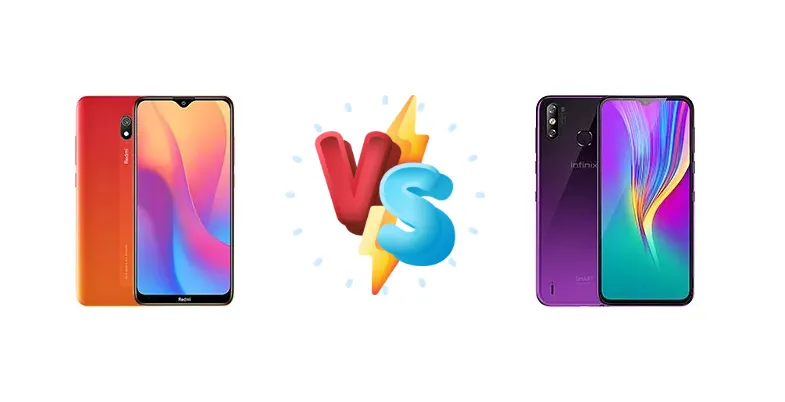
The Xiaomi Redmi 8A and Infinix Smart 4c represent the extreme end of the smartphone price spectrum. Both aim to deliver essential smartphone functionality at a rock-bottom cost, but they achieve this with significantly different hardware. This comparison dissects their core components to determine which offers the best value for users prioritizing affordability.
🏆 Quick Verdict
For the average user, the Xiaomi Redmi 8A is the better choice. Its Qualcomm Snapdragon 439 chipset, with its octa-core configuration, provides a noticeable performance advantage over the Infinix Smart 4c’s quad-core Helio A22, making it more responsive for everyday tasks and light multitasking. While both offer basic functionality, the Redmi 8A delivers a smoother experience.
| Network |
|---|
| 2G bands | GSM 850 / 900 / 1800 / 1900 | GSM 850 / 900 / 1800 / 1900 |
| 3G bands | HSDPA 850 / 900 / 1900 / 2100 | HSDPA 850 / 900 / 2100 |
| 4G bands | 1, 2, 3, 4, 5, 7, 8, 20, 38, 40 - Global | 1, 3, 5, 8, 38, 40, 41 |
| Speed | HSPA, LTE | HSPA 21.1/5.76 Mbps, LTE Cat4 150/50 Mbps |
| Technology | GSM / HSPA / LTE | GSM / HSPA / LTE |
| | 1, 3, 5, 8, 34, 38, 39, 40, 41 - China | - |
| Launch |
|---|
| Announced | 2019, September 25. Released 2019, September 30 | 2019, November. Released 2019, December |
| Status | Discontinued | Discontinued |
| Body |
|---|
| Build | Glass front (Gorilla Glass 5), plastic back, plastic frame | - |
| Dimensions | 156.5 x 75.4 x 9.4 mm (6.16 x 2.97 x 0.37 in) | 167 x 76 x 8.3 mm (6.57 x 2.99 x 0.33 in) |
| SIM | Nano-SIM + Nano-SIM | Nano-SIM + Nano-SIM |
| Weight | 188 g (6.63 oz) | 183 g (6.46 oz) |
| | Water-repellent coating | - |
| Display |
|---|
| Protection | Corning Gorilla Glass 5 | - |
| Resolution | 720 x 1520 pixels, 19:9 ratio (~270 ppi density) | 720 x 1600 pixels, 20:9 ratio (~266 ppi density) |
| Size | 6.22 inches, 96.6 cm2 (~81.8% screen-to-body ratio) | 6.6 inches, 105.2 cm2 (~82.9% screen-to-body ratio) |
| Type | IPS LCD, 400 nits (typ) | IPS LCD |
| Platform |
|---|
| CPU | Octa-core (4x1.95 GHz Cortex-A53 & 4x1.45 GHz Cortex A53) | Quad-core 2.0 GHz Cortex-A53 |
| Chipset | Qualcomm SDM439 Snapdragon 439 (12 nm) | Mediatek MT6761 Helio A22 (12 nm) |
| GPU | Adreno 505 | PowerVR GE8320 |
| OS | Android 9.0 (Pie), upgradable to Android 10, MIUI 12 | Android 9.0 (Pie) |
| Memory |
|---|
| Card slot | microSDXC (dedicated slot) | microSDXC (dedicated slot) |
| Internal | 32GB 2GB RAM, 32GB 3GB RAM, 64GB 4GB RAM | 32GB 2GB RAM |
| | eMMC 5.1 | eMMC 5.1 |
| Main Camera |
|---|
| Dual | - | 8 MP
Auxiliary lens |
| Features | LED flash, HDR, panorama | Dual-LED flash |
| Single | 12 MP, f/1.8, (wide), 1/2.55", 1.4µm, dual pixel PDAF | - |
| Video | 1080p@30fps | 1080p@30fps |
| Selfie camera |
|---|
| Features | HDR | - |
| Single | 8 MP, f/2.0, 1/4.0", 1.12µm | 5 MP |
| Video | 1080p@30fps | - |
| Sound |
|---|
| 3.5mm jack | Yes | Yes |
| 35mm jack | Yes | Yes |
| Loudspeaker | Yes | Yes |
| Comms |
|---|
| Bluetooth | 4.2, A2DP, LE | 5.0, A2DP, LE |
| NFC | No | No |
| Positioning | GPS, GLONASS, BDS | GPS |
| Radio | FM Radio, built-in antenna | FM radio |
| USB | USB Type-C 2.0, OTG | microUSB 2.0 |
| WLAN | Wi-Fi 802.11 b/g/n, Wi-Fi Direct | Wi-Fi 802.11 a/b/g/n |
| Features |
|---|
| Sensors | Accelerometer, proximity, compass | Fingerprint (rear-mounted), accelerometer, proximity, compass |
| Battery |
|---|
| Charging | 18W wired | - |
| Type | Li-Po 5000 mAh, non-removable | 4000 mAh, non-removable |
| Misc |
|---|
| Colors | Midnight Black, Ocean Blue, Sunset Red | Midnight Black, Quetzal Cyan, Cosmic Purple |
| Models | MZB8458IN, M1908C3KG, M1908C3KH | X653C |
| Price | About 120 EUR | - |
| SAR | 0.48 W/kg (head) 1.07 W/kg (body) | - |
| SAR EU | 0.23 W/kg (head) 1.48 W/kg (body) | - |
| Tests |
|---|
| Performance |
AnTuTu: 89901 (v8)
GeekBench: 3030 (v4.4)
GFXBench: 7fps (ES 3.1 onscreen) | - |
Xiaomi Redmi 8A
- More powerful octa-core processor for smoother multitasking.
- Faster 18W wired charging.
- Potentially better sustained performance due to chipset architecture.
- Display specs are likely basic.
- Camera performance will be limited.
Infinix Smart 4c
- Extremely affordable price point.
- Sufficient for basic calling and texting.
- Likely lightweight and easy to handle.
- Quad-core processor struggles with multitasking.
- Slower charging speeds.
- Limited performance for anything beyond basic tasks.
Display Comparison
Neither device boasts a standout display. Both are likely to feature LCD panels, typical for this price point. However, detailed display specs (resolution, brightness, color gamut) are unavailable. Given the market segment, expect 720p+ resolution and limited color accuracy. The focus here is on functionality, not visual fidelity.
Camera Comparison
Camera performance on both devices will be limited. Without specific sensor details, it’s safe to assume both feature basic cameras suitable for casual snapshots in good lighting conditions. The absence of Optical Image Stabilization (OIS) on either device means low-light performance will be poor. Any marketing around 'AI' camera features should be viewed skeptically, as processing power is limited. The Redmi 8A may have a slight edge if it incorporates a more sophisticated image processing pipeline, but this is speculative.
Performance
The core difference lies in the chipset. The Xiaomi Redmi 8A’s Qualcomm Snapdragon 439 is an octa-core processor featuring four Cortex-A53 cores clocked at 1.95 GHz and another four at 1.45 GHz. This contrasts sharply with the Infinix Smart 4c’s MediaTek Helio A22, a quad-core processor clocked at 2.0 GHz. While the Helio A22 has a higher clock speed *per core*, the Redmi 8A’s eight cores provide superior multitasking capabilities. The Snapdragon 439’s architecture is better suited for handling multiple apps simultaneously without significant slowdown. The 12nm process node used by both chipsets suggests similar power efficiency, but the Snapdragon’s architectural advantages will likely translate to better sustained performance.
Battery Life
Battery capacity is not specified for either device. However, given the budget nature of these phones, expect capacities around 3000-4000 mAh. The Redmi 8A’s 18W wired charging is a significant advantage over the likely 10W or slower charging on the Smart 4c. This means the Redmi 8A will recharge much faster, reducing downtime and improving usability. Even with similar battery capacities, the Snapdragon 439’s potentially better power efficiency could translate to slightly longer battery life.
Buying Guide
Buy the Xiaomi Redmi 8A if you need a phone that can handle more than just basic calling and texting – if you occasionally browse social media, use messaging apps, or play simple games, the Redmi 8A’s processor will provide a more fluid experience. Buy the Infinix Smart 4c if your primary need is a very basic, reliable phone for calls and texts, and you are on an extremely tight budget where every dollar counts. The Smart 4c prioritizes absolute minimum cost over performance.
Frequently Asked Questions
❓ Will the Helio A22 in the Infinix Smart 4c struggle with popular apps like WhatsApp and Facebook?
While the Helio A22 can run these apps, you may experience noticeable lag and slowdown when switching between them or using multiple features within the apps. The quad-core processor is simply less capable of handling multitasking compared to the octa-core Snapdragon 439 in the Redmi 8A.
❓ How long will it take to fully charge the Redmi 8A with the 18W charger?
While a precise 0-100% charge time isn't available, the 18W charging should fully charge the Redmi 8A in approximately 2-3 hours, depending on battery capacity. This is significantly faster than the Infinix Smart 4c, which likely supports slower charging speeds.
❓ Is the Redmi 8A a good option for playing mobile games?
The Redmi 8A is suitable for very light gaming – simple 2D games or older titles. However, demanding 3D games will likely experience significant frame rate drops and lag. The Snapdragon 439 isn't a gaming powerhouse.
❓ Does either phone support fast internet connectivity like 4G LTE?
Both the Redmi 8A and Smart 4c are expected to support 4G LTE connectivity, given their release timeframe and target market. However, the specific LTE bands supported may vary depending on the region.