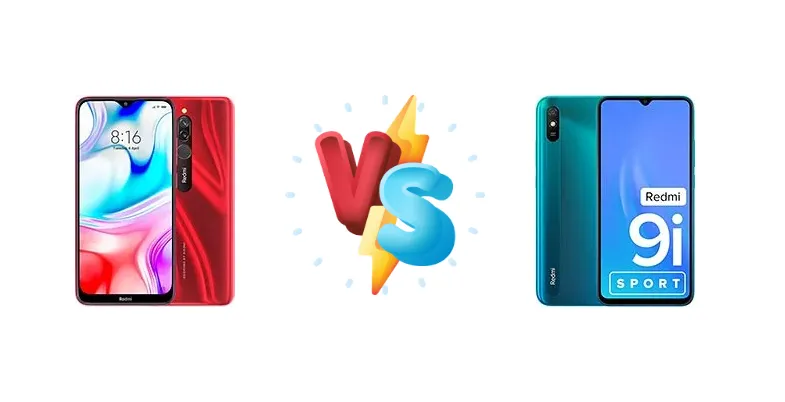
Xiaomi's Redmi series consistently delivers value, but navigating the numerous models can be tricky. The Redmi 8 and Redmi 9i Sport represent two distinct approaches to the ultra-budget segment. The Redmi 8, released earlier, offers a proven Qualcomm chipset, while the 9i Sport introduces MediaTek's Helio G25, aiming for a slight performance boost. This comparison dissects the key differences to determine which phone offers the best experience for your money.
🏆 Quick Verdict
For most users, the Redmi 9i Sport edges out the Redmi 8. While the Redmi 8 boasts 18W charging, the Helio G25 in the 9i Sport provides a noticeable CPU performance uplift, making it more responsive for everyday tasks. The trade-off is slower charging, but the performance gain is more impactful for the typical user.
| Network |
|---|
| 2G bands | GSM 850 / 900 / 1800 / 1900 | GSM 850 / 900 / 1800 / 1900 |
| 3G bands | HSDPA 850 / 900 / 1700(AWS) / 1900 / 2100 - Global | HSDPA 850 / 900 / 2100 |
| 4G bands | 1, 2, 3, 4, 5, 7, 8, 20, 38, 40 - Global | 1, 3, 5, 8, 40, 41 |
| Speed | HSPA, LTE | HSPA, LTE |
| Technology | GSM / HSPA / LTE | GSM / HSPA / LTE |
| | 1, 3, 5, 8, 40, 41 - India | - |
| Launch |
|---|
| Announced | 2019, October 09. Released 2019, October 12 | 2021, September 28 |
| Status | Discontinued | Available. Released 2021, September 28 |
| Body |
|---|
| Build | Glass front (Gorilla Glass 5), plastic back, plastic frame | - |
| Dimensions | 156.5 x 75.4 x 9.4 mm (6.16 x 2.97 x 0.37 in) | 164.9 x 77.1 x 9 mm (6.49 x 3.04 x 0.35 in) |
| SIM | Nano-SIM + Nano-SIM | Nano-SIM + Nano-SIM |
| Weight | 188 g (6.63 oz) | 194 g (6.84 oz) |
| | Water-repellent coating | Water-repellent coating |
| Display |
|---|
| Protection | Corning Gorilla Glass 5 | - |
| Resolution | 720 x 1520 pixels, 19:9 ratio (~270 ppi density) | 720 x 1600 pixels, 20:9 ratio (~269 ppi density) |
| Size | 6.22 inches, 96.6 cm2 (~81.8% screen-to-body ratio) | 6.53 inches, 102.9 cm2 (~81.0% screen-to-body ratio) |
| Type | IPS LCD, 400 nits (typ) | IPS LCD, 400 nits (typ) |
| Platform |
|---|
| CPU | Octa-core (4x1.95 GHz Cortex-A53 & 4x1.45 GHz Cortex A53) | Octa-core (4x2.0 GHz Cortex-A53 & 4x1.5 GHz Cortex-A53) |
| Chipset | Qualcomm SDM439 Snapdragon 439 (12 nm) | Mediatek MT6762G Helio G25 (12 nm) |
| GPU | Adreno 505 | PowerVR GE8320 |
| OS | Android 9.0 (Pie), upgradable to Android 10, MIUI 12 | Android 10, MIUI 12 |
| Memory |
|---|
| Card slot | microSDXC (dedicated slot) | microSDXC (dedicated slot) |
| Internal | 32GB 3GB RAM, 64GB 4GB RAM | 64GB 4GB RAM, 128GB 4GB RAM |
| | eMMC 5.1 | eMMC 5.1 |
| Main Camera |
|---|
| Features | LED flash, HDR, panorama | LED flash, HDR |
| Single | 12 MP, f/1.8, 1/2.55", 1.4µm, dual pixel PDAF
Auxiliary lens | 13 MP, f/2.2, 28mm (wide), 1.0µm, PDAF |
| Video | 1080p@30fps | 1080p@30fps |
| Selfie camera |
|---|
| Features | HDR | HDR |
| Single | 8 MP, f/2.0, 1/4.0", 1.12µm | 5 MP, f/2.2, (wide), 1.12µm |
| Video | 1080p@30fps | 1080p@30fps |
| Sound |
|---|
| 3.5mm jack | Yes | Yes |
| 35mm jack | Yes | Yes |
| Loudspeaker | Yes | Yes |
| Comms |
|---|
| Bluetooth | 4.2, A2DP, LE | 5.0, A2DP, LE |
| Infrared port | Yes | - |
| NFC | No | No |
| Positioning | GPS, GLONASS, GALILEO, BDS | GPS, GLONASS, BDS |
| Radio | Wireless FM radio (no wired headphones required) | FM radio |
| USB | USB Type-C 2.0, OTG | microUSB 2.0, OTG |
| WLAN | Wi-Fi 802.11 b/g/n, Wi-Fi Direct | Wi-Fi 802.11 а/b/g/n, Wi-Fi Direct |
| Features |
|---|
| Sensors | Fingerprint (rear-mounted), accelerometer, proximity, compass | Accelerometer, proximity, compass |
| Battery |
|---|
| Charging | 18W wired | 10W wired |
| Type | Li-Po 5000 mAh, non-removable | Li-Po 5000 mAh |
| Misc |
|---|
| Colors | Onyx Black, Ruby Red, Sapphire Blue, Phantom Red | Carbon Black, Coral Green, Metallic Blue |
| Models | M1908C3IC, MZB8255IN, M1908C3IG, M1908C3IH | - |
| Price | About 210 EUR | About 100 EUR |
| SAR | 0.34 W/kg (head) 1.00 W/kg (body) | - |
| SAR EU | 0.23 W/kg (head) 1.48 W/kg (body) | - |
Xiaomi Redmi 8
- Faster 18W charging
- Proven Snapdragon 439 platform
- Potentially better software optimization (due to maturity)
- Slightly slower CPU performance
- May feel less responsive during multitasking
Xiaomi Redmi 9i Sport
- Slightly faster CPU performance with Helio G25
- More responsive user experience
- Better suited for light gaming
- Slower 10W charging
- Helio G25 may have less refined software support
Display Comparison
Both devices likely feature similar LCD panels, given their price points. Detailed display specs (resolution, brightness) are not provided, but the focus here is on internal performance. Bezels are expected to be comparable, typical of this segment. Color accuracy is unlikely to be a strong suit on either device, prioritizing cost over color calibration.
Camera Comparison
Without detailed camera specifications, a direct comparison is difficult. Both phones likely feature a primary camera and depth sensor. Given the market segment, image processing will prioritize speed over detail. The absence of OIS on either device means low-light performance will be limited. Any secondary cameras (e.g., 2MP macro) are unlikely to provide significant value and should be considered marketing features rather than genuine photographic tools.
Performance
The core difference lies in the chipsets. The Redmi 8's Snapdragon 439 (12nm) utilizes a dual-cluster configuration with 4x1.95 GHz Cortex-A53 cores and 4x1.45 GHz Cortex-A53 cores. The Redmi 9i Sport's Helio G25 (12nm) also employs an octa-core setup, but with slightly higher clocked Cortex-A53 cores at 2.0 GHz and 1.5 GHz. This clock speed increase, while modest, translates to a tangible performance advantage for the 9i Sport in CPU-bound tasks. The Snapdragon 439 is a mature platform, known for its stability, but the Helio G25 offers a small edge in raw processing power. Both likely utilize LPDDR3 RAM, limiting overall system responsiveness.
Battery Life
Battery capacity is not specified, but both devices likely house batteries in the 4000-5000 mAh range, typical for this price bracket. The Redmi 8's 18W wired charging is a clear advantage on paper, allowing for faster top-ups. However, the Redmi 9i Sport's 10W charging will take considerably longer to reach 100%. In real-world usage, the slightly more efficient Helio G25 might partially offset the charging disparity, but the Redmi 8 will still offer a quicker charging experience.
Buying Guide
Buy the Xiaomi Redmi 8 if you prioritize faster charging and are primarily focused on basic smartphone functions like calls, texts, and light social media use. Buy the Xiaomi Redmi 9i Sport if you value a slightly smoother user experience, particularly when multitasking or running slightly more demanding apps, and are willing to accept slower charging speeds. Gamers on a tight budget will also find the 9i Sport a better choice.
Frequently Asked Questions
❓ Will the Helio G25 in the Redmi 9i Sport overheat during prolonged gaming sessions?
The Helio G25 is a relatively low-power chipset. While it won't deliver flagship-level gaming performance, it's unlikely to overheat significantly during moderate gaming sessions. Expect playable frame rates in less demanding titles, but avoid pushing graphics settings to the maximum.
❓ Is the difference in charging speed between 18W and 10W really that noticeable in everyday use?
Yes, the difference is quite noticeable. 18W charging on the Redmi 8 will significantly reduce the time it takes to fully charge the device, especially when starting from a low battery level. 10W charging on the 9i Sport will require a much longer charging period, potentially taking several hours to reach 100%.
❓ Which phone is better for running multiple apps simultaneously?
The Redmi 9i Sport is better suited for multitasking due to the slightly higher clocked CPU cores of the Helio G25. While neither phone has a large amount of RAM, the 9i Sport will exhibit less lag when switching between apps.
❓ Does either phone support fast charging protocols beyond the advertised wattage?
Neither phone is expected to support advanced fast charging protocols like Power Delivery or Quick Charge. They are limited to the standard charging speeds advertised (18W for the Redmi 8 and 10W for the Redmi 9i Sport).