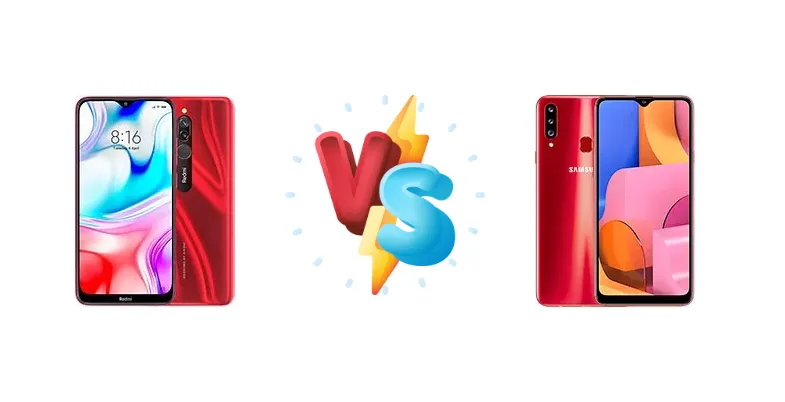
The Xiaomi Redmi 8 and Samsung Galaxy A20s represent a critical segment of the smartphone market: affordable devices for everyday users. Both phones aim to deliver essential functionality without breaking the bank, but they achieve this with different approaches to chipset design and feature sets. This comparison dissects the core differences to help you determine which device best suits your needs.
🏆 Quick Verdict
For the average user prioritizing sustained performance and slightly faster charging, the Xiaomi Redmi 8 emerges as the better choice. Its Snapdragon 439, built on a smaller 12nm process, offers a modest but noticeable advantage over the Galaxy A20s' Snapdragon 450, despite the latter's slightly higher clock speed.
| Network |
|---|
| 2G bands | GSM 850 / 900 / 1800 / 1900 | GSM 850 / 900 / 1800 / 1900 |
| 3G bands | HSDPA 850 / 900 / 1700(AWS) / 1900 / 2100 - Global | HSDPA 850 / 900 / 1900 / 2100 - SM-A207F/DS |
| 4G bands | 1, 2, 3, 4, 5, 7, 8, 20, 38, 40 - Global | 1, 2, 3, 5, 7, 8, 20, 28, 34, 38, 39, 40, 41 - SM-A207F/DS |
| Speed | HSPA, LTE | HSPA, LTE |
| Technology | GSM / HSPA / LTE | GSM / HSPA / LTE |
| | 1, 3, 5, 8, 40, 41 - India | 1, 2, 3, 4, 5, 7, 8, 12, 13, 17, 20, 28, 38, 40, 41, 66 - SM-A207M/DS |
| Launch |
|---|
| Announced | 2019, October 09. Released 2019, October 12 | 2019, September 24. Released 2019, October 05 |
| Status | Discontinued | Discontinued |
| Body |
|---|
| Build | Glass front (Gorilla Glass 5), plastic back, plastic frame | Glass front, plastic back, plastic frame |
| Dimensions | 156.5 x 75.4 x 9.4 mm (6.16 x 2.97 x 0.37 in) | 163.3 x 77.5 x 8 mm (6.43 x 3.05 x 0.31 in) |
| SIM | Nano-SIM + Nano-SIM | · Nano-SIM· Nano-SIM + Nano-SIM |
| Weight | 188 g (6.63 oz) | 183 g (6.46 oz) |
| | Water-repellent coating | - |
| Display |
|---|
| Protection | Corning Gorilla Glass 5 | - |
| Resolution | 720 x 1520 pixels, 19:9 ratio (~270 ppi density) | 720 x 1560 pixels, 19.5:9 ratio (~264 ppi density) |
| Size | 6.22 inches, 96.6 cm2 (~81.8% screen-to-body ratio) | 6.5 inches, 103.7 cm2 (~81.9% screen-to-body ratio) |
| Type | IPS LCD, 400 nits (typ) | IPS LCD |
| Platform |
|---|
| CPU | Octa-core (4x1.95 GHz Cortex-A53 & 4x1.45 GHz Cortex A53) | Octa-core 1.8 GHz Cortex-A53 |
| Chipset | Qualcomm SDM439 Snapdragon 439 (12 nm) | Qualcomm SDM450 Snapdragon 450 (14 nm) |
| GPU | Adreno 505 | Adreno 506 |
| OS | Android 9.0 (Pie), upgradable to Android 10, MIUI 12 | Android 9.0 (Pie), upgradable to Android 11, One UI Core 3.1 |
| Memory |
|---|
| Card slot | microSDXC (dedicated slot) | microSDXC (dedicated slot) |
| Internal | 32GB 3GB RAM, 64GB 4GB RAM | 32GB 2GB RAM, 32GB 3GB RAM, 64GB 4GB RAM |
| | eMMC 5.1 | eMMC 5.1 |
| Main Camera |
|---|
| Features | LED flash, HDR, panorama | LED flash, panorama, HDR |
| Single | 12 MP, f/1.8, 1/2.55", 1.4µm, dual pixel PDAF
Auxiliary lens | - |
| Triple | - | 13 MP, f/1.8, 27mm (wide), PDAF
8 MP, f/2.2, 13mm (ultrawide), 1/4.0", 1.12µm
Auxiliary lens |
| Video | 1080p@30fps | 1080p@30fps |
| Selfie camera |
|---|
| Features | HDR | - |
| Single | 8 MP, f/2.0, 1/4.0", 1.12µm | 8 MP, f/2.0 |
| Video | 1080p@30fps | 1080p@30fps |
| Sound |
|---|
| 3.5mm jack | Yes | Yes |
| 35mm jack | Yes | Yes |
| Loudspeaker | Yes | Yes |
| Comms |
|---|
| Bluetooth | 4.2, A2DP, LE | 4.2, A2DP, LE |
| Infrared port | Yes | - |
| NFC | No | No |
| Positioning | GPS, GLONASS, GALILEO, BDS | GPS, GLONASS, GALILEO, BDS |
| Radio | Wireless FM radio (no wired headphones required) | FM radio |
| USB | USB Type-C 2.0, OTG | USB Type-C 2.0 |
| WLAN | Wi-Fi 802.11 b/g/n, Wi-Fi Direct | Wi-Fi 802.11 b/g/n, Wi-Fi Direct |
| Features |
|---|
| Sensors | Fingerprint (rear-mounted), accelerometer, proximity, compass | Fingerprint (rear-mounted), accelerometer, gyro, proximity, compass |
| Battery |
|---|
| Charging | 18W wired | 15W wired |
| Type | Li-Po 5000 mAh, non-removable | Li-Po 4000 mAh, non-removable |
| Misc |
|---|
| Colors | Onyx Black, Ruby Red, Sapphire Blue, Phantom Red | Black, Blue, Red, Green |
| Models | M1908C3IC, MZB8255IN, M1908C3IG, M1908C3IH | SM-A207F, SM-A207M, SM-A2070 |
| Price | About 210 EUR | About 250 EUR |
| SAR | 0.34 W/kg (head) 1.00 W/kg (body) | 0.69 W/kg (head) 1.43 W/kg (body) |
| SAR EU | 0.23 W/kg (head) 1.48 W/kg (body) | 0.35 W/kg (head) 0.83 W/kg (body) |
Xiaomi Redmi 8
- Faster 18W charging
- More efficient Snapdragon 439 (12nm)
- Potentially better sustained performance due to thermal efficiency
- Samsung's One UI is not available
- Potentially less frequent software updates
Samsung Galaxy A20s
- Samsung One UI experience
- Potentially wider software update support
- Slightly higher CPU clock speed (on some cores)
- Slower 15W charging
- Less efficient Snapdragon 450 (14nm)
- Potential for more thermal throttling
Display Comparison
Neither device boasts a standout display. Both likely utilize IPS LCD panels, common in this price bracket. The key difference lies under the hood; the Redmi 8's chipset will have to work harder to drive the display due to the less efficient manufacturing process of the A20s' chip. While specific brightness and color accuracy data are unavailable, the A20s' 14nm chip *could* allow for slightly more efficient display power management, but this is unlikely to be a significant real-world difference.
Camera Comparison
Without detailed camera specs beyond the presence of multiple sensors, a direct comparison is difficult. Both phones likely feature a primary camera alongside depth and macro sensors. However, the image signal processor (ISP) within the Snapdragon 439 and 450 are similar, so image quality will likely be comparable in good lighting conditions. The Redmi 8's slightly more efficient chipset *could* allow for more processing power dedicated to image processing, potentially leading to better low-light performance, but this is speculative. The inclusion of 2MP macro sensors on both devices is largely a marketing tactic, offering limited practical benefit.
Performance
The core of the difference lies in the chipsets. The Xiaomi Redmi 8 features the Qualcomm Snapdragon 439 (12nm), while the Samsung Galaxy A20s uses the Snapdragon 450 (14nm). While the A20s has a slightly higher CPU clock speed (1.8 GHz vs 1.95 GHz on four cores of the Redmi 8), the 12nm process of the 439 offers better transistor density and, crucially, improved power efficiency. This translates to potentially less thermal throttling during sustained tasks. Both CPUs utilize the same Cortex-A53 architecture, meaning the performance gap will be noticeable primarily in multi-threaded workloads and gaming. The A20s' larger process node means more heat generated for the same workload.
Battery Life
Battery capacity is not provided, but both phones likely feature batteries in the 3500-4000 mAh range, typical for this segment. The Redmi 8's 18W wired charging is a clear advantage over the Galaxy A20s' 15W charging. This means the Redmi 8 will reach a full charge faster, reducing downtime. While the A20s' 14nm chip *could* theoretically be slightly more power-efficient in idle scenarios, the Redmi 8's more efficient chipset and faster charging likely result in a better overall user experience regarding battery life and convenience.
Buying Guide
Buy the Xiaomi Redmi 8 if you need a phone that can handle multitasking and light gaming with a bit more efficiency, and if faster charging is a priority. Buy the Samsung Galaxy A20s if you prefer the Samsung One UI experience and a potentially wider availability of software updates, even if it means sacrificing a small amount of raw processing power.
Frequently Asked Questions
❓ Will I notice a significant difference in gaming performance between the Redmi 8 and Galaxy A20s?
While both phones can handle casual gaming, the Redmi 8's Snapdragon 439, with its 12nm process, is likely to provide a smoother experience during longer gaming sessions due to reduced thermal throttling. Expect playable frame rates in titles like PUBG Mobile at lower settings, but don't anticipate high-end performance.
❓ How much faster is the 18W charging on the Redmi 8 compared to the 15W charging on the Galaxy A20s?
The 18W charging on the Redmi 8 will noticeably reduce charging times. While exact 0-100% times depend on battery capacity, expect the Redmi 8 to charge approximately 20-30% faster than the Galaxy A20s, offering greater convenience for users who frequently need to top up their battery.
❓ Does the Snapdragon 450 in the Galaxy A20s overheat easily during demanding tasks?
The Snapdragon 450, built on a 14nm process, is prone to thermal throttling under sustained load. While it won't necessarily overheat to the point of being unusable, you may experience performance drops during extended gaming or video recording sessions. The Redmi 8's 12nm Snapdragon 439 is better equipped to handle heat.