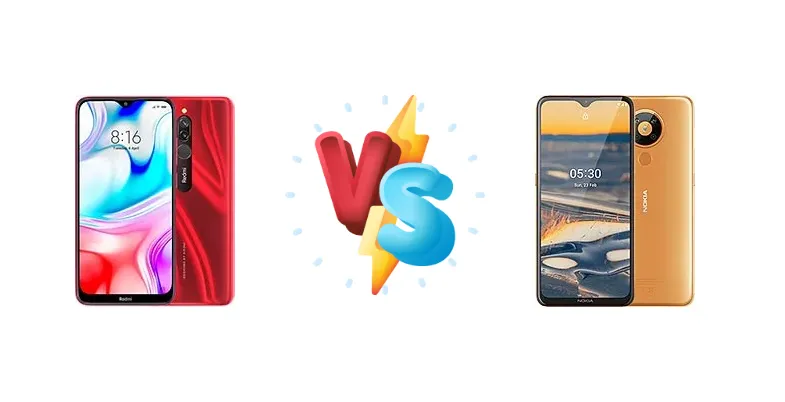
The Xiaomi Redmi 8 and Nokia 5.3 represent two distinct approaches to the budget smartphone market. The Redmi 8, often found at a lower price point, prioritizes affordability. The Nokia 5.3, leveraging Nokia’s brand recognition and a slightly more powerful chipset, aims for a balance of features and performance. This comparison dissects their key differences to determine which device delivers the best value.
🏆 Quick Verdict
For the average user prioritizing overall performance and future-proofing, the Nokia 5.3 is the better choice. Its Snapdragon 665, built on an 11nm process, offers a noticeable performance uplift over the Redmi 8’s Snapdragon 439, despite the slower charging speed. However, the Redmi 8 remains a viable option for those on an extremely tight budget.
| Network |
|---|
| 2G bands | GSM 850 / 900 / 1800 / 1900 | GSM 850 / 900 / 1800 / 1900 |
| 3G bands | HSDPA 850 / 900 / 1700(AWS) / 1900 / 2100 - Global | HSDPA 850 / 900 / 1900 / 2100 - Global |
| 4G bands | 1, 2, 3, 4, 5, 7, 8, 20, 38, 40 - Global | 1, 3, 5, 7, 8, 20, 28, 38, 40, 41 - Global |
| Speed | HSPA, LTE | HSPA 42.2/5.76 Mbps, LTE Cat4 150/50 Mbps |
| Technology | GSM / HSPA / LTE | GSM / HSPA / LTE |
| | 1, 3, 5, 8, 40, 41 - India | 1, 3, 5, 8, 40, 41 - India |
| Launch |
|---|
| Announced | 2019, October 09. Released 2019, October 12 | 2020, March 19. Released 2020, April 02 |
| Status | Discontinued | Discontinued |
| Body |
|---|
| Build | Glass front (Gorilla Glass 5), plastic back, plastic frame | Glass front (Gorilla Glass 3), plastic back, plastic frame |
| Dimensions | 156.5 x 75.4 x 9.4 mm (6.16 x 2.97 x 0.37 in) | 164.3 x 76.6 x 8.5 mm (6.47 x 3.02 x 0.33 in) |
| SIM | Nano-SIM + Nano-SIM | · Nano-SIM· Nano-SIM + Nano-SIM |
| Weight | 188 g (6.63 oz) | 185 g (6.53 oz) |
| | Water-repellent coating | - |
| Display |
|---|
| Protection | Corning Gorilla Glass 5 | Corning Gorilla Glass 3 |
| Resolution | 720 x 1520 pixels, 19:9 ratio (~270 ppi density) | 720 x 1600 pixels, 20:9 ratio (~268 ppi density) |
| Size | 6.22 inches, 96.6 cm2 (~81.8% screen-to-body ratio) | 6.55 inches, 103.6 cm2 (~82.3% screen-to-body ratio) |
| Type | IPS LCD, 400 nits (typ) | IPS LCD, 450 nits (typ) |
| Platform |
|---|
| CPU | Octa-core (4x1.95 GHz Cortex-A53 & 4x1.45 GHz Cortex A53) | Octa-core (4x2.0 GHz Kryo 260 Gold & 4x1.8 GHz Kryo 260 Silver) |
| Chipset | Qualcomm SDM439 Snapdragon 439 (12 nm) | Qualcomm SM6125 Snapdragon 665 (11 nm) |
| GPU | Adreno 505 | Adreno 610 |
| OS | Android 9.0 (Pie), upgradable to Android 10, MIUI 12 | Android 10, upgradable to Android 11, Android One |
| Memory |
|---|
| Card slot | microSDXC (dedicated slot) | microSDXC (dedicated slot) |
| Internal | 32GB 3GB RAM, 64GB 4GB RAM | 64GB 3GB RAM, 64GB 4GB RAM, 64GB 6GB RAM, 128GB 4GB RAM |
| | eMMC 5.1 | eMMC 5.1 |
| Main Camera |
|---|
| Features | LED flash, HDR, panorama | LED flash, HDR, panorama |
| Quad | - | 13 MP, f/1.8, (wide), PDAF
5 MP, 13mm (ultrawide)
2 MP (macro)
Auxiliary lens |
| Single | 12 MP, f/1.8, 1/2.55", 1.4µm, dual pixel PDAF
Auxiliary lens | - |
| Video | 1080p@30fps | 4K@30fps, 1080p@30fps |
| Selfie camera |
|---|
| Features | HDR | - |
| Single | 8 MP, f/2.0, 1/4.0", 1.12µm | 8 MP, f/2.0, (wide) |
| Video | 1080p@30fps | 1080p@30fps |
| Sound |
|---|
| 3.5mm jack | Yes | Yes |
| 35mm jack | Yes | Yes |
| Loudspeaker | Yes | Yes |
| Comms |
|---|
| Bluetooth | 4.2, A2DP, LE | 4.2, A2DP, LE, aptX |
| Infrared port | Yes | - |
| NFC | No | Yes |
| Positioning | GPS, GLONASS, GALILEO, BDS | GPS, GLONASS, BDS |
| Radio | Wireless FM radio (no wired headphones required) | FM radio |
| USB | USB Type-C 2.0, OTG | USB Type-C 2.0, OTG |
| WLAN | Wi-Fi 802.11 b/g/n, Wi-Fi Direct | Wi-Fi 802.11 b/g/n/ac, Wi-Fi Direct |
| Features |
|---|
| Sensors | Fingerprint (rear-mounted), accelerometer, proximity, compass | Fingerprint (rear-mounted), accelerometer, proximity |
| Battery |
|---|
| Charging | 18W wired | 10W wired |
| Type | Li-Po 5000 mAh, non-removable | Li-Po 4000 mAh |
| Misc |
|---|
| Colors | Onyx Black, Ruby Red, Sapphire Blue, Phantom Red | Cyan, Sand, Charcoal |
| Models | M1908C3IC, MZB8255IN, M1908C3IG, M1908C3IH | TA-1234, TA-1223, TA-1227, TA-1229 |
| Price | About 210 EUR | About 290 EUR |
| SAR | 0.34 W/kg (head) 1.00 W/kg (body) | 1.03 W/kg (head) 0.95 W/kg (body) |
| SAR EU | 0.23 W/kg (head) 1.48 W/kg (body) | 0.70 W/kg (head) 1.39 W/kg (body) |
Xiaomi Redmi 8
- Faster 18W charging
- Generally lower price point
- Simple and straightforward Android experience
- Less powerful Snapdragon 439 chipset
- Potentially lower camera quality
- Less efficient processor
Nokia 5.3
- More powerful Snapdragon 665 chipset
- Improved image processing capabilities
- Better overall performance and multitasking
- Slower 10W charging
- Slightly higher price
- May receive fewer software updates
Display Comparison
Neither device boasts a standout display. Both likely feature LCD panels, common in this price bracket. The key difference lies under the hood: display driver efficiency. While specific display specs are unavailable, the Nokia 5.3’s more modern chipset may allow for slightly better color reproduction and viewing angles. Bezels are expected to be comparable, reflecting the budget nature of both phones.
Camera Comparison
Without detailed camera sensor information, a direct comparison is difficult. However, the Snapdragon 665’s image signal processor (ISP) in the Nokia 5.3 is significantly more advanced than the one found in the Snapdragon 439. This means better image processing, improved dynamic range, and potentially superior low-light performance. While both phones likely include a standard and macro lens setup, the Nokia 5.3 will likely produce more usable images, especially in challenging conditions. The Redmi 8's camera will likely be adequate for basic snapshots, but will struggle with detail and noise reduction.
Performance
The Nokia 5.3’s Qualcomm Snapdragon 665 (11nm) is the clear winner in performance. The 11nm fabrication process is more efficient than the Redmi 8’s Snapdragon 439 (12nm), resulting in better thermal management and sustained performance. The CPU architecture also favors the Nokia 5.3; its Kryo 260 Gold cores (2.0 GHz) offer a performance advantage over the Redmi 8’s Cortex-A53 cores (1.95 GHz). While both are octa-core, the Snapdragon 665’s architecture is more modern and capable. This translates to faster app loading times and smoother multitasking on the Nokia 5.3.
Battery Life
The Redmi 8’s 18W wired charging is a notable advantage over the Nokia 5.3’s 10W charging. This means faster top-ups, reducing downtime. However, the Snapdragon 665’s superior efficiency in the Nokia 5.3 partially offsets the slower charging. While battery capacity isn’t specified, the Nokia 5.3 is likely to offer comparable, if not slightly better, real-world battery life due to its more efficient processor. The Redmi 8’s faster charging is beneficial for users who frequently need a quick power boost.
Buying Guide
Buy the Xiaomi Redmi 8 if you need the absolute lowest possible price and are primarily focused on basic tasks like calling, texting, and light social media use. Its affordability makes it ideal for first-time smartphone users or as a reliable backup device. Buy the Nokia 5.3 if you prefer a smoother user experience, better multitasking capabilities, and a more efficient processor for handling demanding apps and occasional gaming. The Nokia 5.3 offers a more well-rounded experience for a slightly higher investment.
Frequently Asked Questions
❓ Will the Snapdragon 665 in the Nokia 5.3 struggle with demanding games like PUBG Mobile?
While the Snapdragon 665 isn't a gaming powerhouse, it can handle PUBG Mobile at medium settings with reasonable frame rates. Expect some occasional stuttering, but it's a playable experience. The Redmi 8’s Snapdragon 439 will struggle significantly more with the same game.
❓ Is the 10W charging on the Nokia 5.3 a dealbreaker in 2024?
10W charging is slow by today's standards, taking over 2 hours for a full charge. However, the Snapdragon 665’s efficiency means you may not need to charge as frequently. If you can charge overnight, it’s less of an issue. The Redmi 8’s 18W charging is a clear advantage for those needing quick top-ups.
❓ Does the Nokia 5.3 benefit from Nokia's Android One program?
The Nokia 5.3 originally launched with Android One, promising timely updates and a clean software experience. However, Nokia's update commitment has become less reliable. While it likely received at least one major Android update, long-term support is uncertain compared to Xiaomi's MIUI.