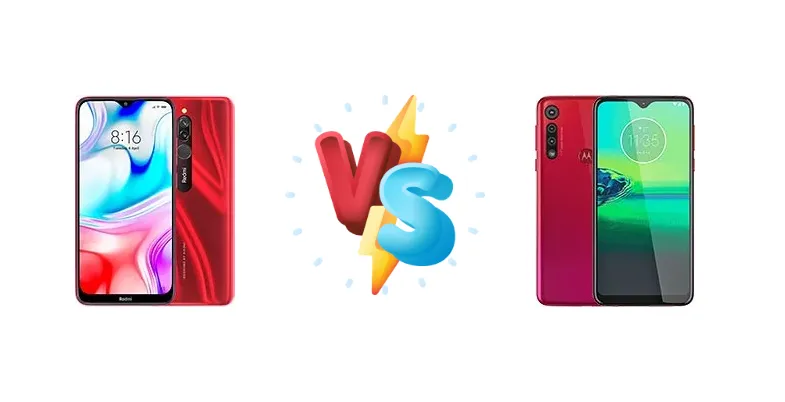
The Xiaomi Redmi 8 and Motorola Moto G8 Play represent a critical segment of the smartphone market: affordable devices for everyday use. Both phones aim to deliver essential functionality without breaking the bank, but they take different approaches under the hood, primarily in their choice of chipset. This comparison dissects the Qualcomm Snapdragon 439 in the Redmi 8 against the MediaTek Helio P70M in the Moto G8 Play, revealing which offers the better experience for the price.
🏆 Quick Verdict
For the average user prioritizing responsiveness and a slightly smoother experience, the Motorola Moto G8 Play emerges as the better choice. Its Helio P70M chipset, featuring Cortex-A73 cores, provides a noticeable performance edge over the Redmi 8’s Snapdragon 439, particularly in multitasking and app loading times. However, the Redmi 8’s 18W charging offers a slight convenience advantage.
| Network |
|---|
| 2G bands | GSM 850 / 900 / 1800 / 1900 | GSM 850 / 900 / 1800 / 1900 |
| 3G bands | HSDPA 850 / 900 / 1700(AWS) / 1900 / 2100 - Global | HSDPA 850 / 900 / 1700(AWS) / 1900 / 2100 |
| 4G bands | 1, 2, 3, 4, 5, 7, 8, 20, 38, 40 - Global | 1, 2, 3, 4, 5, 7, 8, 28, 66 - LATAM |
| Speed | HSPA, LTE | HSPA, LTE |
| Technology | GSM / HSPA / LTE | GSM / HSPA / LTE |
| | 1, 3, 5, 8, 40, 41 - India | - |
| Launch |
|---|
| Announced | 2019, October 09. Released 2019, October 12 | 2019, October. Released 2019, October |
| Status | Discontinued | Discontinued |
| Body |
|---|
| Build | Glass front (Gorilla Glass 5), plastic back, plastic frame | Glass front, plastic back, plastic frame |
| Dimensions | 156.5 x 75.4 x 9.4 mm (6.16 x 2.97 x 0.37 in) | 157.6 x 75.4 x 9 mm (6.20 x 2.97 x 0.35 in) |
| SIM | Nano-SIM + Nano-SIM | Nano-SIM + Nano-SIM |
| Weight | 188 g (6.63 oz) | 183.6 g (6.49 oz) |
| | Water-repellent coating | - |
| Display |
|---|
| Protection | Corning Gorilla Glass 5 | - |
| Resolution | 720 x 1520 pixels, 19:9 ratio (~270 ppi density) | 720 x 1520 pixels, 19:9 ratio (~271 ppi density) |
| Size | 6.22 inches, 96.6 cm2 (~81.8% screen-to-body ratio) | 6.2 inches, 95.9 cm2 (~80.7% screen-to-body ratio) |
| Type | IPS LCD, 400 nits (typ) | IPS LCD |
| Platform |
|---|
| CPU | Octa-core (4x1.95 GHz Cortex-A53 & 4x1.45 GHz Cortex A53) | Octa-core (4x2.1 GHz Cortex-A73 & 4x2.0 GHz Cortex-A53) |
| Chipset | Qualcomm SDM439 Snapdragon 439 (12 nm) | Mediatek MT6771 Helio P70M (12 nm) |
| GPU | Adreno 505 | Mali-G72 MP3 |
| OS | Android 9.0 (Pie), upgradable to Android 10, MIUI 12 | Android 9.0 (Pie), upgradable to Android 10 |
| Memory |
|---|
| Card slot | microSDXC (dedicated slot) | microSDXC (uses shared SIM slot) |
| Internal | 32GB 3GB RAM, 64GB 4GB RAM | 32GB 2GB RAM |
| | eMMC 5.1 | eMMC 5.1 |
| Main Camera |
|---|
| Features | LED flash, HDR, panorama | LED flash, HDR, panorama |
| Single | 12 MP, f/1.8, 1/2.55", 1.4µm, dual pixel PDAF
Auxiliary lens | - |
| Triple | - | 13 MP, f/2.0, (wide), 1.25µm, PDAF
8 MP, f/2.2, 117˚ (ultrawide), 1.12µm
Auxiliary lens |
| Video | 1080p@30fps | 1080p@30fps |
| Selfie camera |
|---|
| Features | HDR | HDR |
| Single | 8 MP, f/2.0, 1/4.0", 1.12µm | 8 MP |
| Video | 1080p@30fps | 1080p@30fps |
| Sound |
|---|
| 3.5mm jack | Yes | Yes |
| 35mm jack | Yes | Yes |
| Loudspeaker | Yes | Yes |
| Comms |
|---|
| Bluetooth | 4.2, A2DP, LE | 4.2, A2DP, LE |
| Infrared port | Yes | - |
| NFC | No | No |
| Positioning | GPS, GLONASS, GALILEO, BDS | GPS, GLONASS, GALILEO |
| Radio | Wireless FM radio (no wired headphones required) | FM radio |
| USB | USB Type-C 2.0, OTG | USB Type-C 2.0 |
| WLAN | Wi-Fi 802.11 b/g/n, Wi-Fi Direct | Wi-Fi 802.11 b/g/n |
| Features |
|---|
| Sensors | Fingerprint (rear-mounted), accelerometer, proximity, compass | Fingerprint (rear-mounted), accelerometer, gyro, proximity |
| Battery |
|---|
| Charging | 18W wired | - |
| Type | Li-Po 5000 mAh, non-removable | Li-Po 4000 mAh, non-removable |
| Misc |
|---|
| Colors | Onyx Black, Ruby Red, Sapphire Blue, Phantom Red | Black onyx, Magenta red |
| Models | M1908C3IC, MZB8255IN, M1908C3IG, M1908C3IH | XT2015, XT2015-2 |
| Price | About 210 EUR | About 90 EUR |
| SAR | 0.34 W/kg (head) 1.00 W/kg (body) | 0.62 W/kg (head) 1.68 W/kg (body) |
| SAR EU | 0.23 W/kg (head) 1.48 W/kg (body) | - |
Xiaomi Redmi 8
- Faster 18W charging for quicker top-ups.
- Xiaomi’s MIUI offers extensive customization options.
- Potentially more vibrant display colors (based on brand tendencies).
- Snapdragon 439 chipset is less powerful than the Helio P70M.
- Cortex-A53 cores offer lower single-core performance.
- MIUI can be resource-intensive, potentially impacting performance.
Motorola Moto G8 Play
- Helio P70M chipset with Cortex-A73 cores delivers better performance.
- More responsive user experience for daily tasks.
- Motorola’s near-stock Android offers a cleaner, faster interface.
- Likely slower charging speeds compared to the Redmi 8.
- Motorola’s software update support is often less consistent than Xiaomi’s.
- May prioritize color accuracy over vibrant display settings.
Display Comparison
Neither device boasts a standout display. Both utilize 12nm process technology, suggesting similar power efficiency in display operation. Without specific display specs (resolution, brightness, panel type) beyond the chipsets, a direct comparison is limited. However, Motorola historically focuses on color accuracy in this price bracket, while Xiaomi often prioritizes vibrant, saturated colors. Users sensitive to color fidelity might lean towards the Moto G8 Play, while those preferring a more visually 'popping' image may prefer the Redmi 8.
Camera Comparison
Without detailed camera specifications (sensor size, aperture, features), a definitive camera comparison is difficult. However, the market positioning of both phones suggests similar camera capabilities focused on basic photography. Both likely feature a primary sensor paired with depth or macro sensors of limited utility. Image processing will be a key differentiator; Xiaomi’s software often emphasizes scene recognition and AI enhancements, while Motorola typically aims for more natural-looking images. The Helio P70M’s integrated image signal processor (ISP) *may* offer slightly faster processing speeds, but this is unlikely to be a major factor in real-world image quality.
Performance
The core difference lies in the chipsets. The Redmi 8’s Snapdragon 439 utilizes an octa-core configuration split between 1.95 GHz and 1.45 GHz Cortex-A53 cores. The Moto G8 Play’s Helio P70M, also octa-core, features a more potent arrangement: 2.1 GHz Cortex-A73 cores paired with 2.0 GHz Cortex-A53 cores. The Cortex-A73 cores represent a significant architectural leap over the A53, offering substantially improved single-core performance. This translates to faster app launches, smoother scrolling, and a more responsive user interface on the Moto G8 Play. While both are 12nm chips, the Helio P70M’s superior core design provides a clear advantage in CPU-bound tasks.
Battery Life
Battery capacity is not provided, making a direct mAh comparison impossible. However, the Redmi 8’s 18W wired charging is a notable advantage over the Moto G8 Play, which likely supports standard 10W or 15W charging based on Motorola’s typical offerings in this segment. This means the Redmi 8 will replenish its battery significantly faster, reducing downtime. If battery life is paramount and frequent top-ups are desired, the Redmi 8’s charging speed is a compelling benefit. Without knowing the battery capacities, it's difficult to say which phone will last longer on a single charge.
Buying Guide
Buy the Xiaomi Redmi 8 if you prioritize a brand with a strong ecosystem and value the convenience of 18W fast charging, even if it means sacrificing some processing power. Buy the Motorola Moto G8 Play if you need a phone that feels more responsive for daily tasks, benefits from the more powerful Cortex-A73 cores in its chipset, and are willing to trade off slightly slower charging speeds for improved performance.
Frequently Asked Questions
❓ Will the Moto G8 Play struggle with demanding games like PUBG Mobile?
While the Helio P70M isn't a gaming powerhouse, it's capable of running PUBG Mobile at medium settings with reasonable frame rates. Expect some occasional stuttering, especially in intense firefights. The Snapdragon 439 in the Redmi 8 will likely require even lower settings and may experience more frequent performance drops.
❓ Does the Redmi 8's 18W charging significantly reduce charging time compared to a standard 10W charger?
Yes, 18W charging will noticeably reduce charging time. A full charge from 0% to 100% with the included charger will likely take around 2-2.5 hours, compared to 3.5-4 hours with a standard 10W charger. This is a significant convenience factor for users who frequently need to top up their battery.
❓ Which phone is likely to receive more software updates?
Xiaomi generally provides more frequent software updates for its devices, including MIUI feature updates and security patches. Motorola’s update schedule is often less predictable and may be limited to essential security updates. If long-term software support is a priority, the Redmi 8 is the better choice.