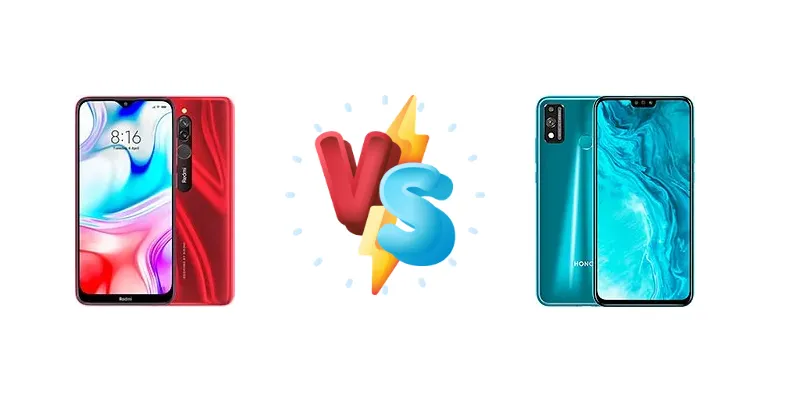
The Xiaomi Redmi 8 and Honor 9X Lite represent compelling options in the ultra-budget smartphone segment. While both aim to deliver essential smartphone functionality at a low price, they diverge significantly in their core hardware. This comparison dissects the differences between the Qualcomm Snapdragon 439 and the Kirin 710F, revealing which device offers the best value for your money.
🏆 Quick Verdict
For most users, the Honor 9X Lite emerges as the better choice. Its Kirin 710F chipset, featuring more powerful Cortex-A73 cores, provides a noticeably smoother experience for everyday tasks and light gaming. While the Redmi 8 offers 18W charging, the 9X Lite’s superior processing power outweighs this advantage for the average user.
| Network |
|---|
| 2G bands | GSM 850 / 900 / 1800 / 1900 | GSM 850 / 900 / 1800 / 1900 |
| 3G bands | HSDPA 850 / 900 / 1700(AWS) / 1900 / 2100 - Global | HSDPA 850 / 900 / 1900 / 2100 |
| 4G bands | 1, 2, 3, 4, 5, 7, 8, 20, 38, 40 - Global | 1, 3, 7, 8, 20 |
| Speed | HSPA, LTE | HSPA 42.2/5.76 Mbps, LTE (2CA) Cat6 300/50 Mbps |
| Technology | GSM / HSPA / LTE | GSM / HSPA / LTE |
| | 1, 3, 5, 8, 40, 41 - India | - |
| Launch |
|---|
| Announced | 2019, October 09. Released 2019, October 12 | 2020, April 17. Released 2020, May 14 |
| Status | Discontinued | Discontinued |
| Body |
|---|
| Build | Glass front (Gorilla Glass 5), plastic back, plastic frame | - |
| Dimensions | 156.5 x 75.4 x 9.4 mm (6.16 x 2.97 x 0.37 in) | 160.4 x 76.6 x 7.8 mm (6.31 x 3.02 x 0.31 in) |
| SIM | Nano-SIM + Nano-SIM | Nano-SIM + Nano-SIM |
| Weight | 188 g (6.63 oz) | 188 g (6.63 oz) |
| | Water-repellent coating | - |
| Display |
|---|
| Protection | Corning Gorilla Glass 5 | - |
| Resolution | 720 x 1520 pixels, 19:9 ratio (~270 ppi density) | 1080 x 2340 pixels, 19.5:9 ratio (~397 ppi density) |
| Size | 6.22 inches, 96.6 cm2 (~81.8% screen-to-body ratio) | 6.5 inches, 103.2 cm2 (~84.0% screen-to-body ratio) |
| Type | IPS LCD, 400 nits (typ) | IPS LCD |
| Platform |
|---|
| CPU | Octa-core (4x1.95 GHz Cortex-A53 & 4x1.45 GHz Cortex A53) | Octa-core (4x2.2 GHz Cortex-A73 & 4x1.7 GHz Cortex-A53) |
| Chipset | Qualcomm SDM439 Snapdragon 439 (12 nm) | Kirin 710F (12 nm) |
| GPU | Adreno 505 | Mali-G51 MP4 |
| OS | Android 9.0 (Pie), upgradable to Android 10, MIUI 12 | Android 9.0 (Pie), EMUI 9.1, Google Play Services |
| Memory |
|---|
| Card slot | microSDXC (dedicated slot) | microSDXC (dedicated slot) |
| Internal | 32GB 3GB RAM, 64GB 4GB RAM | 128GB 4GB RAM |
| | eMMC 5.1 | - |
| Main Camera |
|---|
| Dual | - | 48 MP, f/1.8, (wide), 1/2.0", 0.8µm, PDAF
Auxiliary lens |
| Features | LED flash, HDR, panorama | LED flash, HDR, panorama |
| Single | 12 MP, f/1.8, 1/2.55", 1.4µm, dual pixel PDAF
Auxiliary lens | - |
| Video | 1080p@30fps | 1080p@30fps |
| Selfie camera |
|---|
| Features | HDR | - |
| Single | 8 MP, f/2.0, 1/4.0", 1.12µm | 8 MP, f/2.0, (wide) |
| Video | 1080p@30fps | 1080p@30fps |
| Sound |
|---|
| 3.5mm jack | Yes | Yes |
| 35mm jack | Yes | Yes |
| Loudspeaker | Yes | Yes |
| Comms |
|---|
| Bluetooth | 4.2, A2DP, LE | 4.2, A2DP, LE |
| Infrared port | Yes | - |
| NFC | No | Yes (market/region dependent) |
| Positioning | GPS, GLONASS, GALILEO, BDS | GPS, GLONASS, BDS |
| Radio | Wireless FM radio (no wired headphones required) | FM radio |
| USB | USB Type-C 2.0, OTG | microUSB 2.0 |
| WLAN | Wi-Fi 802.11 b/g/n, Wi-Fi Direct | Wi-Fi 802.11 a/b/g/n/ac, dual-band, Wi-Fi Direct |
| Features |
|---|
| Sensors | Fingerprint (rear-mounted), accelerometer, proximity, compass | Fingerprint (rear-mounted), accelerometer, proximity, compass |
| Battery |
|---|
| Charging | 18W wired | 10W wired |
| Type | Li-Po 5000 mAh, non-removable | Li-Po 3750 mAh |
| Misc |
|---|
| Colors | Onyx Black, Ruby Red, Sapphire Blue, Phantom Red | Emerald Green, Midnight Black |
| Models | M1908C3IC, MZB8255IN, M1908C3IG, M1908C3IH | JSN-L21, JSN-L22, JSN-L23 |
| Price | About 210 EUR | About 220 EUR |
| SAR | 0.34 W/kg (head) 1.00 W/kg (body) | - |
| SAR EU | 0.23 W/kg (head) 1.48 W/kg (body) | - |
Xiaomi Redmi 8
- Faster 18W charging
- Potentially better battery life due to efficient chipset
- Established Xiaomi ecosystem
- Less powerful Snapdragon 439 chipset
- Slower app loading times
- Less responsive user interface
Honor 9X Lite
- More powerful Kirin 710F chipset
- Smoother multitasking experience
- Better performance in demanding apps
- Slower 10W charging
- Potentially lower battery life under heavy load
- Honor's software support can be inconsistent
Display Comparison
Neither device boasts a standout display. Both likely utilize LCD panels, common in this price bracket. The focus here isn't on visual fidelity, but on functionality. Without specific display specs, we can assume similar resolutions and brightness levels. The real difference lies elsewhere.
Camera Comparison
Without detailed camera specifications, a direct comparison is difficult. However, it’s safe to assume both phones feature modest camera setups geared towards casual photography. The presence of a 2MP macro lens on either device is largely a marketing gimmick, offering limited practical benefit. Image quality will likely be heavily reliant on software processing, and the larger sensor (if any) will be the determining factor. The Kirin 710F’s ISP *may* offer slightly better image processing capabilities, but this is speculative without further data.
Performance
The core distinction between these phones is the chipset. The Honor 9X Lite’s Kirin 710F, built on a 12nm process, features four Cortex-A73 cores clocked at 2.2 GHz, paired with four Cortex-A53 cores at 1.7 GHz. This architecture is significantly more capable than the Redmi 8’s Snapdragon 439. The SD439 utilizes eight Cortex-A53 cores, split between 1.95 GHz and 1.45 GHz. The A73 cores in the Kirin 710F offer a substantial performance boost in single-core tasks and a more fluid multitasking experience. While both are 12nm chips, the architectural advantage of the Kirin 710F translates to a more responsive user interface and better app loading times. The SD439 is adequate for basic tasks, but will struggle with demanding applications.
Battery Life
The Redmi 8’s 18W wired charging is its key advantage in this category. While battery capacity isn’t specified, 18W charging allows for significantly faster top-ups compared to the Honor 9X Lite’s 10W charging. However, the Kirin 710F’s improved efficiency could partially offset the charging speed difference. Users who prioritize minimizing downtime will favor the Redmi 8, while those who don’t mind slower charging will benefit from the 9X Lite’s superior performance.
Buying Guide
Buy the Xiaomi Redmi 8 if you prioritize faster charging and are primarily focused on basic smartphone functions like calls, texts, and light social media use. Its 18W charging is a boon for those who frequently top up their battery. Buy the Honor 9X Lite if you value a more responsive user experience, better multitasking capabilities, and a slight edge in gaming performance. The Kirin 710F offers a tangible performance uplift for a minimal price difference.
Frequently Asked Questions
❓ Will the Kirin 710F in the Honor 9X Lite handle popular games like PUBG Mobile?
The Kirin 710F is capable of running PUBG Mobile, but likely at medium settings to maintain a stable frame rate. Don't expect high-end graphics or consistently smooth performance during intense firefights. The Snapdragon 439 in the Redmi 8 will struggle with PUBG, even on the lowest settings.
❓ Is the 18W charging on the Redmi 8 a significant advantage in real-world use?
Yes, 18W charging is a noticeable improvement over 10W. It can reduce charging times from 0-100% by approximately 30-45 minutes, making it ideal for users who need to quickly top up their battery throughout the day. However, the Kirin 710F's efficiency might mitigate some of this difference.
❓ Which phone is better for someone who primarily uses social media and messaging apps?
The Honor 9X Lite is the better choice. The Kirin 710F ensures a smoother and more responsive experience when scrolling through social media feeds and switching between apps, even with multiple apps open in the background. The Redmi 8 will handle these tasks, but may exhibit occasional lag.
❓ How does the software experience differ between Xiaomi's MIUI and Honor's Magic UI?
MIUI (Xiaomi) is known for its extensive customization options and feature set, but can also be prone to bloatware. Magic UI (Honor) offers a cleaner, more stock-Android-like experience, but historically has had less consistent software updates. Both interfaces are based on Android, but offer distinct user experiences.