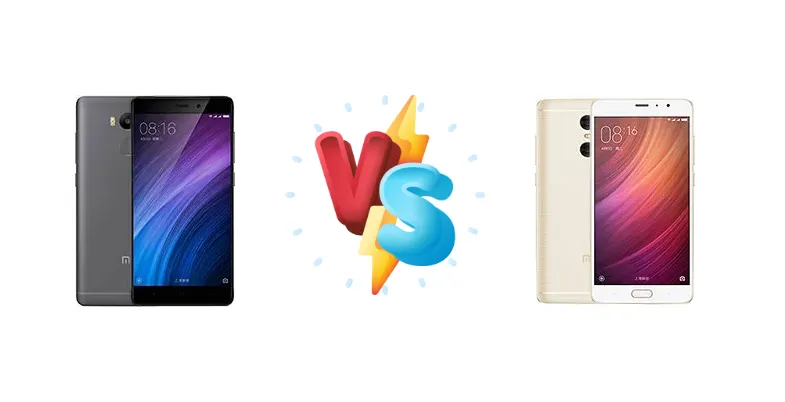
Xiaomi's Redmi series has consistently delivered impressive value for money. The Redmi 4 Prime and Redmi Pro were both popular choices in their time, offering compelling features at affordable prices. But which one truly comes out on top? Let's dive into a comprehensive comparison.
🏆 Quick Verdict
The Redmi 4 Prime boasts significantly better battery life (91h vs 80h), making it ideal for heavy users. However, the Redmi Pro’s more powerful deca-core processor and potentially better camera (depending on the edition) offer a performance edge. It's a trade-off between endurance and speed.
| Network |
|---|
| 2G bands | GSM 850 / 900 / 1800 / 1900 - SIM 1 & SIM 2 | GSM 850 / 900 / 1800 / 1900 - SIM 1 & SIM 2 |
| 3G bands | HSDPA 850 / 900 / 1900 / 2100 | HSDPA 850 / 900 / 1900 / 2100 |
| 4G bands | 1, 3, 7, 38, 39, 40, 41 | 1, 3, 5, 7, 8, 38, 39, 40, 41 |
| Speed | HSPA 42.2/5.76 Mbps, LTE (2CA) Cat6 300/50 Mbps | HSPA, LTE |
| Technology | GSM / CDMA / HSPA / EVDO / LTE | GSM / CDMA / HSPA / EVDO / LTE |
| | CDMA2000 1xEV-DO & TD-SCDMA | TD-SCDMA |
| Launch |
|---|
| Announced | 2016, November. Released 2016, November | 2016, July. Released 2016, August |
| Status | Discontinued | Discontinued |
| Body |
|---|
| Build | Glass front, aluminum back, aluminum frame | Glass front, aluminum back, aluminum frame |
| Dimensions | 141.3 x 69.6 x 8.9 mm (5.56 x 2.74 x 0.35 in) | 151.5 x 76.2 x 8.2 mm (5.96 x 3.00 x 0.32 in) |
| SIM | Hybrid Dual SIM | Nano-SIM + Micro-SIM |
| Weight | 156 g (5.50 oz) | 174 g (6.14 oz) |
| Display |
|---|
| Resolution | 1080 x 1920 pixels, 16:9 ratio (~441 ppi density) | 1080 x 1920 pixels, 16:9 ratio (~401 ppi density) |
| Size | 5.0 inches, 68.9 cm2 (~70.1% screen-to-body ratio) | 5.5 inches, 83.4 cm2 (~72.2% screen-to-body ratio) |
| Type | IPS LCD | AMOLED |
| Platform |
|---|
| CPU | Octa-core 2.0 GHz Cortex-A53 | Deca-core 2.5 GHz - Exclusive editionDeca-core 2.3 GHz - High editionDeca-core 2.1 GHz - Standard edition |
| Chipset | Qualcomm MSM8953 Snapdragon 625 (14 nm) | Mediatek MT6797T Helio X25 (20 nm) - High & Exclusive editionsMediatek MT6797 Helio X20 (20 nm) - Standard edition |
| GPU | Adreno 506 | Mali-T880 MP4 |
| OS | Android 6.0.1 (Marshmallow), MIUI 8 | Android 6.0 (Marshmallow), MIUI 10 |
| Memory |
|---|
| Card slot | microSDXC (uses shared SIM slot) | microSDXC (uses shared SIM slot) |
| Internal | 32GB 3GB RAM | 32GB 3GB RAM, 64GB 3GB RAM, 128GB 4GB RAM (Exclusive edition) |
| | eMMC 5.1 | - |
| Main Camera |
|---|
| Dual | - | 13 MP, f/2.0, PDAF
Auxiliary lens |
| Features | Dual-LED dual-tone flash, HDR, panorama | Dual-LED dual-tone flash, HDR, panorama |
| Single | 13 MP, f/2.2, PDAF | - |
| Video | 1080p@30fps | 1080p@30fps, 720p@120fps |
| Selfie camera |
|---|
| Single | 5 MP, f/2.2 | 5 MP, f/2.0 |
| Video | 1080p@30fps | 1080p@30fps |
| Sound |
|---|
| 3.5mm jack | Yes | Yes |
| 35mm jack | Yes | Yes |
| Loudspeaker | Yes | Yes |
| Comms |
|---|
| Bluetooth | 4.2, A2DP, LE | 4.2, A2DP, LE |
| Infrared port | Yes | Yes |
| NFC | No | No |
| Positioning | GPS, GLONASS, BDS | GPS, GLONASS, BDS |
| Radio | FM radio | FM radio; recording |
| USB | microUSB 2.0, OTG | USB Type-C |
| WLAN | Wi-Fi 802.11 a/b/g/n, dual-band, Wi-Fi Direct | Wi-Fi 802.11 b/g/n, Wi-Fi Direct |
| Features |
|---|
| Sensors | Fingerprint (rear-mounted), accelerometer, gyro, proximity, compass | Fingerprint (front-mounted), accelerometer, gyro, proximity, compass |
| Battery |
|---|
| Charging | 10W wired | - |
| Type | Li-Po 4100 mAh, non-removable | Li-Ion 4050 mAh, non-removable |
| Misc |
|---|
| Colors | Gold, Dark Gray, Silver | Silver, Gold, Gray |
| Price | About 160 EUR | About 170 EUR |
| Tests |
|---|
| Battery life |
Endurance rating 91h
|
Endurance rating 80h
|
| Camera |
Photo / Video |
Photo / Video |
| Performance | - |
Basemark OS II 2.0: 1696Basemark X: 23846 |
Xiaomi Redmi 4 Prime
- Exceptional battery life
- Reliable performance
- Affordable price
- Compact design
- Less powerful processor
- Potentially inferior camera
- Older design
Xiaomi Redmi Pro
- Powerful deca-core processor
- Potentially better camera
- Sleek metal design
- Faster performance
- Shorter battery life
- Potentially higher price (at launch)
- Mediatek chipset (some concerns about optimization)
Display Comparison
Both phones featured a 5.5-inch display, likely with a 1080p resolution. While both were adequate, the Redmi Pro's potentially better color accuracy and contrast (depending on the panel used) might give it a slight edge. However, this is difficult to definitively confirm without more detailed specifications.
Camera Comparison
Both phones featured a rear camera, but the Redmi Pro's camera hardware and image processing were generally considered superior. The Redmi Pro often had a larger aperture and potentially optical image stabilization (OIS), leading to better low-light performance and sharper images. The Redmi 4 Prime's camera was still capable, but not as impressive.
Performance
The Redmi Pro's deca-core processor (Helio X20/X25) significantly outperforms the Redmi 4 Prime's Snapdragon 625. Expect smoother multitasking, faster app loading times, and better gaming performance on the Redmi Pro, especially in the Exclusive and High editions.
Battery Life
The Redmi 4 Prime's standout feature is its exceptional battery life, achieving an endurance rating of 91 hours. This is significantly better than the Redmi Pro's 80 hours, making it a clear winner for users who need a phone that can last for days on a single charge.
Buying Guide
The Xiaomi Redmi 4 Prime is perfect for users prioritizing long battery life and reliable performance for everyday tasks. The Redmi Pro is a better choice for those who value faster processing speeds, potentially better camera quality, and are willing to sacrifice some battery endurance.
Frequently Asked Questions
❓ Which phone is better for gaming?
The Redmi Pro, with its more powerful deca-core processor, is significantly better for gaming.
❓ Is the Redmi 4 Prime still worth buying?
If battery life is your top priority and you're on a tight budget, the Redmi 4 Prime remains a decent option, though it's quite dated now.
❓ What are the differences between the Redmi Pro editions?
The Redmi Pro came in Standard, High, and Exclusive editions, differing primarily in processor speed (2.1 GHz, 2.3 GHz, and 2.5 GHz respectively) and RAM configuration.