
Xiaomi Redmi 15C vs Motorola Moto G32: Which Budget Phone Reigns Supreme?
| Phones Images | |||||
|---|---|---|---|---|---|
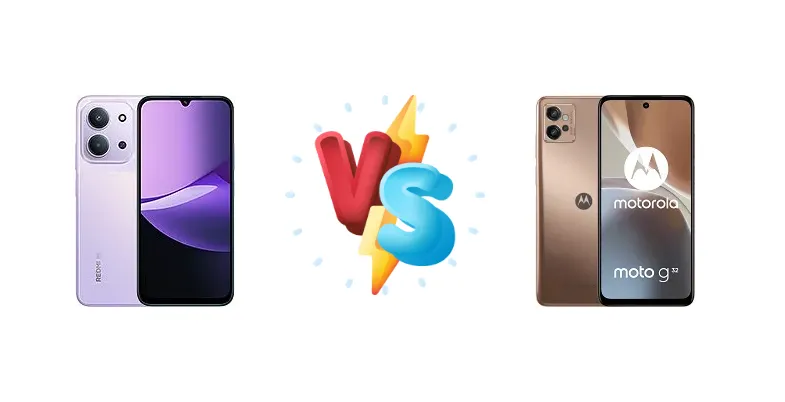
|
🏆 Quick Verdict
For the average user prioritizing sustained performance and faster charging, the Xiaomi Redmi 15C emerges as the winner. Its Dimensity 6300 chipset, coupled with 33W charging, offers a noticeable edge over the Moto G32's Snapdragon 680 and 30W charging, making it better suited for demanding tasks and quicker top-ups.
| PHONES | ||
|---|---|---|
| Phone Names | Xiaomi Redmi 15C | Motorola Moto G32 |
| Network | ||
|---|---|---|
| 2G bands | GSM 850 / 900 / 1800 / 1900 | GSM 850 / 900 / 1800 / 1900 |
| 3G bands | HSDPA 800 / 850 / 900 / 1700(AWS) / 1900 / 2100 | HSDPA 850 / 900 / 1900 / 2100 |
| 4G bands | 1, 2, 3, 4, 5, 7, 8, 12, 13, 17, 18, 19, 20, 26, 28, 32, 38, 40, 41, 42, 48, 66, 71 | 1, 3, 5, 7, 8, 20, 28, 38, 40, 41 |
| 5G bands | 1, 2, 3, 5, 7, 8, 12, 20, 26, 28, 38, 40, 41, 48, 66, 71, 77, 78 SA/NSA | - |
| Speed | HSPA, LTE, 5G | HSPA, LTE |
| Technology | GSM / HSPA / LTE / 5G | GSM / HSPA / LTE |
| Launch | ||
|---|---|---|
| Announced | 2025, September 18 | 2022, July 28 |
| Status | Available. Released 2025, September 18 | Available. Released 2022, August 16 |
| Body | ||
|---|---|---|
| Build | - | Glass front, plastic frame, plastic back |
| Dimensions | 173.2 x 81.1 x 8.2 mm (6.82 x 3.19 x 0.32 in) | 161.8 x 73.8 x 8.5 mm (6.37 x 2.91 x 0.33 in) |
| SIM | Nano-SIM + Nano-SIM | · Nano-SIM· Nano-SIM + Nano-SIM |
| Weight | 211 g (7.44 oz) | 184 g (6.49 oz) |
| - | Water-repellent design | |
| Display | ||
|---|---|---|
| Protection | Mohs level 6 | - |
| Resolution | 720 x 1600 pixels, 20:9 ratio (~254 ppi density) | 1080 x 2400 pixels, 20:9 ratio (~405 ppi density) |
| Size | 6.9 inches, 114.9 cm2 (~81.8% screen-to-body ratio) | 6.5 inches, 102.0 cm2 (~85.4% screen-to-body ratio) |
| Type | IPS LCD, 120Hz, 810 nits (HBM) | IPS LCD, 90Hz |
| Platform | ||
|---|---|---|
| CPU | Octa-core (2x2.4 GHz Cortex-A76 & 6x2.0 GHz Cortex-A55) | Octa-core (4x2.4 GHz Kryo 265 Gold & 4x1.9 GHz Kryo 265 Silver) |
| Chipset | Mediatek Dimensity 6300 (6 nm) | Qualcomm SM6225 Snapdragon 680 4G (6 nm) |
| GPU | Mali-G57 MC2 | Adreno 610 |
| OS | Android 15, HyperOS 2 | Android 12, upgradable to Android 13 |
| Memory | ||
|---|---|---|
| Card slot | microSDXC (dedicated slot) | microSDXC (dedicated slot) |
| Internal | 128GB 4GB RAM, 256GB 4GB RAM, 256GB 8GB RAM | 64GB 4GB RAM, 128GB 4GB RAM, 128GB 6GB RAM, 128GB 8GB RAM, 256GB 8GB RAM |
| Main Camera | ||
|---|---|---|
| Dual | 50 MP, f/1.8, 28mm (wide), 1/2.76", 0.64µm, PDAF Auxiliary lens | - |
| Features | LED flash, HDR | LED flash, HDR, panorama |
| Triple | - | 50 MP, f/1.8 (wide), 1/2.76", 0.64µm, PDAF 8 MP, f/2.2, 118˚ (ultrawide), 1/4.0", 1.12µm 2 MP, f/2.4, (macro/depth) |
| Video | 1080p@30fps | 1080p@30fps |
| Selfie camera | ||
|---|---|---|
| Features | HDR | - |
| Single | 8 MP, f/2.0, (wide), 1/4.0", 1.12µm | 16 MP, f/2.4, (wide), 1.0µm |
| Video | 1080p@30fps | 1080p@30fps |
| Sound | ||
|---|---|---|
| 3.5mm jack | - | Yes |
| 35mm jack | Yes | Yes |
| Loudspeaker | Yes | Yes, with stereo speakers |
| Comms | ||
|---|---|---|
| Bluetooth | 5.4, A2DP, LE | 5.2, A2DP, LE |
| NFC | Yes (market/region dependent) | Yes (market/region dependent) |
| Positioning | GPS, GLONASS, GALILEO, BDS | GPS, GLONASS, GALILEO |
| Radio | FM radio | FM radio |
| USB | USB Type-C 2.0, OTG | USB Type-C 2.0 |
| WLAN | Wi-Fi 802.11 a/b/g/n/ac, dual-band | Wi-Fi 802.11 a/b/g/n/ac, dual-band, Wi-Fi Direct |
| Features | ||
|---|---|---|
| Sensors | Fingerprint (side-mounted), accelerometer, compass | Fingerprint (side-mounted), accelerometer, gyro, proximity, compass |
| Battery | ||
|---|---|---|
| Charging | 33W wired, PD, 50% in 28 min 10W reverse wired | 30W wired |
| Type | 6000 mAh | Li-Po 5000 mAh |
| Misc | ||
|---|---|---|
| Colors | Midnight Black, Mint Green, Dusk Purple | Mineral Grey, Satin Silver, Rose Gold |
| Models | 2508CRN2BC, 2508CRN2BG, 25062RN2DE | XT2235-2, XT2235-3 |
| Price | € 131.09 | ₹ 8,990 |
| EU LABEL | ||
|---|---|---|
| Battery | 62:06h endurance, 1000 cycles | - |
| Energy | Class B | - |
| Free fall | Class A (270 falls) | - |
| Repairability | Class C | - |
Xiaomi Redmi 15C
- Faster charging with 33W and PD support
- More powerful chipset (Dimensity 6300) for better performance
- Longer battery endurance (62:06h)
- Software experience may be less clean than Motorola's
- Camera performance is likely similar to the Moto G32 without further specs
Motorola Moto G32
- Clean and near-stock Android experience
- Potentially better power efficiency for basic tasks
- Reliable Qualcomm chipset
- Slower charging speed (30W)
- Less powerful chipset (Snapdragon 680) for demanding tasks
- Likely shorter battery life compared to Redmi 15C
Display Comparison
Neither device boasts a standout display. While specific display specs (resolution, panel type) are missing, the focus here is on performance. The absence of high refresh rates on both suggests a prioritization of battery life over visual fluidity. The real difference lies in the underlying processing power needed to drive a more complex display, which the Redmi 15C's chipset is better equipped to handle if a future software update were to enable higher refresh rates.
Camera Comparison
Without detailed camera specifications, a direct comparison is difficult. However, the market positioning of these phones suggests a focus on affordability over photographic excellence. Both likely feature a primary sensor paired with auxiliary lenses (potentially a macro or depth sensor). The Redmi 15C’s stronger processing power could offer an advantage in image processing, potentially leading to better dynamic range and noise reduction, but this is speculative without further data. Users shouldn't expect flagship-level camera performance from either device.
Performance
The core of the difference lies in the chipsets. The Xiaomi Redmi 15C’s MediaTek Dimensity 6300 (6nm) features a 2x2.4 GHz Cortex-A76 and 6x2.0 GHz Cortex-A55 configuration. This architecture, particularly the A76 cores, provides a significant performance uplift compared to the Motorola Moto G32’s Qualcomm Snapdragon 680 4G (6nm) with its 4x2.4 GHz Kryo 265 Gold and 4x1.9 GHz Kryo 265 Silver cores. While both are 6nm chips, the Cortex-A76 cores in the Dimensity 6300 are generally more powerful than the Kryo 265 Gold cores, translating to snappier app launches and smoother multitasking. This benefits users who frequently switch between applications or engage in light gaming.
Battery Life
The Xiaomi Redmi 15C boasts a remarkable 62:06h endurance, suggesting excellent battery optimization. While the Moto G32’s battery life isn’t specified, the Redmi 15C’s endurance is a significant advantage. Furthermore, the Redmi 15C’s 33W wired charging with PD support allows for a 50% charge in just 28 minutes, a substantial improvement over the Moto G32’s 30W charging. The Redmi 15C also includes 10W reverse wired charging, a feature absent on the Moto G32, adding to its versatility.
Buying Guide
Buy the Xiaomi Redmi 15C if you need a phone capable of handling multitasking and moderate gaming with a faster charging experience. Its Dimensity 6300 provides a performance boost for users who aren't solely focused on camera capabilities. Buy the Motorola Moto G32 if you prioritize a clean software experience and a potentially more efficient chipset for basic tasks, accepting a slight performance trade-off and slower charging speeds.