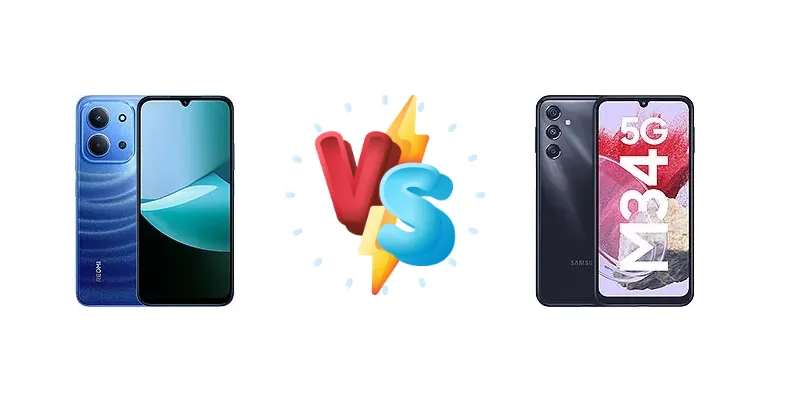
The Xiaomi Redmi 15C 4G and Samsung Galaxy M34 5G represent compelling options in the crowded budget smartphone market. The Redmi 15C focuses on delivering a solid experience at an extremely competitive price point, while the Galaxy M34 5G aims to bridge the gap between affordability and 5G connectivity with a more modern chipset. This comparison dissects their key differences to determine which device best suits your needs.
🏆 Quick Verdict
For the average user prioritizing future-proofing and smoother performance, the Samsung Galaxy M34 5G is the better choice. Its Exynos 1280 chipset, built on a 5nm process, offers a significant performance advantage and 5G support. However, the Redmi 15C remains a strong contender for those on a tighter budget who don't require 5G.
| Network |
|---|
| 2G bands | GSM 850 / 900 / 1800 / 1900 | GSM 850 / 900 / 1800 / 1900 |
| 3G bands | HSDPA 850 / 900 / 2100 | HSDPA 850 / 900 / 1700(AWS) / 1900 / 2100 |
| 4G bands | LTE | 1, 2, 3, 4, 5, 7, 8, 12, 17, 20, 26, 28, 38, 40, 41, 66 |
| 5G bands | - | 1, 3, 5, 7, 8, 28, 38, 40, 41, 66, 78 SA/NSA/Sub6 |
| Speed | HSPA, LTE | HSPA, LTE, 5G |
| Technology | GSM / HSPA / LTE | GSM / HSPA / LTE / 5G |
| Launch |
|---|
| Announced | 2025, August 01 | 2023, July 03 |
| Status | Available. Released 2025, August 01 | Available. Released 2023, July 15 |
| Body |
|---|
| Build | Glass front (Gorilla Glass 3), plastic frame, glass back or silicone polymer (eco leather) back | - |
| Dimensions | 171.6 x 79.5 x 8 mm (6.76 x 3.13 x 0.31 in) | 161.7 x 77.2 x 8.8 mm (6.37 x 3.04 x 0.35 in) |
| SIM | Nano-SIM + Nano-SIM | Nano-SIM + Nano-SIM |
| Weight | 205 g (7.23 oz) | 208 g (7.34 oz) |
| Display |
|---|
| Protection | Corning Gorilla Glass 3 | Corning Gorilla Glass 5 |
| Resolution | 720 x 1600 pixels, 20:9 ratio (~254 ppi density) | 1080 x 2340 pixels, 19.5:9 ratio (~396 ppi density) |
| Size | 6.9 inches, 114.9 cm2 (~84.3% screen-to-body ratio) | 6.5 inches, 103.7 cm2 (~83.1% screen-to-body ratio) |
| Type | IPS LCD, 120Hz | Super AMOLED, 120Hz, 1000 nits (peak) |
| Platform |
|---|
| CPU | Octa-core (2x2.0 GHz Cortex-A75 & 6x1.8 GHz Cortex-A55) | Octa-core (2x2.4 GHz Cortex-A78 & 6x2.0 GHz Cortex-A55) |
| Chipset | Mediatek Helio G81 Ultra (12 nm) | Exynos 1280 (5 nm) |
| GPU | Mali-G52 MC2 | Mali-G68 |
| OS | Android 15, HyperOS 2 | Android 13, upgradable to Android 16, One UI 8 |
| Memory |
|---|
| Card slot | microSDXC (dedicated slot) | microSDXC (uses shared SIM slot) |
| Internal | 128GB 4GB RAM, 128GB 6GB RAM, 128GB 8GB RAM, 256GB 4GB RAM, 256GB 8GB RAM | 128GB 6GB RAM, 128GB 8GB RAM, 256GB 8GB RAM |
| Main Camera |
|---|
| Dual | 50 MP, f/1.8, 28mm (wide), 1/2.76", 0.64µm, PDAF
Auxiliary lens | - |
| Features | LED flash, HDR | LED flash, panorama, HDR |
| Triple | - | 50 MP, f/1.8, (wide), PDAF, OIS
8 MP, f/2.2, 120˚ (ultrawide)
2 MP, f/2.4 |
| Video | 1080p@30fps | 4K@30fps, 1080p@30fps |
| Selfie camera |
|---|
| Features | HDR | - |
| Single | 8 MP, f/2.0, (wide), 1/4.0", 1.12µm | 13 MP, f/2.2, (wide) |
| Video | 1080p@30fps | 1080p@30fps |
| Sound |
|---|
| 35mm jack | Yes | Yes |
| Loudspeaker | Yes | Yes |
| Comms |
|---|
| Bluetooth | 5.4, A2DP, LE | 5.3, A2DP, LE |
| NFC | Yes (market/region dependent) | Yes |
| Positioning | GPS, GLONASS, GALILEO, BDS | GPS, GLONASS, GALILEO, BDS |
| Radio | FM radio | FM radio |
| USB | USB Type-C 2.0, OTG | USB Type-C 2.0, OTG |
| WLAN | Wi-Fi 802.11 a/b/g/n/ac, dual-band | Wi-Fi 802.11 a/b/g/n/ac, dual-band, Wi-Fi Direct |
| Features |
|---|
| Sensors | Fingerprint (side-mounted), accelerometer, compass | Fingerprint (side-mounted), accelerometer, gyro, compass |
| Battery |
|---|
| Charging | 33W wired, PD | 25W wired |
| Type | 6000 mAh | Li-Po 6000 mAh |
| Misc |
|---|
| Colors | Moonlight Blue, Mint Green, Midnight Gray, Twilight Orange | Midnight Blue, Prism Silver, Waterfall Blue |
| Models | 25078RA3EA, 25078RA3EL | SM-M346B, SM-M346B/DS, SM-M346B1, SM-M346B1/DS |
| Price | $ 119.50 / £ 89.00 / € 99.00 | About 190 EUR |
| SAR | - | 0.89 W/kg (head) |
Xiaomi Redmi 15C 4G
- Faster 33W charging with PD support.
- More affordable price point.
- Reliable performance for basic tasks.
- Less powerful Helio G81 chipset.
- No 5G connectivity.
- Potentially lower image quality.
Samsung Galaxy M34 5G
- More powerful and efficient Exynos 1280 chipset.
- 5G connectivity for faster data speeds.
- Potentially better camera performance.
- Slower 25W charging.
- Higher price compared to the Redmi 15C.
- May experience some thermal throttling under sustained load.
Display Comparison
While both devices likely feature LCD panels (based on market segment), the core difference lies in processing power. The Redmi 15C's display specs are not provided, but typically in this price range, expect a 60Hz refresh rate. The Galaxy M34 5G, however, benefits from the Exynos 1280's image signal processor, potentially leading to more accurate color reproduction and better dynamic range. The absence of high refresh rate panels on either device suggests a focus on battery conservation rather than visual fluidity.
Camera Comparison
Without detailed camera specifications, a direct comparison is difficult. However, the Exynos 1280's ISP in the Galaxy M34 5G likely provides superior image processing capabilities, potentially resulting in better low-light performance and more accurate colors. The Redmi 15C will likely rely more heavily on software processing to compensate for its less powerful chipset. It's reasonable to assume the M34 will offer more consistent image quality across various lighting conditions. The presence of a 2MP macro camera on either device is largely a marketing tactic, offering limited practical benefit.
Performance
The Exynos 1280 (5nm) in the Galaxy M34 5G represents a substantial leap over the Helio G81 (12nm) found in the Redmi 15C. The 5nm fabrication process inherently provides better power efficiency and allows for higher transistor density, translating to improved performance and reduced heat generation. The Cortex-A78 cores in the Exynos 1280, clocked at 2.4 GHz, are architecturally superior to the Cortex-A75 cores (2.0 GHz) in the Helio G81, offering faster single-core performance. This difference will be most noticeable in demanding applications and multitasking. The M34's 5G modem also adds a layer of future-proofing.
Battery Life
The Redmi 15C features 33W wired charging with PD, potentially offering faster charging speeds than the Galaxy M34 5G's 25W charging. However, the Exynos 1280's 5nm efficiency could offset the difference in charging wattage, resulting in comparable real-world battery life despite potentially having a similar capacity battery. The Redmi 15C's faster charging is beneficial for quick top-ups, while the M34's efficiency could lead to longer sustained usage.
Buying Guide
Buy the Xiaomi Redmi 15C 4G if you need a reliable, affordable smartphone for basic tasks like calling, texting, and social media, and 5G connectivity isn't a priority. Buy the Samsung Galaxy M34 5G if you prefer a more responsive user experience, benefit from 5G network access, and value the potential for longer software support and better thermal management.
Frequently Asked Questions
❓ Does the Exynos 1280 in the Galaxy M34 5G overheat during prolonged gaming sessions?
While the Exynos 1280 is a capable chipset, it's known to exhibit some thermal throttling under sustained heavy load, particularly in passively cooled devices like the Galaxy M34 5G. Expect some performance reduction after extended gaming, but it shouldn't be severe enough to render the phone unusable.
❓ Is the 2MP macro camera on either phone worth using?
Generally, 2MP macro cameras on budget phones offer limited practical value. The low resolution results in images lacking detail and sharpness. They are primarily a marketing feature and are unlikely to significantly enhance your photography experience.
❓ What 5G bands does the Samsung Galaxy M34 5G support?
The specific 5G bands supported by the Galaxy M34 5G will vary depending on the region. It's crucial to check the specifications for your specific market to ensure compatibility with your carrier's 5G network. Look for support for n78, n41, and n28 bands for widespread 5G coverage.
❓ Will the Redmi 15C 4G receive regular software updates?
Xiaomi's update track record for budget devices like the Redmi 15C is typically limited to one major Android update and a few security patches. Don't expect the same level of long-term software support as you would find on a flagship Samsung device.