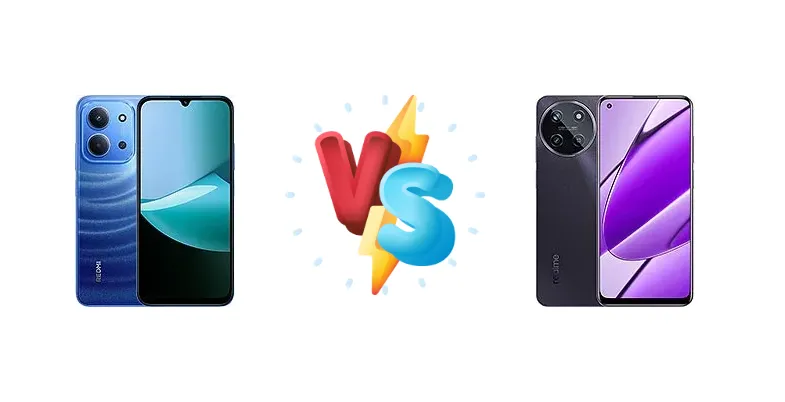
The sub-$200 smartphone market is fiercely competitive, and the Xiaomi Redmi 15C 4G and Realme 11 4G represent compelling options. While both aim to deliver value, they take different approaches. The Redmi 15C focuses on a larger screen and established brand recognition, while the Realme 11 4G prioritizes a more modern chipset and significantly faster charging. This comparison dives deep into the specifics to determine which phone offers the best experience.
🏆 Quick Verdict
For most users, the Realme 11 4G is the better choice. Its Mediatek Helio G99, built on a 6nm process, provides a noticeable performance uplift and improved efficiency compared to the Redmi 15C’s Helio G81. The 67W charging is a game-changer, drastically reducing downtime, making it ideal for power users.
| Network |
|---|
| 2G bands | GSM 850 / 900 / 1800 / 1900 | GSM 850 / 900 / 1800 / 1900 |
| 3G bands | HSDPA 850 / 900 / 2100 | HSDPA 850 / 900 / 2100 |
| 4G bands | LTE | LTE |
| Speed | HSPA, LTE | HSPA, LTE |
| Technology | GSM / HSPA / LTE | GSM / HSPA / LTE |
| Launch |
|---|
| Announced | 2025, August 01 | 2023, July 31 |
| Status | Available. Released 2025, August 01 | Available. Released 2023, July 31 |
| Body |
|---|
| Build | Glass front (Gorilla Glass 3), plastic frame, glass back or silicone polymer (eco leather) back | Glass front (Gorilla Glass 5), plastic frame, plastic back |
| Dimensions | 171.6 x 79.5 x 8 mm (6.76 x 3.13 x 0.31 in) | 159.9 x 73.3 x 8 mm (6.30 x 2.89 x 0.31 in) |
| SIM | Nano-SIM + Nano-SIM | Nano-SIM + Nano-SIM |
| Weight | 205 g (7.23 oz) | 178 g (6.28 oz) |
| Display |
|---|
| Protection | Corning Gorilla Glass 3 | Corning Gorilla Glass 5 |
| Resolution | 720 x 1600 pixels, 20:9 ratio (~254 ppi density) | 1080 x 2400 pixels, 20:9 ratio (~411 ppi density) |
| Size | 6.9 inches, 114.9 cm2 (~84.3% screen-to-body ratio) | 6.4 inches, 98.9 cm2 (~84.4% screen-to-body ratio) |
| Type | IPS LCD, 120Hz | Super AMOLED, 90Hz, 1000 nits (peak) |
| Platform |
|---|
| CPU | Octa-core (2x2.0 GHz Cortex-A75 & 6x1.8 GHz Cortex-A55) | Octa-core (2x2.2 GHz Cortex-A76 & 6x2.0 GHz Cortex-A55) |
| Chipset | Mediatek Helio G81 Ultra (12 nm) | Mediatek Helio G99 (6 nm) |
| GPU | Mali-G52 MC2 | Mali-G57 MC2 |
| OS | Android 15, HyperOS 2 | Android 12, Realme UI 3.0 |
| Memory |
|---|
| Card slot | microSDXC (dedicated slot) | microSDXC (dedicated slot) |
| Internal | 128GB 4GB RAM, 128GB 6GB RAM, 128GB 8GB RAM, 256GB 4GB RAM, 256GB 8GB RAM | 128GB 8GB RAM, 256GB 8GB RAM |
| Main Camera |
|---|
| Dual | 50 MP, f/1.8, 28mm (wide), 1/2.76", 0.64µm, PDAF
Auxiliary lens | 108 MP, f/1.8, 25mm (wide), 1/1.67", 0.64µm, PDAF
Auxiliary lens |
| Features | LED flash, HDR | LED flash, HDR, panorama |
| Video | 1080p@30fps | 1080p@30fps |
| Selfie camera |
|---|
| Features | HDR | HDR, panorama |
| Single | 8 MP, f/2.0, (wide), 1/4.0", 1.12µm | 16 MP, f/2.5, 27mm (wide) |
| Video | 1080p@30fps | 1080p@30fps |
| Sound |
|---|
| 35mm jack | Yes | Yes |
| Loudspeaker | Yes | Yes |
| Comms |
|---|
| Bluetooth | 5.4, A2DP, LE | 5.2, A2DP, LE, aptX HD, aptX Adaptive |
| NFC | Yes (market/region dependent) | Unspecified |
| Positioning | GPS, GLONASS, GALILEO, BDS | GPS, GLONASS, GALILEO, BDS |
| Radio | FM radio | No |
| USB | USB Type-C 2.0, OTG | USB Type-C 2.0, OTG |
| WLAN | Wi-Fi 802.11 a/b/g/n/ac, dual-band | Wi-Fi 802.11 a/b/g/n/ac, dual-band |
| Features |
|---|
| Sensors | Fingerprint (side-mounted), accelerometer, compass | Fingerprint (side-mounted), accelerometer, gyro, proximity, compass |
| Battery |
|---|
| Charging | 33W wired, PD | 67W wired, 50% in 17 min |
| Type | 6000 mAh | 5000 mAh |
| Misc |
|---|
| Colors | Moonlight Blue, Mint Green, Midnight Gray, Twilight Orange | Black, Gold |
| Models | 25078RA3EA, 25078RA3EL | RMX3636 |
| Price | $ 119.50 / £ 89.00 / € 99.00 | About 280 EUR |
Xiaomi Redmi 15C 4G
- Potentially lower price point
- Familiar MIUI software experience
- Large display (assumed, based on market positioning)
- Less powerful and less efficient Helio G81 chipset
- Slower 33W charging
- Potentially lower performance in demanding tasks
Realme 11 4G
- More powerful and efficient Helio G99 chipset
- Ultra-fast 67W charging
- Improved performance for gaming and multitasking
- May be slightly more expensive
- Realme UI may not appeal to all users
- Potentially less brand recognition than Xiaomi
Display Comparison
Neither device boasts a standout display. While specific display specs (resolution, panel type) are missing, the focus here is on the underlying chipset's ability to drive the display efficiently. The Realme 11's Helio G99, with its more modern architecture, is better equipped to handle graphically intensive tasks on the display, potentially resulting in smoother animations and a more responsive experience. Bezels are likely comparable given the price bracket, and color accuracy will likely be standard for this segment.
Camera Comparison
Without detailed camera specs, it's difficult to make a definitive judgment. However, the Realme 11 4G likely benefits from the more powerful ISP (Image Signal Processor) integrated within the Helio G99. This could translate to better image processing, particularly in challenging lighting conditions. The Redmi 15C’s G81 ISP is adequate for basic photography, but will likely struggle to match the Realme 11’s potential for detail and dynamic range. We anticipate both phones will include a standard array of lenses, but the Realme 11’s processing capabilities give it an edge.
Performance
The core difference lies in the chipsets. The Realme 11 4G’s Mediatek Helio G99 (6nm) is a clear upgrade over the Redmi 15C’s Helio G81 (12nm). The 6nm process inherently offers better power efficiency, translating to less heat generation and potentially sustained performance during prolonged gaming sessions. The G99’s CPU, featuring 2x2.2 GHz Cortex-A76 cores, also provides a clock speed advantage over the Redmi 15C’s 2x2.0 GHz Cortex-A75 cores. This means faster app loading times and snappier multitasking for the Realme 11. While both use octa-core configurations, the architectural improvements in the G99 are significant.
Battery Life
The Realme 11 4G’s 67W charging is the standout feature here. The claim of 50% charge in 17 minutes is a substantial advantage over the Redmi 15C’s 33W charging. While battery capacity isn’t specified, the faster charging speed effectively mitigates any potential capacity difference. The Helio G99’s 6nm efficiency also contributes to better battery life, meaning the Realme 11 4G will likely last longer on a single charge despite potentially having a similar or smaller battery capacity.
Buying Guide
Buy the Xiaomi Redmi 15C 4G if you prioritize a potentially lower price point and a familiar MIUI experience, and your usage is primarily focused on basic tasks like calling, texting, and light social media. Buy the Realme 11 4G if you value faster performance for gaming and multitasking, and the convenience of incredibly rapid 67W charging, even if it means spending slightly more upfront.
Frequently Asked Questions
❓ Will the Realme 11 4G overheat during extended gaming sessions?
The Mediatek Helio G99’s 6nm process is designed for improved thermal efficiency compared to the Redmi 15C’s Helio G81. While some heat is inevitable during gaming, the G99 is less prone to throttling, meaning it should maintain higher performance for longer periods. However, sustained peak performance will still generate heat, so a case with good ventilation is recommended.
❓ Is the difference in charging speed between 33W and 67W really that noticeable?
Absolutely. The Realme 11 4G’s 67W charging is a game-changer. Going from 0% to 50% in just 17 minutes is significantly faster than the Redmi 15C’s 33W charging. This drastically reduces downtime and makes it much more convenient to top up your phone throughout the day. It's a feature that needs to be experienced to fully appreciate.
❓ Does the Realme 11 4G support VoLTE/VoWiFi on all carriers?
Carrier compatibility can vary. While the Realme 11 4G *should* support VoLTE and VoWiFi on most major carriers, it's crucial to check compatibility with your specific carrier before purchasing. Realme's website or your carrier's support documentation are the best resources for this information.