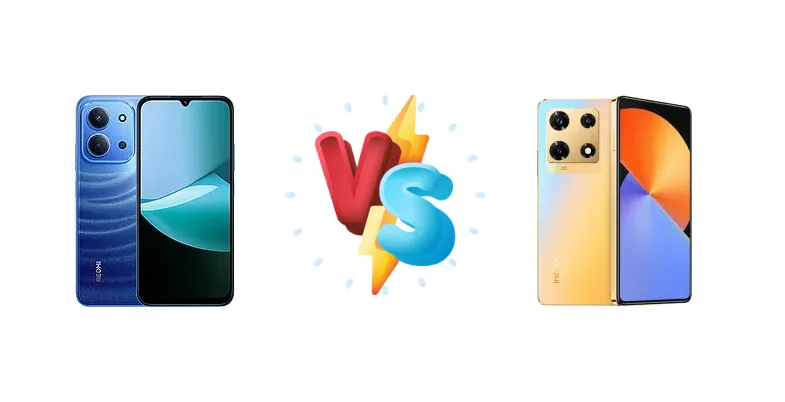
The Xiaomi Redmi 15C 4G and the Infinix Note 30 Pro represent compelling options in the crowded budget smartphone market. While both aim to deliver value, they take different approaches. The Redmi 15C focuses on established reliability, while the Note 30 Pro pushes the envelope with faster charging and a newer chipset. This comparison dissects their key differences to determine which device best suits your needs.
🏆 Quick Verdict
For the average user prioritizing speed and convenience, the Infinix Note 30 Pro is the clear winner. Its Helio G99 chipset, built on a more efficient 6nm process, offers a noticeable performance uplift, and its 68W charging significantly reduces downtime. However, the Redmi 15C remains a viable option for those on a tighter budget.
| Network |
|---|
| 2G bands | GSM 850 / 900 / 1800 / 1900 | GSM 850 / 900 / 1800 / 1900 |
| 3G bands | HSDPA 850 / 900 / 2100 | HSDPA 850 / 900 / 1700(AWS) / 1900 / 2100 |
| 4G bands | LTE | 1, 2, 3, 4, 5, 7, 8, 12, 17, 20, 28, 38, 40, 41, 66 |
| Speed | HSPA, LTE | HSPA, LTE |
| Technology | GSM / HSPA / LTE | GSM / HSPA / LTE |
| Launch |
|---|
| Announced | 2025, August 01 | 2023, May 22 |
| Status | Available. Released 2025, August 01 | Available. Released 2023, May 22 |
| Body |
|---|
| Build | Glass front (Gorilla Glass 3), plastic frame, glass back or silicone polymer (eco leather) back | Glass front, plastic frame, glass back |
| Dimensions | 171.6 x 79.5 x 8 mm (6.76 x 3.13 x 0.31 in) | 162.7 x 76 x 8.2 mm (6.41 x 2.99 x 0.32 in) |
| SIM | Nano-SIM + Nano-SIM | Nano-SIM + Nano-SIM |
| Weight | 205 g (7.23 oz) | 203 g (7.16 oz) |
| | - | IP53 |
| Display |
|---|
| Protection | Corning Gorilla Glass 3 | - |
| Resolution | 720 x 1600 pixels, 20:9 ratio (~254 ppi density) | 1080 x 2400 pixels, 20:9 ratio (~395 ppi density) |
| Size | 6.9 inches, 114.9 cm2 (~84.3% screen-to-body ratio) | 6.67 inches, 107.4 cm2 (~86.9% screen-to-body ratio) |
| Type | IPS LCD, 120Hz | AMOLED, 1B colors, 120Hz, 900 nits (peak) |
| | - | * the display diagonal size and resolution is unconfirmed |
| Platform |
|---|
| CPU | Octa-core (2x2.0 GHz Cortex-A75 & 6x1.8 GHz Cortex-A55) | Octa-core (2x2.2 GHz Cortex-A76 & 6x2.0 GHz Cortex-A55) |
| Chipset | Mediatek Helio G81 Ultra (12 nm) | Mediatek Helio G99 (6 nm) |
| GPU | Mali-G52 MC2 | Mali-G57 MC2 |
| OS | Android 15, HyperOS 2 | Android 13, XOS 13 |
| Memory |
|---|
| Card slot | microSDXC (dedicated slot) | microSDXC (dedicated slot) |
| Internal | 128GB 4GB RAM, 128GB 6GB RAM, 128GB 8GB RAM, 256GB 4GB RAM, 256GB 8GB RAM | 256GB 8GB RAM |
| Main Camera |
|---|
| Dual | 50 MP, f/1.8, 28mm (wide), 1/2.76", 0.64µm, PDAF
Auxiliary lens | - |
| Features | LED flash, HDR | Quad-LED flash, HDR, panorama |
| Triple | - | 108 MP, (wide), 1/1.67", PDAF
2 MP (macro)
Auxiliary lens |
| Video | 1080p@30fps | 1440p@30fps, 1080p@30fps |
| Selfie camera |
|---|
| Features | HDR | LED flash, HDR |
| Single | 8 MP, f/2.0, (wide), 1/4.0", 1.12µm | 32 MP, f/2.0, (wide), 1/2.8" |
| Video | 1080p@30fps | 1080p@30fps |
| Sound |
|---|
| 3.5mm jack | - | Yes |
| 35mm jack | Yes | Yes |
| Loudspeaker | Yes | Yes, with dual speakers |
| | - | Sound by JBL
24-bit/192kHz audio |
| Comms |
|---|
| Bluetooth | 5.4, A2DP, LE | Yes |
| NFC | Yes (market/region dependent) | Yes (market/region dependent) |
| Positioning | GPS, GLONASS, GALILEO, BDS | GPS |
| Radio | FM radio | FM radio |
| USB | USB Type-C 2.0, OTG | USB Type-C 2.0, OTG |
| WLAN | Wi-Fi 802.11 a/b/g/n/ac, dual-band | Wi-Fi 802.11 a/b/g/n/ac, dual-band, Wi-Fi Direct |
| Features |
|---|
| Sensors | Fingerprint (side-mounted), accelerometer, compass | Fingerprint (side-mounted), accelerometer, gyro, proximity, compass |
| Battery |
|---|
| Charging | 33W wired, PD | 68W wired, PD3.0, 80% in 30 min
15W wireless
Reverse wireless |
| Type | 6000 mAh | 5000 mAh |
| Misc |
|---|
| Colors | Moonlight Blue, Mint Green, Midnight Gray, Twilight Orange | Magic Black, Variable Gold |
| Models | 25078RA3EA, 25078RA3EL | X678B |
| Price | $ 119.50 / £ 89.00 / € 99.00 | - |
Xiaomi Redmi 15C 4G
- More affordable price point
- Reliable Mediatek Helio G81 chipset for basic tasks
- PD wired charging support
- Slower charging speed (33W)
- Less powerful chipset compared to the G99
- Lacks wireless charging
Infinix Note 30 Pro
- Faster and more efficient Mediatek Helio G99 chipset
- Ultra-fast 68W wired charging with PD3.0
- 15W wireless charging and reverse wireless charging
- Generally higher price than the Redmi 15C
- May experience slightly more heat under sustained load (though the 6nm process mitigates this)
- Potentially larger physical size
Display Comparison
Neither device boasts a standout display. While specific panel details are missing, the focus here is on the underlying performance. The more significant difference lies in the chipset's ability to drive the display smoothly. Both are likely 60Hz panels, but the G99 in the Note 30 Pro will handle UI transitions and light gaming with less strain.
Camera Comparison
Without detailed camera specs, a direct comparison is difficult. However, the market positioning suggests the Note 30 Pro likely features a more sophisticated camera system. The G99’s ISP (Image Signal Processor) is newer and more capable than the G81’s, potentially resulting in better image processing, especially in low-light conditions. It's reasonable to assume the Note 30 Pro will offer more refined image quality, even if the megapixel count is similar. We can expect the Redmi 15C to rely more heavily on software processing to compensate for its less powerful ISP.
Performance
The core difference lies in the chipsets. The Infinix Note 30 Pro’s Mediatek Helio G99 (6nm) represents a significant upgrade over the Redmi 15C’s Helio G81 (12nm). The 6nm process inherently offers better power efficiency, translating to less heat generation and potentially sustained performance during extended gaming sessions. The G99 also features a slightly faster CPU configuration – 2x2.2 GHz Cortex-A76 cores versus the G81’s 2x2.0 GHz Cortex-A75 cores – providing a tangible boost in responsiveness. While both utilize octa-core designs, the architectural improvements in the G99 give it a clear edge.
Battery Life
The Infinix Note 30 Pro’s 68W charging is a game-changer. The claim of 80% charge in 30 minutes drastically reduces downtime compared to the Redmi 15C’s 33W charging. While the Redmi 15C supports PD, the Note 30 Pro adds PD3.0 for even faster negotiation and charging speeds. Furthermore, the Note 30 Pro includes 15W wireless charging and reverse wireless charging, features absent on the Redmi 15C. The actual battery capacity isn't specified, but the charging speed advantage of the Note 30 Pro is substantial.
Buying Guide
Buy the Xiaomi Redmi 15C 4G if you need a dependable, affordable smartphone for basic tasks and light gaming, and prioritize a proven track record over cutting-edge features. Buy the Infinix Note 30 Pro if you prefer a faster, more responsive experience, value rapid charging, and appreciate the added convenience of wireless charging and reverse wireless charging capabilities.
Frequently Asked Questions
❓ Will the Helio G99 in the Infinix Note 30 Pro handle demanding games like PUBG Mobile smoothly?
Yes, the Helio G99 is capable of running PUBG Mobile at medium to high settings with reasonable frame rates. The 6nm process and improved CPU architecture provide a noticeable performance boost over the G81, reducing lag and stuttering during gameplay. However, don't expect flagship-level performance.
❓ How much faster is the 68W charging on the Infinix Note 30 Pro compared to the 33W charging on the Redmi 15C?
The 68W charging on the Note 30 Pro is significantly faster. Infinix claims 80% charge in 30 minutes, while the Redmi 15C will take considerably longer to reach the same charge level. This translates to less time tethered to a wall and more time using your phone.
❓ Does the Infinix Note 30 Pro's reverse wireless charging work with any Qi-compatible device?
Yes, the Infinix Note 30 Pro supports Qi-compatible wireless charging for reverse wireless charging. You can use it to wirelessly charge earbuds, smartwatches, or other devices that support the Qi standard, albeit at a slower charging speed than wired charging.
❓ Is the difference between the Cortex-A75 and Cortex-A76 cores in these chipsets noticeable in everyday use?
While both are performance cores, the Cortex-A76 in the Helio G99 offers a slight architectural advantage, resulting in improved single-core performance. This translates to snappier app launches, smoother multitasking, and a more responsive overall user experience.