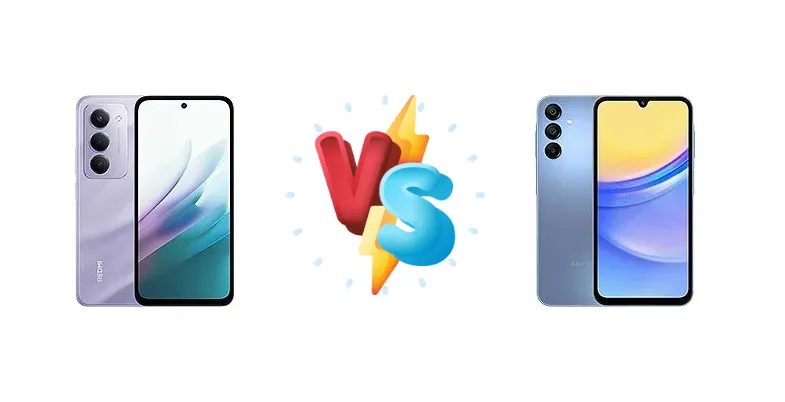
The sub-$200 smartphone market is fiercely competitive, and the Xiaomi Redmi 15 4G and Samsung Galaxy A15 5G are two strong contenders. The Redmi 15 4G focuses on raw processing power with its Snapdragon 685, while the Galaxy A15 5G prioritizes future-proofing with 5G connectivity and a focus on battery endurance. This comparison will dissect their key differences to determine which device delivers the best value.
🏆 Quick Verdict
For the average user prioritizing longevity and connectivity, the Samsung Galaxy A15 5G is the better choice. Its significantly longer battery life (14:31h active use) and 5G support outweigh the Redmi 15 4G’s slightly faster CPU. However, users heavily invested in performance-intensive tasks may find the Redmi 15 4G more responsive.
| Network |
|---|
| 2G bands | GSM 850 / 900 / 1800 / 1900 | GSM 850 / 900 / 1800 / 1900 |
| 3G bands | HSDPA 850 / 900 / 1900 / 2100 | HSDPA 850 / 900 / 1700(AWS) / 1900 / 2100 |
| 4G bands | LTE | 1, 2, 3, 4, 5, 7, 8, 12, 17, 20, 26, 28, 38, 40, 41, 66 |
| 5G bands | - | 1, 3, 5, 7, 8, 26, 28, 40, 41, 66, 77, 78 SA/NSA/Sub6 |
| Speed | HSPA, LTE | HSPA, LTE, 5G |
| Technology | GSM / HSPA / LTE | GSM / HSPA / LTE / 5G |
| Launch |
|---|
| Announced | 2025, August 01 | 2023, December 11 |
| Status | Available. Released 2025, August 01 | Available. Released 2023, December 16 |
| Body |
|---|
| Build | - | Glass front, plastic back, plastic frame |
| Dimensions | 171.1 x 82.1 x 8.6 mm (6.74 x 3.23 x 0.34 in) | 160.1 x 76.8 x 8.4 mm (6.30 x 3.02 x 0.33 in) |
| SIM | Nano-SIM + Nano-SIM | · Nano-SIM· Nano-SIM + Nano-SIM |
| Weight | 224 g (7.90 oz) | 200 g (7.05 oz) |
| Display |
|---|
| Resolution | 1080 x 2340 pixels, 19.5:9 ratio (~374 ppi density) | 1080 x 2340 pixels, 19.5:9 ratio (~396 ppi density) |
| Size | 6.9 inches, 116.9 cm2 (~83.2% screen-to-body ratio) | 6.5 inches, 103.7 cm2 (~84.3% screen-to-body ratio) |
| Type | IPS LCD, 144Hz | Super AMOLED, 90Hz, 800 nits (HBM) |
| Platform |
|---|
| CPU | Octa-core (4x2.8 GHz Cortex-A73 & 4x1.9 GHz Cortex-A53) | Octa-core (2x2.2 GHz Cortex-A76 & 6x2.0 GHz Cortex-A55) |
| Chipset | Qualcomm SM6225 Snapdragon 685 (6 nm) | Mediatek Dimensity 6100+ (6 nm) |
| GPU | Adreno 610 | Mali-G57 MC2 |
| OS | Android 15, HyperOS 2 | Android 14, upgradable to Android 16, One UI 8, up to 4 major Android upgrades |
| Memory |
|---|
| Card slot | microSDXC (uses shared SIM slot) | microSDXC (uses shared SIM slot) |
| Internal | 128GB 6GB RAM, 256GB 8GB RAM | 64GB 4GB RAM, 128GB 4GB RAM, 128GB 6GB RAM, 128GB 8GB RAM, 256GB 8GB RAM |
| Main Camera |
|---|
| Dual | 50 MP, f/1.8, (wide), PDAF
Auxiliary lens | - |
| Features | LED flash, HDR | LED flash, panorama, HDR |
| Triple | - | 50 MP, f/1.8, (wide), AF
5 MP, f/2.2, (ultrawide)
2 MP (macro) |
| Video | 1080p@30fps | 1080p@30fps, gyro-EIS |
| Selfie camera |
|---|
| Features | HDR | - |
| Single | 8 MP, f/2.0, (wide) | 13 MP, f/2.0, (wide) |
| Video | 1080p@30fps | 1080p@30fps |
| Sound |
|---|
| 35mm jack | No | Yes |
| Loudspeaker | Yes | Yes |
| Comms |
|---|
| Bluetooth | 5.0, A2DP, LE | 5.3, A2DP, LE |
| Infrared port | Yes | - |
| NFC | Yes (market/region dependent) | Yes (market/region dependent) |
| Positioning | GPS, GLONASS, GALILEO, BDS | GPS, GALILEO, GLONASS, BDS, QZSS |
| Radio | No | No |
| USB | USB Type-C 2.0 | USB Type-C 2.0 |
| WLAN | Wi-Fi 802.11 b/g/n/ac, dual-band | Wi-Fi 802.11 a/b/g/n/ac, dual-band, Wi-Fi Direct |
| Features |
|---|
| Sensors | Fingerprint (side-mounted), accelerometer, compass | Fingerprint (side-mounted), accelerometer, gyro, compass |
| Battery |
|---|
| Charging | 33W wired | 25W wired |
| Type | Si/C Li-Ion 7000 mAh | 5000 mAh |
| Misc |
|---|
| Colors | Midnight Black, Titan Gray, Sandy Purple | Brave Black, Personality Yellow, Magical Blue, Optimistic Blue |
| Models | - | SM-A156B, SM-A156B/DS, SM-A156P, SM-A156P/DS, SM-A156U, SM-A156U1, SM-A156U1/DS, SM-A156W, SM-A156P/N, SM-A156P/DSN, SM-S156VL, SM-A156M, SM-A156E, SM-A156E/DSN |
| Price | € 120.00 / $ 135.00 / £ 109.00 | € 167.00 / $ 79.97 / ₹ 17,490 |
| SAR EU | - | 0.80 W/kg (head) 1.46 W/kg (body) |
Xiaomi Redmi 15 4G
- Faster CPU clock speeds for potentially snappier performance.
- 33W fast charging for quicker top-ups.
- Potentially more affordable price point.
- Lacks 5G connectivity.
- Likely shorter battery life compared to the A15 5G.
Samsung Galaxy A15 5G
- 5G connectivity for future-proofing.
- Exceptional battery life (14:31h active use).
- Brighter display for better outdoor visibility.
- Slower CPU clock speeds.
- Slower 25W charging.
Display Comparison
The Samsung Galaxy A15 5G boasts a notably brighter display, reaching a measured peak of 786 nits. This is a significant advantage over what we'd expect from the Redmi 15 4G, making the A15 5G far more usable in direct sunlight. While the Redmi 15 4G’s panel specifications are unknown, Samsung’s brightness level suggests a superior viewing experience outdoors. The A15 5G’s brightness also implies a potentially wider color gamut, though this requires further testing. Bezels are likely comparable given the price point, and both will likely utilize LCD panels.
Camera Comparison
Without detailed camera specs, a direct comparison is difficult. However, given the price bracket, both phones likely feature a primary sensor paired with auxiliary lenses of limited utility. The focus should be on the main sensor’s quality and image processing. Samsung generally excels in image processing, producing vibrant and shareable photos. Xiaomi’s approach tends to be more natural, but can sometimes lack the same level of detail. The absence of Optical Image Stabilization (OIS) on either device suggests reliance on software stabilization, which may struggle in low-light conditions. We anticipate similar performance in good lighting, but Samsung’s processing may give it an edge in challenging scenarios.
Performance
The chipset battle pits Qualcomm’s Snapdragon 685 against MediaTek’s Dimensity 6100+. Both are 6nm chips, but their CPU architectures differ. The Redmi 15 4G’s Snapdragon 685 uses a combination of Cortex-A73 and A53 cores, peaking at 2.8 GHz. The Galaxy A15 5G’s Dimensity 6100+ employs Cortex-A76 and A55 cores, with a peak of 2.2 GHz. While the Snapdragon has higher clock speeds, the A76 cores in the Dimensity 6100+ are more efficient and offer better single-core performance. This translates to smoother app launches and responsiveness in the A15 5G, despite the lower clock speed. The Dimensity 6100+ also benefits from a more modern GPU, potentially offering a slight edge in gaming. The Redmi 15 4G may feel faster in bursty tasks, but the A15 5G will likely maintain smoother performance over extended use.
Battery Life
The Samsung Galaxy A15 5G clearly wins in battery endurance, achieving an impressive 14 hours and 31 minutes of active use. The Redmi 15 4G’s battery capacity is unknown, but the A15 5G’s performance sets a high bar. Furthermore, the A15 5G’s 25W charging, while slower than the Redmi 15 4G’s 33W, is adequate given the larger battery. The Redmi 15 4G’s faster charging will offer quicker top-ups, but the A15 5G’s superior capacity will likely result in fewer charging cycles overall.
Buying Guide
Buy the Xiaomi Redmi 15 4G if you need a phone that feels snappier for everyday tasks and light gaming, and don't require 5G connectivity. Buy the Samsung Galaxy A15 5G if you prioritize all-day battery life, future-proof 5G support, and a brighter, more visible display in outdoor conditions.
Frequently Asked Questions
❓ Does the MediaTek Dimensity 6100+ in the Galaxy A15 5G tend to overheat during prolonged gaming sessions?
The Dimensity 6100+ is a relatively efficient chip built on a 6nm process. While it won't match flagship performance, it's unlikely to suffer from significant overheating during typical gaming sessions. The A15 5G’s larger chassis should also aid in heat dissipation. Expect some throttling after extended play, but it shouldn't be severe.
❓ Is the 33W charging on the Redmi 15 4G a substantial advantage over the A15 5G’s 25W charging, considering the likely battery size difference?
While 33W is faster than 25W, the Galaxy A15 5G’s significantly larger battery capacity (implied by its 14:31h active use score) mitigates this advantage. The Redmi 15 4G will charge faster from 0-100%, but the A15 5G will likely provide more overall usage time between charges.
❓ How does the Snapdragon 685's CPU architecture (Cortex-A73/A53) compare to the Dimensity 6100+'s (Cortex-A76/A55) in real-world app loading and multitasking?
The Dimensity 6100+'s Cortex-A76 cores are a generation newer and more efficient than the Snapdragon 685's Cortex-A73 cores. This translates to faster app loading times and smoother multitasking, even with the lower clock speed. The A76 cores excel in single-core performance, which is crucial for responsive user experience.