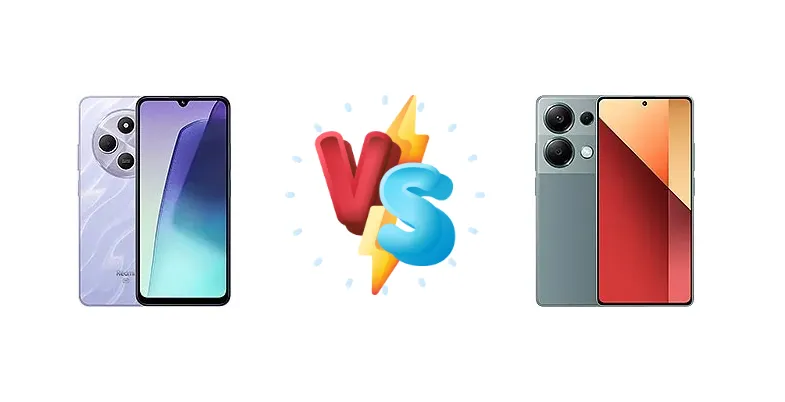
Xiaomi's Redmi series consistently delivers compelling value, but choosing between models can be tricky. The Redmi 14R represents a more recent release focusing on efficiency with its Snapdragon 4 Gen 2, while the Redmi Note 13 Pro 4G prioritizes rapid charging and a brighter display. This comparison dissects the key differences to determine which phone best suits your needs.
🏆 Quick Verdict
For the average user prioritizing convenience and a vibrant display, the Redmi Note 13 Pro 4G is the better choice. Its 67W charging significantly reduces downtime, and the 1047 nit peak brightness is excellent for outdoor visibility. However, the Redmi 14R’s newer, more efficient Snapdragon 4 Gen 2 offers a compelling alternative for those focused on long-term performance and thermal management.
| Network |
|---|
| 2G bands | GSM 850 / 900 / 1800 / 1900 | GSM 850 / 900 / 1800 / 1900 |
| 3G bands | HSDPA 850 / 900 / 2100 | HSDPA 850 / 900 / 1700(AWS) / 1900 / 2100 |
| 4G bands | 1, 3, 5, 8, 34, 38, 39, 40, 41 | 1, 2, 3, 4, 5, 7, 8, 12, 13, 17, 18, 19, 20, 26, 28, 38, 40, 41, 66 |
| 5G bands | 1, 5, 8, 28, 41, 78 SA/NSA/Sub6 | - |
| Speed | HSPA, LTE, 5G | HSPA, LTE |
| Technology | GSM / CDMA / HSPA / CDMA2000 / LTE / 5G | GSM / HSPA / LTE |
| Launch |
|---|
| Announced | 2024, September 14 | 2024, January 15 |
| Status | Available. Released 2024, September | Available. Released 2024, January 15 |
| Body |
|---|
| Build | Glass front, plastic frame, glass back or silicone polymer (eco leather) back | Glass front (Gorilla Glass 5), plastic frame, plastic back |
| Dimensions | 171.9 x 77.8 x 8.2 mm (6.77 x 3.06 x 0.32 in) | 161.1 x 75 x 8 mm (6.34 x 2.95 x 0.31 in) |
| SIM | Nano-SIM + Nano-SIM | Nano-SIM + Nano-SIM |
| Weight | 205.4 / 208.5 / 212.4 g (7.23 oz) | 188 g (6.63 oz) |
| Display |
|---|
| Protection | - | Corning Gorilla Glass 5 |
| Resolution | 720 x 1640 pixels (~260 ppi density) | 1080 x 2400 pixels, 20:9 ratio (~395 ppi density) |
| Size | 6.88 inches, 112.4 cm2 (~84.0% screen-to-body ratio) | 6.67 inches, 107.4 cm2 (~88.9% screen-to-body ratio) |
| Type | IPS LCD, 120Hz, 450 nits (typ), 600 nits (HBM) | AMOLED, 1B colors, 120Hz, 500 nits (typ), 1000 nits (HBM), 1300 nits (peak) |
| Platform |
|---|
| CPU | Octa-core (2x2.2 GHz Cortex-A78 & 6x1.95 GHz Cortex-A55) | Octa-core (2x2.2 GHz Cortex-A76 & 6x2.0 GHz Cortex-A55) |
| Chipset | Qualcomm SM4450 Snapdragon 4 Gen 2 (4 nm) | Mediatek Helio G99 Ultra |
| GPU | Adreno 613 | Mali-G57 MC2 |
| OS | Android 14, HyperOS | Android 13, up to 3 major Android upgrades, HyperOS |
| Memory |
|---|
| Card slot | microSDXC (dedicated slot) | microSDXC (uses shared SIM slot) |
| Internal | 128GB 4GB RAM, 128GB 6GB RAM, 128GB 8GB RAM, 256GB 8GB RAM, 256GB 12GB RAM | 128GB 8GB RAM, 256GB 8GB RAM, 256GB 12GB RAM, 512GB 8GB RAM, 512GB 12GB RAM |
| Main Camera |
|---|
| Dual | 13 MP, (wide), AF
2 MP
Auxiliary lens | - |
| Features | LED flash, HDR | LED flash, HDR, panorama |
| Triple | - | 200 MP, f/1.7, 23mm (wide), 1/1.4", 0.56µm, multi-directional PDAF, OIS
8 MP, f/2.2, 15mm, 120˚ (ultrawide), 1/4.4", 1.0µm
2 MP (macro) |
| Video | 1080p@30fps | 1080p@30/60fps |
| Selfie camera |
|---|
| Single | 5 MP | 16 MP, f/2.4, (wide), 1/3.0", 1.0µm |
| Video | 1080p@30fps | 1080p@30/60fps |
| Sound |
|---|
| 35mm jack | Yes | Yes |
| Loudspeaker | Yes | Yes, with dual speakers |
| Comms |
|---|
| Bluetooth | 5.0, A2DP, LE | 5.2, A2DP, LE |
| Infrared port | - | Yes |
| NFC | No | Yes (market/region dependent) |
| Positioning | GPS, GLONASS, GALILEO, BDS | GPS, GLONASS, GALILEO, BDS |
| Radio | No | FM radio |
| USB | USB Type-C 2.0 | USB Type-C 2.0, OTG |
| WLAN | Wi-Fi 802.11 a/b/g/n/ac, dual-band | Wi-Fi 802.11 a/b/g/n/ac, dual-band |
| Features |
|---|
| Sensors | Fingerprint (side-mounted), accelerometer, compass | Fingerprint (under display, optical), accelerometer, gyro, compass |
| Battery |
|---|
| Charging | 18W wired, PD | 67W wired, 50% in 16 min, 100% in 46 min |
| Type | 5160 mAh | 5000 mAh |
| Misc |
|---|
| Colors | Midnight Black, Sage Green, Starry Blue, Purple | Midnight Black, Lavender Purple, Forest Green |
| Models | - | 23117RA68G, 2312FPCA6G |
| Price | About 140 EUR | € 92.00 / $ 269.99 / £ 299.99 |
| SAR | - | 1.09 W/kg (head) 1.09 W/kg (body) |
| SAR EU | - | 0.99 W/kg (head) 0.99 W/kg (body) |
Xiaomi Redmi 14R
- More efficient Snapdragon 4 Gen 2 chipset
- Potentially better thermal management
- Modern 4nm manufacturing process
- Slower 18W charging
- Likely lower peak display brightness
Xiaomi Redmi Note 13 Pro 4G
- 67W fast charging (50% in 16 min)
- Brighter 1047 nit display
- Longer active use battery life (11:36h)
- Older Helio G99 Ultra chipset
- Less power-efficient chipset
Display Comparison
The Redmi Note 13 Pro 4G boasts a significantly brighter display, reaching a measured 1047 nits. This is a substantial advantage for outdoor use, where the Redmi 14R’s display brightness is not specified but likely falls considerably lower. While both likely utilize AMOLED panels (based on Redmi series trends), the Note 13 Pro 4G’s higher peak brightness and potentially better color calibration make it the superior choice for media consumption. Bezels are expected to be similar on both devices, given their market positioning.
Camera Comparison
Detailed camera analysis is limited by the provided data. Both phones are expected to feature multi-camera setups, but the specifics are unknown. The Redmi Note 13 Pro 4G likely benefits from Xiaomi’s more mature image processing algorithms, potentially delivering more refined photos. Without sensor size or aperture information, it’s difficult to definitively declare a winner, but the Note 13 Pro 4G’s brand positioning suggests a greater emphasis on camera capabilities. We can assume both will include a standard wide, ultrawide, and potentially macro lens, though the quality of the macro lens is likely minimal on both.
Performance
The chipset is where the core difference lies. The Redmi 14R features the Qualcomm SM4450 Snapdragon 4 Gen 2, built on a 4nm process. This smaller node generally translates to improved power efficiency and reduced heat generation compared to the Redmi Note 13 Pro 4G’s MediaTek Helio G99 Ultra. While both CPUs feature a 2x2.2 GHz core configuration, the Snapdragon 4 Gen 2 utilizes Cortex-A78 cores, offering a performance edge over the Note 13 Pro 4G’s Cortex-A76 cores. The 4nm process of the Snapdragon should also result in less throttling during extended gaming sessions. However, the Helio G99 Ultra is a proven performer in its segment.
Battery Life
The Redmi Note 13 Pro 4G excels in charging speed, achieving 50% charge in just 16 minutes and a full charge in 46 minutes with its 67W wired charging. The Redmi 14R’s 18W charging is significantly slower. However, the Snapdragon 4 Gen 2’s efficiency could offset the charging disparity. The Note 13 Pro 4G also demonstrates a strong 11:36h active use score, indicating excellent battery life. While the Redmi 14R’s battery capacity is unknown, the more efficient chipset could provide comparable real-world endurance.
Buying Guide
Buy the Xiaomi Redmi 14R if you need a phone with a modern, efficient processor for sustained tasks and appreciate a potentially cooler running device. Buy the Xiaomi Redmi Note 13 Pro 4G if you prefer a brighter screen, incredibly fast charging, and a longer tested battery life in active use, even if it means an older chipset.
Frequently Asked Questions
❓ Will the Helio G99 Ultra in the Redmi Note 13 Pro 4G overheat during prolonged gaming sessions?
While the Helio G99 Ultra is a capable chipset, it's built on a larger process node than the Snapdragon 4 Gen 2. Expect some thermal throttling during extended gaming, particularly with graphically demanding titles. However, Xiaomi's thermal management solutions should mitigate this to a degree, and casual gaming should be fine.
❓ Is the 18W charging on the Redmi 14R too slow in 2024?
18W charging is undeniably slower than the 67W on the Note 13 Pro 4G. It will take significantly longer to fully charge the device. However, the Snapdragon 4 Gen 2’s efficiency means you may not need to charge as frequently, potentially lessening the impact of the slower charging speed.
❓ Does the Redmi Note 13 Pro 4G support features like HDR10+ for video playback?
While not explicitly stated in the provided data, Redmi Note series phones typically support HDR10+ playback. This would enhance the viewing experience on the phone's bright display, offering richer colors and greater contrast. Check official specifications for confirmation.
❓ How does the Snapdragon 4 Gen 2's CPU architecture benefit everyday tasks on the Redmi 14R?
The Snapdragon 4 Gen 2 utilizes Cortex-A78 cores, which are more efficient and offer better single-core performance than the Cortex-A76 cores found in the Helio G99 Ultra. This translates to snappier app launches, smoother multitasking, and a more responsive user experience during everyday tasks like browsing, social media, and email.