
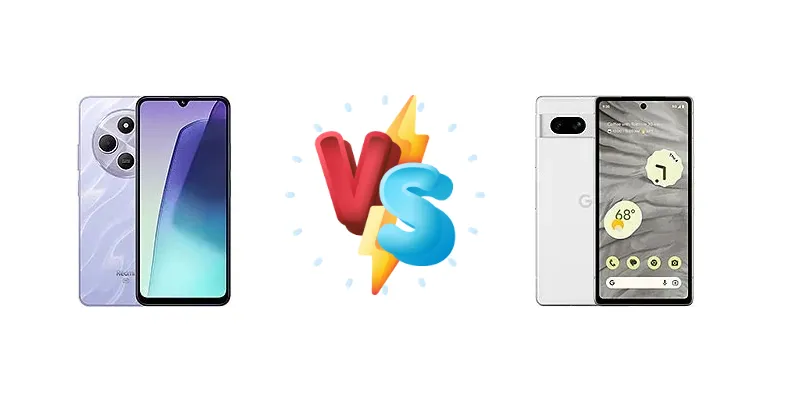
Xiaomi Redmi 14R vs Google Pixel 7a: Which Android Phone Wins?
| Phones Images | |||||
|---|---|---|---|---|---|
|
🏆 Quick Verdict
For the average user prioritizing camera quality and software experience, the Google Pixel 7a is the clear winner. However, the Redmi 14R offers compelling performance for the price, particularly for those focused on efficiency and less demanding tasks, making it a strong contender in the budget segment.
| PHONES | ||
|---|---|---|
| Phone Names | Xiaomi Redmi 14R | Google Pixel 7a |
| Network | ||
|---|---|---|
| 2G bands | GSM 850 / 900 / 1800 / 1900 | GSM 850 / 900 / 1800 / 1900 |
| 3G bands | HSDPA 850 / 900 / 2100 | HSDPA 800 / 850 / 900 / 1700(AWS) / 1900 / 2100 |
| 4G bands | 1, 3, 5, 8, 34, 38, 39, 40, 41 | 1, 2, 3, 4, 5, 7, 8, 12, 13, 14, 17, 20, 25, 26, 28, 29, 30, 38, 40, 41, 48, 66, 71 - GWKK3, G0DZQ |
| 5G bands | 1, 5, 8, 28, 41, 78 SA/NSA/Sub6 | 1, 2, 3, 5, 7, 8, 12, 14, 20, 25, 28, 30, 38, 41, 48, 66, 71, 77, 78 SA/NSA/Sub6 - GWKK3 |
| Speed | HSPA, LTE, 5G | HSPA, LTE, 5G |
| Technology | GSM / CDMA / HSPA / CDMA2000 / LTE / 5G | GSM / HSPA / LTE / 5G |
| - | 1, 2, 3, 5, 7, 8, 12, 20, 25, 28, 38, 40, 41, 66, 75, 76, 77, 78, 79 SA/NSA/Sub6 - GHL1X, G82U8 | |
| Launch | ||
|---|---|---|
| Announced | 2024, September 14 | 2023, May 10 |
| Status | Available. Released 2024, September | Available. Released 2023, May 10 |
| Body | ||
|---|---|---|
| Build | Glass front, plastic frame, glass back or silicone polymer (eco leather) back | Glass front (Gorilla Glass 3), aluminum frame, plastic back |
| Dimensions | 171.9 x 77.8 x 8.2 mm (6.77 x 3.06 x 0.32 in) | 152 x 72.9 x 9 mm (5.98 x 2.87 x 0.35 in) |
| SIM | Nano-SIM + Nano-SIM | Nano-SIM + eSIM |
| Weight | 205.4 / 208.5 / 212.4 g (7.23 oz) | 193.5 g (6.84 oz) |
| - | IP67 dust/water resistant (up to 1m for 30 min) | |
| Display | ||
|---|---|---|
| Protection | - | Corning Gorilla Glass 3 |
| Resolution | 720 x 1640 pixels (~260 ppi density) | 1080 x 2400 pixels, 20:9 ratio (~429 ppi density) |
| Size | 6.88 inches, 112.4 cm2 (~84.0% screen-to-body ratio) | 6.1 inches, 90.7 cm2 (~81.8% screen-to-body ratio) |
| Type | IPS LCD, 120Hz, 450 nits (typ), 600 nits (HBM) | OLED, HDR, 90Hz |
| - | Always-on display | |
| Platform | ||
|---|---|---|
| CPU | Octa-core (2x2.2 GHz Cortex-A78 & 6x1.95 GHz Cortex-A55) | Octa-core (2x2.85 GHz Cortex-X1 & 2x2.35 GHz Cortex-A78 & 4x1.80 GHz Cortex-A55) |
| Chipset | Qualcomm SM4450 Snapdragon 4 Gen 2 (4 nm) | Google Tensor G2 (5 nm) |
| GPU | Adreno 613 | Mali-G710 MP7 |
| OS | Android 14, HyperOS | Android 13, upgradable to Android 15, up to 5 major Android upgrades |
| Memory | ||
|---|---|---|
| Card slot | microSDXC (dedicated slot) | No |
| Internal | 128GB 4GB RAM, 128GB 6GB RAM, 128GB 8GB RAM, 256GB 8GB RAM, 256GB 12GB RAM | 128GB 8GB RAM |
| - | UFS 3.1 | |
| Main Camera | ||
|---|---|---|
| Dual | 13 MP, (wide), AF 2 MP Auxiliary lens | 64 MP, f/1.9, 26mm (wide), 1/1.73", 0.8µm, dual pixel PDAF, OIS 13 MP, f/2.2, 120˚ (ultrawide), 1.12µm |
| Features | LED flash, HDR | Dual-LED flash, Pixel Shift, Auto-HDR, panorama |
| Video | 1080p@30fps | 4K@30/60fps, 1080p@30/60/120/240fps, OIS |
| Selfie camera | ||
|---|---|---|
| Features | - | HDR, panorama |
| Single | 5 MP | 13 MP, f/2.2, 20mm (ultrawide), 1.12µm |
| Video | 1080p@30fps | 4K@30fps, 1080p@30fps |
| Sound | ||
|---|---|---|
| 3.5mm jack | - | No |
| 35mm jack | Yes | No |
| Loudspeaker | Yes | Yes, with stereo speakers |
| Comms | ||
|---|---|---|
| Bluetooth | 5.0, A2DP, LE | 5.3, A2DP, LE |
| NFC | No | Yes |
| Positioning | GPS, GLONASS, GALILEO, BDS | GPS, GLONASS, GALILEO, BDS, QZSS, NavIC |
| Radio | No | No |
| USB | USB Type-C 2.0 | USB Type-C 3.2 |
| WLAN | Wi-Fi 802.11 a/b/g/n/ac, dual-band | Wi-Fi 802.11 a/b/g/n/ac/6e, tri-band |
| Features | ||
|---|---|---|
| Sensors | Fingerprint (side-mounted), accelerometer, compass | Fingerprint (under display, optical), accelerometer, gyro, proximity, compass, barometer |
| Battery | ||
|---|---|---|
| Charging | 18W wired, PD | 18W wired, PD3.0 7.5W wireless |
| Type | 5160 mAh | Li-Po 4385 mAh |
| Misc | ||
|---|---|---|
| Colors | Midnight Black, Sage Green, Starry Blue, Purple | Charcoal, Snow, Sea, Coral |
| Models | - | GWKK3, GHL1X, G0DZQ, G82U8 |
| Price | About 140 EUR | € 179.90 / $ 150.00 / £ 170.00 / ₹ 25,980 |
Xiaomi Redmi 14R
- More efficient Snapdragon 4 Gen 2 chipset
- Potentially better sustained performance due to thermal efficiency
- Competitive price point
- Likely inferior camera performance
- MIUI software may not appeal to all users
Google Pixel 7a
- Superior camera quality and image processing
- Clean Android software with guaranteed updates
- Brighter and more accurate display
- Tensor G2 can run warmer under sustained load
- Higher price compared to the Redmi 14R
Display Comparison
The Pixel 7a boasts a significantly brighter display, reaching a measured 1070 nits, which translates to excellent outdoor visibility. While the Redmi 14R’s display specifications are not provided, it’s likely to be considerably dimmer. The Pixel 7a’s OLED panel also benefits from Google’s color calibration, offering more accurate and vibrant colors. The absence of LTPO on either device suggests neither offers adaptive refresh rates for power saving, but the Pixel’s brightness advantage is a key differentiator.
Camera Comparison
The Pixel 7a’s camera system is its standout feature. While specific sensor details aren’t provided, Google’s computational photography prowess, powered by the Tensor G2’s image signal processor, delivers exceptional image quality, particularly in challenging lighting conditions. The Redmi 14R’s camera specifications are not detailed enough to make a direct comparison, but Xiaomi typically focuses on megapixel count rather than sensor size or image processing. The Pixel 7a’s video capabilities are also expected to be superior, with features like cinematic mode and improved stabilization. Ignoring the likely presence of a low-resolution macro lens on the Redmi 14R, the Pixel 7a’s overall camera experience is a significant advantage.
Performance
The core difference lies in the chipsets. The Google Pixel 7a’s Tensor G2 (5nm) utilizes a tri-cluster configuration with Cortex-X1 performance cores, offering significantly higher peak CPU performance (2.85 GHz) compared to the Redmi 14R’s Snapdragon 4 Gen 2 (4nm). While the Snapdragon 4 Gen 2’s Cortex-A78 cores (2.2 GHz) provide a performance boost over previous generations, the Tensor G2’s architecture is designed for more demanding tasks like AI processing and image signal processing. The 4nm process of the Snapdragon 4 Gen 2 should offer better thermal efficiency, potentially leading to more sustained performance under load, but the Tensor G2’s raw power is undeniable. The Pixel 7a likely benefits from faster RAM (LPDDR5x is expected) compared to the Redmi 14R, further enhancing responsiveness.
Battery Life
The Pixel 7a had an Endurance rating of 76 hours, indicating solid battery life. Both phones support 18W wired charging with PD, and the Pixel 7a adds 7.5W wireless charging. The Redmi 14R’s 4nm chipset should contribute to improved power efficiency, potentially offsetting any capacity difference. However, without knowing the Redmi 14R’s battery capacity, it’s difficult to definitively say which phone offers better real-world battery performance. The Pixel 7a’s wireless charging is a convenience feature the Redmi 14R lacks.
Buying Guide
Buy the Xiaomi Redmi 14R if you need a phone that prioritizes battery life and efficient performance for everyday tasks, and you're comfortable with Xiaomi's MIUI software. Buy the Google Pixel 7a if you prefer a superior camera experience, clean Android software with guaranteed updates, and don't mind paying a premium for those features.